Background:
Men who have sex with men (MSM) and people living with HIV (PLHIV) have up to 150x increased risk of developing human papillomavirus (HPV)-driven anal cancer compared to the general population. Despite receiving antiretroviral therapy (ART), PLHIV can have poor HPV clearance resulting in high-grade squamous intraepithelial lesions (HSIL), an anal cancer precursor. High CD103+CD8+ tissue-resident memory T cell (CD8+ TRM) numbers are associated with improved survival in HPV+ oropharyngeal and cervical cancer. Their role in anal cancer has not been investigated. We aim to delineate mucosal immunity responses in MSM (including PLHIV) that result in HPV clearance.
Methods:
Anal biopsies from 67 MSM in the Study of the Prevention of Anal Cancer were studied. Multispectral microscopy was used to determine the effects of HIV co-infection with high-risk HPV16 on local T cell profile. Mann-Whitney t-tests and Spearman correlation were performed. Whole transcriptomic differences between the dysplastic lesion (DL) and peri-lesion (PL) areas were assessed in HSIL regression (R; n=2) or non-regressive disease (NR; n=2) (NanoString GeoMx Digital Spatial Profiler). gProfiler identified key signalling pathways in R versus NR.
Results:
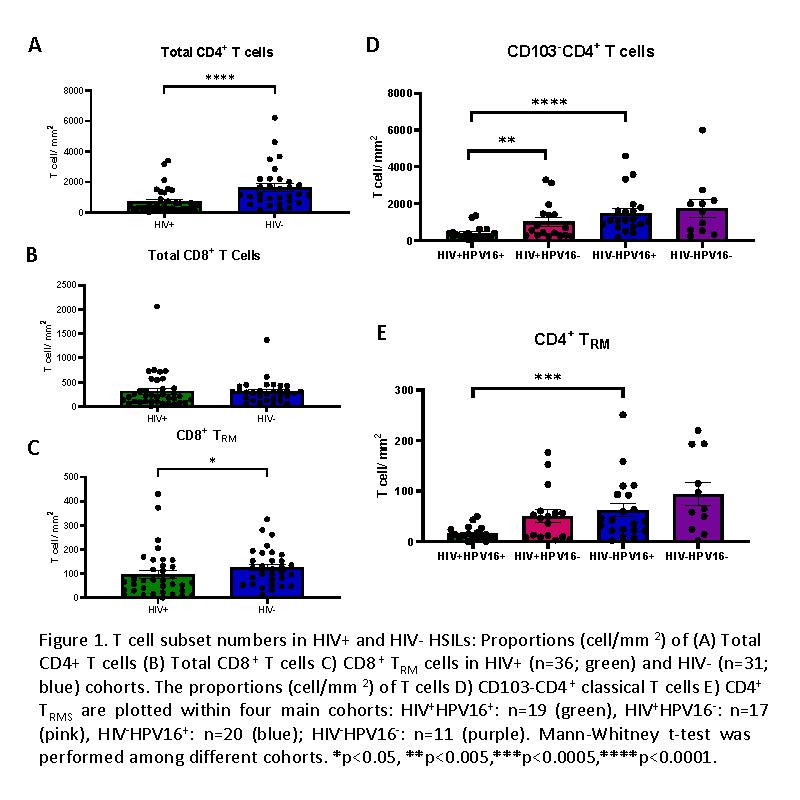
Higher numbers of total CD4+ T cells were evident in MSM with HIV compared to those without (Fig. 1A). While total CD8+ T cells were similar in both cohorts, CD8+ TRMs were lower in MSM with HIV (Fig. 1 B-C). In HPV16+ HSIL, “classical” CD103-CD4+ T cells and CD4+ TRM numbers were lower in MSM with HIV compared to those without (Fig. 1 D-E). In both cohorts, total CD8+ T cell counts positively correlated with CD4+ T cells (HIV+: r=0.504, p< 0.01; HIV-: r=0.617, p< 0.001) and CD8+ TRMs (HIV+: r=0.779, p< 0.0001; HIV-: r=0.747, p< 0.0001). Only in MSM with HIV did CD4+ TRM numbers positively correlate with CD8+ TRM numbers (r=0.450, p=0.0059). In PL, 144 (NR) and 218 (R) genes, and in DL 140 (NR) and 73 (R) genes, were upregulated. Investigation of canonical gene sets found immune response and regulation to tumour cell signals in the R cohort compared to MHC regulation and viral gene expression signals in NR.
Conclusions:
HIV infection is characterized by low CD8+ TRMs and CD4+ TRMs, and classical CD4+ T cell numbers. Low CD8+ TRM numbers may be associated with CD4+ T cell tissue lymphopenia resulting in poor HPV clearance. Even in the ART era, the immune response signals in R but not NR suggest differential cellular and molecular signals in response to HPV infection.