Background:
Doravirine (DOR), an approved NNRTI, and islatravir (ISL), an investigational nucleoside reverse transcriptase translocation inhibitor (NRTTI), have complementary mechanisms of action and resistance profiles. We report Week 48 results from a phase 3, non-inferiority trial (NCT04223791) evaluating a switch from bictegravir/emtricitabine/tenofovir alafenamide (B/F/TAF) to DOR/ISL (100/0.75mg), a once-daily single tablet regimen.
Methods:
Adults with HIV-1 RNA < 50 c/mL for ≥3 months on B/F/TAF without history of treatment failure were randomized 1:1 to switch to DOR/ISL or continue B/F/TAF in this double-blind, active-controlled study. The primary efficacy endpoint was % of participants with HIV-1 RNA ≥50 c/mL at Week 48 (FDA snapshot; non-inferiority margin 4%). Resistance was assessed for clinically significant confirmed viremia (CSCV, 2 consecutive HIV-1 RNA ≥200 c/mL).
Results:
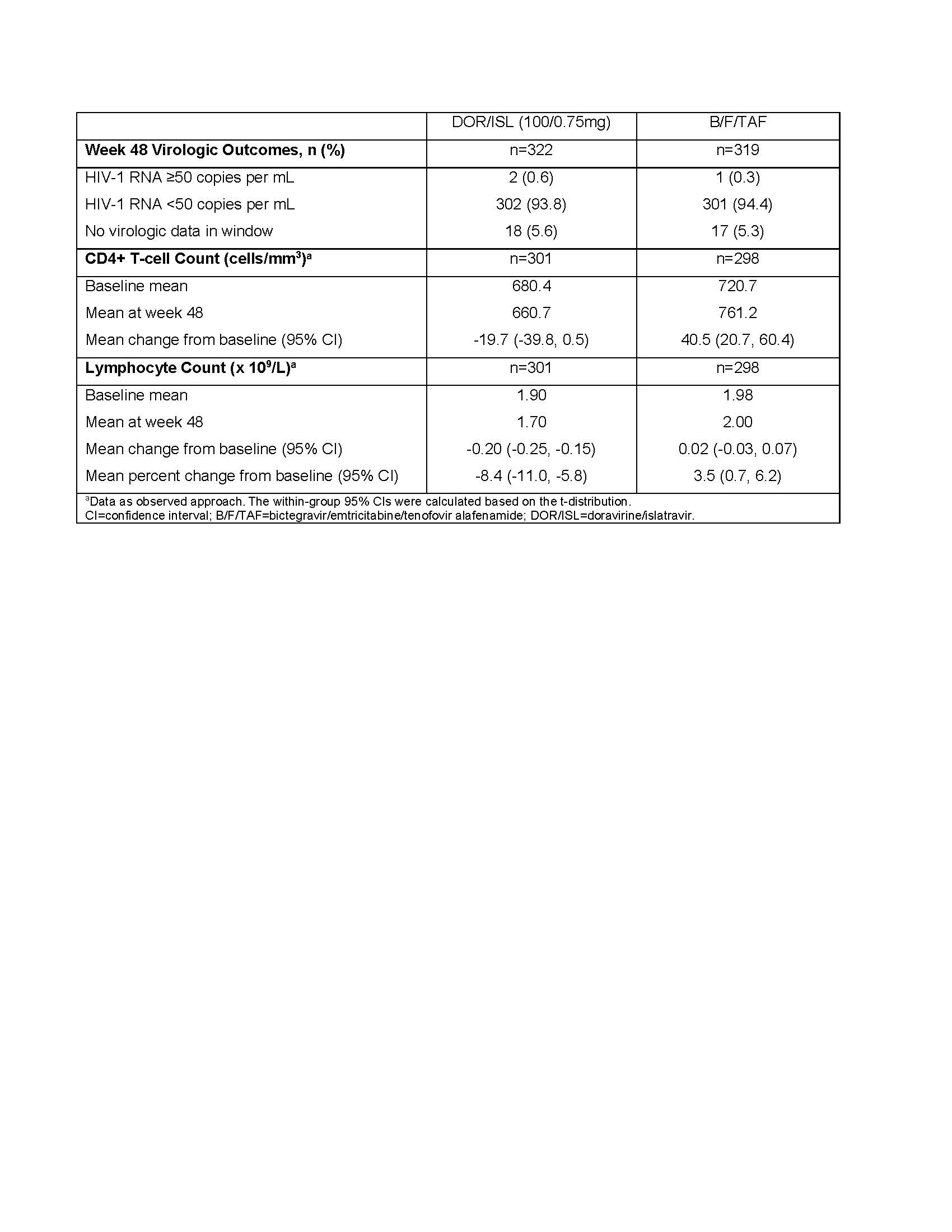
643 participants were randomized; 641 received at least 1 dose (322 switched to DOR/ISL; 319 continued B/F/TAF). Mean age of participants was 47.8 (±12.2) years, with 72% male at birth, 75% White, 18% Black/African American, and 4% Asian. At Week 48, 2 participants (0.6%) on DOR/ISL and 1 (0.3%) on B/F/TAF had HIV-1 RNA ≥50 c/mL (difference 0.3, 95%CI -1.2, 2.0), demonstrating non-inferiority. HIV-1 RNA was < 50 c/mL in 93.8% of participants on DOR/ISL and 94.4% of participants on B/F/TAF (Table). One DOR/ISL participant had CSCV at Week 12; ISL plasma concentration was undetectable, and no resistance mutations were identified. Mean change in CD4+ T-cell count was -19.7 and 40.5 (difference -68.1, 95%CI -94.8, -41.4) cells/mm3, respectively. Total lymphocyte count was also reduced in the DOR/ISL group (Table). Rates of AEs (71.1%, 74.6%) and drug-related AEs (9.9%, 11.9%) were similar between groups, with low rates of discontinuation due to AEs (both 2.5%). The most common AE in both groups was headache (7.8%, 7.2%). Infection rates were comparable between treatment groups (31.4%, 30.7%) and there was 1 CDC AIDS-Defining Category C event in each group (esophageal candidiasis in DOR/ISL, recurrent Kaposi sarcoma in B/F/TAF).
Conclusions:
Switching to DOR/ISL (100/0.75mg) was non-inferior to continuing B/F/TAF for maintaining viral suppression through Week 48 with an AE profile comparable to B/F/TAF. No treatment-emergent resistance was detected in the DOR/ISL group. Observed decreases in CD4+ T-cells and total lymphocytes on DOR/ISL were not associated with differences in infection-related AEs.
Table. Selected Efficacy and Safety Outcomes, DOR/ISL (100/0.75mg) in P018