Background:
Despite a lack of efficacy data in humans, tecovirimat was widely prescribed to people with HIV (PWH) with mpox during the 2022 mpox epidemic, particularly among those with low CD4+ T-cell counts or severe mpox clinical manifestations.
Methods:
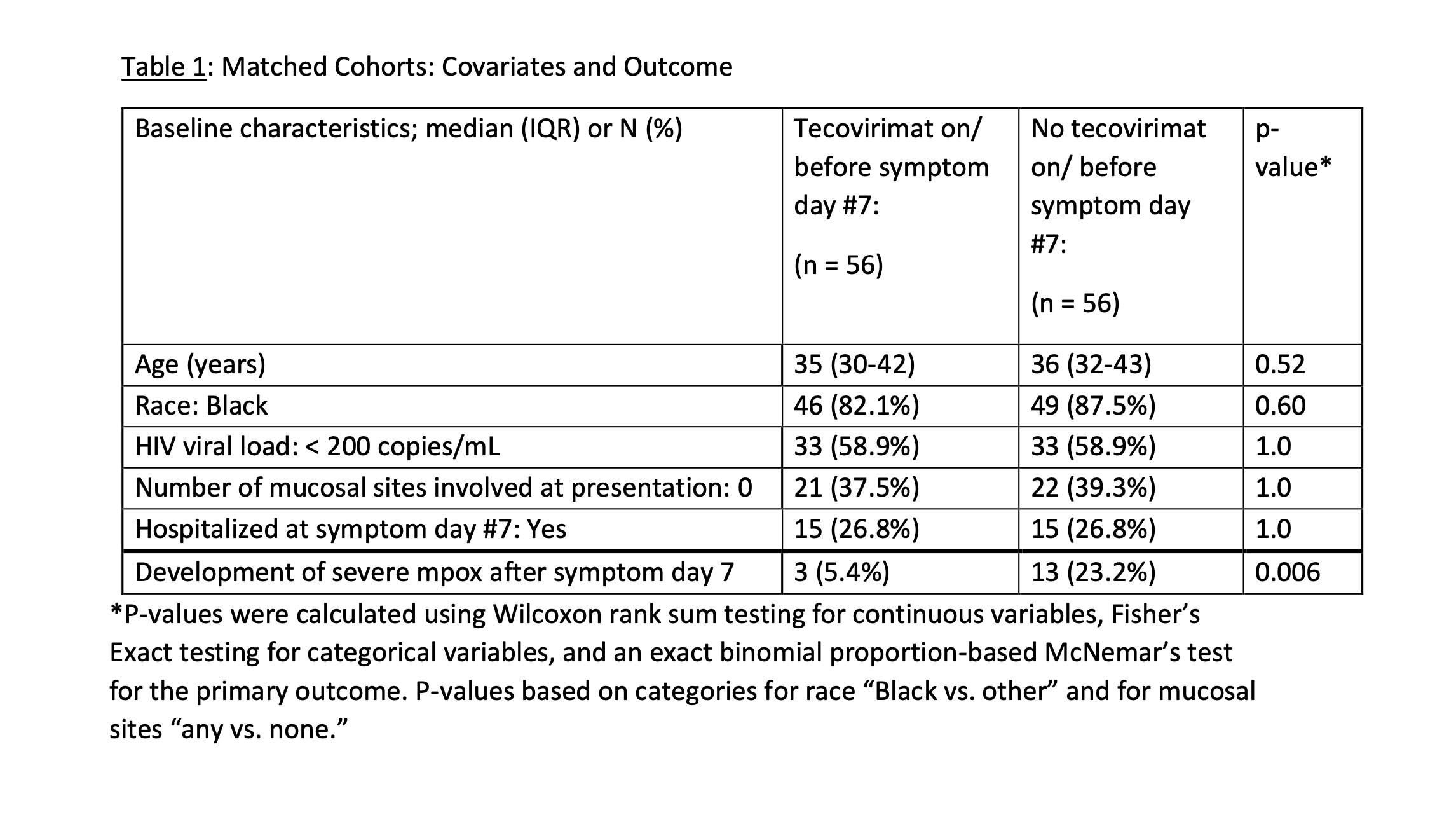
This is a matched cohort study of PWH diagnosed with mpox at four hospitals in Atlanta, Georgia between 6/1/2022 and 10/7/2022. The exposure cohort (‘early tecovirimat’) included PWH with mpox who were treated with tecovirimat within 7 days of symptom onset. The unexposed cohort (‘late/no tecovirimat’) included PWH diagnosed with mpox who did not receive tecovirimat or who received tecovirimat >7 days after symptom onset. Multivariate logistic regression models were used to identify factors associated with progression of mpox disease, defined as development of at least one severe mpox criteria after symptom day 7. The 2 cohorts were matched 1:1 using propensity scores based on the identified predictors.
Results:
Each cohort included 56 matched individuals. Predictors selected for inclusion in the final propensity score estimation model included age, race, HIV viral load suppression, involvement of any mucosal site(s), and hospitalization at day 7. Mpox progression occurred in 3 (5.4%) individuals in the early tecovirimat cohort and in 13 (23.2%) individuals in the late/no tecovirimat cohort (paired odds ratio 11.0 (95% CI 1.4, 85.1), exact binomial test p = 0.006).
Conclusions:
PWH with mpox who were prescribed tecovirimat within 7 days of symptom onset were less likely to have mpox progression compared with matched PWH who didn’t receive early tecovirimat. While awaiting the completion of randomized controlled trials of tecovirimat efficacy for mpox, these results favor starting tecovirimat in all PWH as soon as a mpox diagnosis is suspected.