Background
Doxycycline postexposure prophylaxis (PEP), taken within 72 hours of condomless sexual exposure, did not reduce incident bacterial STIs among cisgender women in the only trial conducted to date; use of doxycycline PEP in that trial was low.
Methods
We describe 35 breakthrough cases of incident Chlamydia trachomatis among 32 participants assigned to doxycycline PEP (n=224) within an open-label randomized trial among 449 cisgender women aged 18-30 years in Kisumu, Kenya. Participants returned quarterly over one year for STI testing and behavioral surveys for a total of 854 visits when participants were assigned to take doxycycline PEP and 753 visits when not on a medication hold. Covariates potentially associated with incident C. trachomatis detection were assessed using Poisson regression using generalized estimation equation methods.
Results
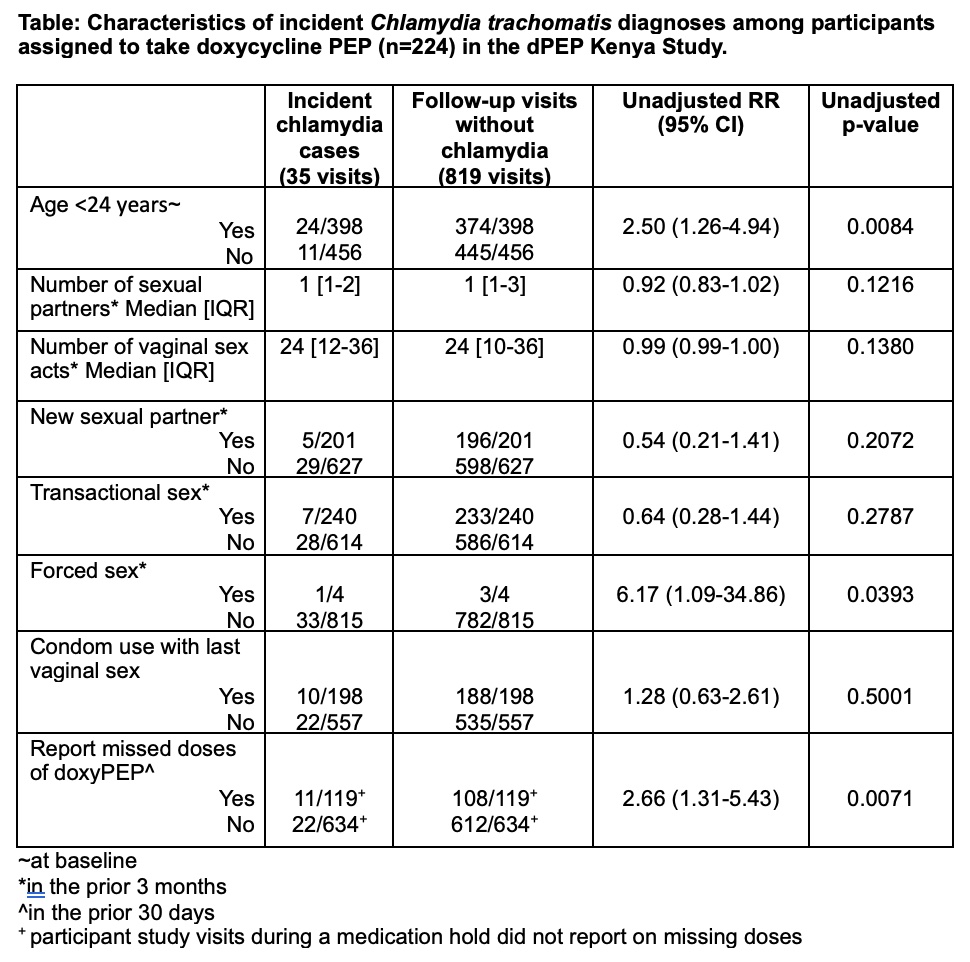
Breakthrough cases of C. trachomatis occurred throughout the study period, 6/35 (17.1%) at Month 3, 13/35 (37.1%) at Month 6, 12/35 (34.3%) at Month 9, and 4/35 (11.4%) at Month 12. Participant age <24 years was associated with incident C. trachomatis, RR 2.50, 95% CI 1.26-4.94, p = 0.008 (Table). The number of sexual partners in the prior 3 months did not differ by C. trachomatis detection (Table). There was no difference in report of recent transactional sex by breakthrough C. trachomatis case detection. The majority (24/34,70.6%) reported having vaginal sex two or more times per week in the prior 3 months with no difference in median number of times in prior 3 months, RR 0.99, 95% CI 0.99-1.00, p=0.138 (Table). Forced sex occurred with 4 reported events in prior 3 months among 854 study visits. Doxycycline PEP was inconsistently taken during the 30 days prior to visits with breakthrough cases of C. trachomatis with 11/35 (31.4%) reports of one or more missed doses with condomless sex and 6/35 (17.1%) reports of not taking any doxycycline. Among participants actively assigned to doxycycline PEP, incident C. trachomatis was associated with reporting a missed dose of doxycycline PEP (11/33, 33.3%) in the prior 30 days versus when no C. trachomatis was detected (108/720, 15.0%), RR 2.66, 95% CI, 1.31-5.43, p = 0.007 (Table).
Conclusions
Detection of incident C. trachomatis among participants assigned to take doxycycline PEP occurred in the setting of a range of experiences with sexual exposures and self-reported doxycycline PEP use. Age less than 24 years and missed doses of doxycycline PEP were associated with incident C. trachomatis in women.
Table or Figure