Background
Doravirine (DOR) and islatravir (ISL; a nucleoside reverse transcriptase translocation inhibitor) are being studied in combination for the treatment of HIV. In people with virologically suppressed HIV-1, the efficacy of switching to DOR/ISL (100/0.25mg) was non-inferior to continuing prior antiretroviral therapy in 2 phase 3 studies. We report the efficacy and safety of DOR/ISL (100/0.25mg) vs bictegravir/emtricitabine/tenofovir alafenamide (BIC/FTC/TAF) in people with HIV-1 naïve to treatment.
Methods
In this ongoing phase 3, double-blind study (MK-8591A-053, NCT05705349), adults with HIV-1 RNA ≥500 c/mL and no documented resistance to study intervention at screening were randomized 1:1 to daily DOR/ISL (100/0.25mg) or BIC/FTC/TAF (with matching placebos), stratified by screening CD4+ T-cell count (</≥200 cells/mm3) and HIV‐1 RNA (≤/>100,000 c/mL). The primary efficacy endpoint was % of participants achieving HIV‐1 RNA <50 c/mL at W48 (FDA snapshot; non-inferiority margin −10%).
Results
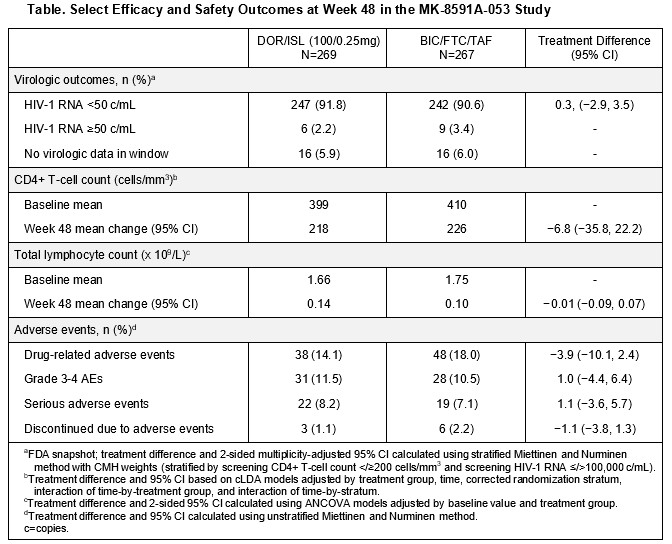
536 participants (DOR/ISL n=269, BIC/FTC/TAF n=267) were treated: mean age 34 yr, assigned female at birth 25%, Black 32%; screening CD4+ T-cell count <200 cells/mm3 17%, HIV-1 RNA >100,000 c/mL 37%, HIV-1 RNA >500,000 c/mL 12%. At W48, 91.8% on DOR/ISL and 90.6% on BIC/FTC/TAF had HIV-1 RNA <50 c/mL (difference 0.3, 95% CI −2.9, 3.5). Virological efficacy was comparable with screening HIV-1 RNA >100,000 (94.0% vs 87.6%) and >500,000 (90.3% vs 84.4%) c/mL. Six participants on DOR/ISL had HIV-1 RNA ≥50 c/mL; 5 had resistance testing. Two participants (with screening HIV-1 RNA >1 million c/mL and non-exclusionary mutations in reverse transcriptase at baseline) acquired treatment-emergent (TE) mutations (L74I, V106A, M184V, F227L; M184I, Y188L); phenotypic analysis revealed susceptibility to ISL and resistance to DOR. Nine participants on BIC/FTC/TAF had HIV-1 RNA ≥50 c/mL; no TE resistance was identified in the 6 that had resistance testing. There were no between-group differences in mean change from baseline in CD4+ T-cell or total lymphocyte count. Drug-related adverse events (AEs) (14% vs 18%) and discontinuations due to AEs (1.1% vs 2.2%) were similar in both groups (Table). Mean change in weight from baseline was 3.6 vs 3.9 kg (difference −0.3, 95% CI −1.5, 0.9).
Conclusions
DOR/ISL (100/0.25 mg) was non-inferior to BIC/FTC/TAF for initial treatment of HIV-1 and generally well-tolerated at W48. Immunologic recovery of CD4+ T-cells and mean change in lymphocytes were comparable in both groups.
Table or Figure