Background
Broadly neutralizing antibodies (bNAbs) VRC07-523LS (VRC07) and CAP256V2LS (CAP256), and vesatolimod were evaluated in a Phase 2a HIV cure study in acutely treated women with HIV-1 in South Africa (NCT05281510). Four of 20 participants maintained post-treatment control without restarting antiretroviral treatment (ART) during 56 weeks of analytical treatment interruption (ATI). Here we investigated changes in bNAb susceptibility during ATI.
Methods
Of the 20 enrolled women, 17 initiated ART during Fiebig stage I, 2 during stages II/III, and 1 during stage V. Virally suppressed participants received up to 10 doses of vesatolimod and 1 dose of both bNAbs on day 7, began ATI on day 35 and remained off ART until day 336 or until they met ART restart criteria. Plasma virus was genotyped and phenotyped using the GenoSure HIV envelope (Env) and PhenoSense mAb assays (Monogram), respectively. Eligibility criteria included a documented history of viral susceptibility to CAP256 or VRC07.
Results
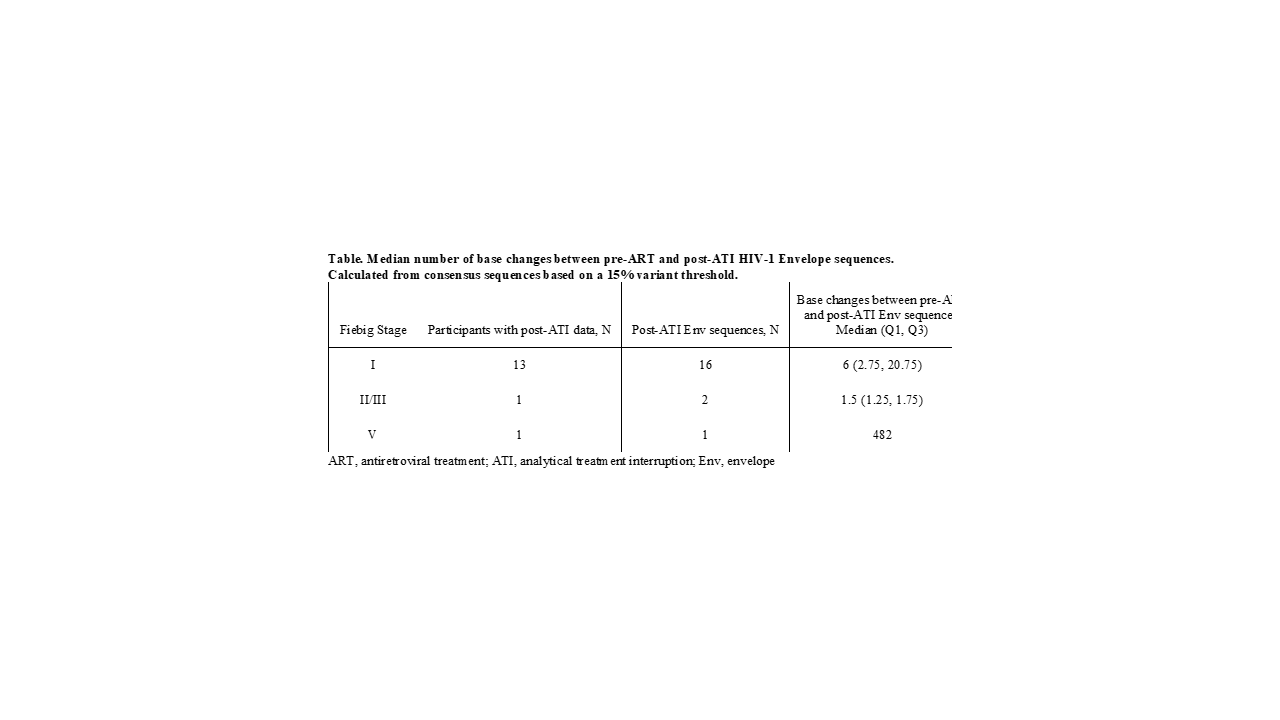
At HIV detection/pre-ART 11/20 participants were susceptible to both bNAbs, 7/20 to only VRC07, 2/20 to only CAP256. Post-ATI geno- and phenotypic data were available for 15/20 participants. For Fiebig I-III participants, HIV-1 Env sequences were highly conserved between detection/pre-ART and post-rebound/ATI (Table). Two participants (dual-bNAb sensitive at detection/pre-ART) showed changes in post-rebound/ATI bNAb susceptibility. The first developed resistance to CAP256 (IC50>50 µg/mL) and increased potency (9-fold IC50) to VRC07, associated with S141P, K290K/S mutations and a V4-loop deletion. The second showed a 25-fold IC50 increase to CAP256 with K176E, A561T mutations, followed by a 3-fold and 5-fold IC50 increase to CAP256 and VRC07 from detection/pre-ART, respectively, with added mutations K97E, K186Q, and A561T. For participants with data at the first rebound visit (n=14) CAP256 susceptibility post-rebound/ATI was correlated with time to rebound (P=0.04) and time to ART restart (P=0.02).
Conclusions
High sequence conservation in Fiebig I-III participants between detection/pre-ART and post-rebound/ATI suggests rebound virus stems from a high-frequency variant archived during acute infection. Changes in bNAb susceptibility were observed in only 2/15 participants. Although CAP256 susceptibility following ATI was associated with time to viral rebound and ART resumption, bNAb susceptibility alone does not fully explain the ATI outcomes (post-treatment rebound versus control) observed in this study.
Table or Figure