Background:
Although HIV disproportionately affects U.S. Hispanics/Latinos, over 50% of this population has never been tested for HIV. While factors such as healthcare access, English proficiency, acculturation, and nativity likely impact HIV testing among Hispanics/Latinos, few population-based studies have examined these associations. We aimed to describe patterns of HIV testing and test positivity among participants in the Hispanic Community Health Study/Study of Latinos (HCHS/SOL), a population-based longitudinal cohort study of U.S. Hispanics/Latinos which recruited participants between 2008-2011 aged 18-74 years.
Methods:
We analyzed data from HCHS/SOL participants who attended study visit 3 (between 2021 and 2023) at field centers in Bronx, NY; Chicago; Miami; and San Diego. Outcomes were lifetime HIV testing, past year testing, and test positivity, by self-report. We estimated prevalence of outcomes by assigned female at birth (AFAB) vs. assigned male at birth (AMAB), sexual orientation, nativity, preferred language, and level of acculturation (measured using the Short Acculturation Scale for Hispanics [SASH] social scale), and calculated 95% confidence intervals.
Results:
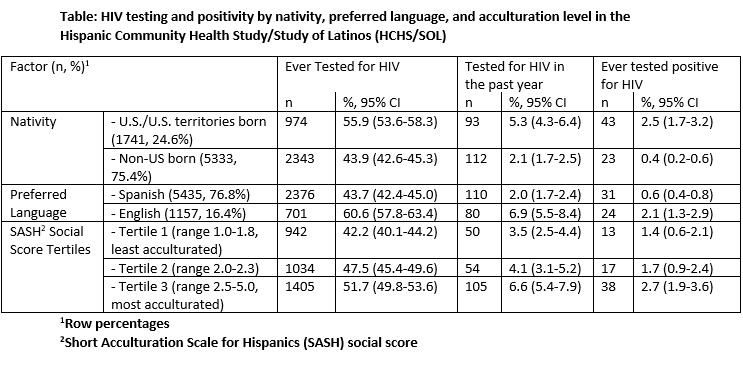
Among 7074 participants, mean age was 60 years (SD 12.1), 63% were AFAB, 73% spoke Spanish as their primary language, 75% were born outside of the U.S. and had been living in the U.S. for an average of 30 years (SD 11.9), and most reported sexual orientation as straight/heterosexual (91%). In total, 3317 (47%) had ever tested for HIV, 205 (3%) tested within the past year, and 69 (1%) reported testing positive. Ever HIV testing was higher among AFAB vs AMAB (49% vs 43%; p<.0001), persons identifying as not heterosexual vs. heterosexual (84% vs 46%; p<.0001), U.S./U.S. territories-born vs non-U.S. born (56% vs. 44%; p<.0001), primary English vs Spanish speakers (61% vs 44%; p<.0001), and highest vs lowest tertiles of social acculturation score (52% vs 42%, p<.0001). Similar patterns were observed with respect to past year HIV testing and test positivity (Table).
Conclusions:
In a large, representative study of Hispanic/Latinos at 4 U.S. sites, we observed large disparities in HIV testing and test positivity by nativity, language preference, and level of acculturation. Achieving CDC recommendations for universal lifetime HIV testing among Hispanic/Latinos will require targeted interventions to increase uptake among individuals who are less acculturated.