Background:
COVID-19 survivors can experience lingering symptoms known as PASC that appear in different phenotypes. The etiology remains elusive and endothelial dysfunction has been postulated as a main driver of PASC.
Methods:
Prospective cohort including COVID- and COVID+ with (COVID+PASC+) or without (COVID+PASC-) PASC. We measured endothelial function using Endopat, an FDA approved test, with derived reactive hyperemic index RHI (endothelial dysfunction≤1.67) and arterial elasticity (augmentation index standardized at 75 bpm or AI@75; (lower =better). PASC symptoms were categorized into three non-exclusive phenotypes: Cardiopulmonary CP (post-exertional malaise, shortness of breath, cough, palpitations), Neurocognitive N (change in smell/taste, neuropathy, ‘brain fog’, headache), and General G (fatigue, gastrointestinal or bladder problems).
Results:
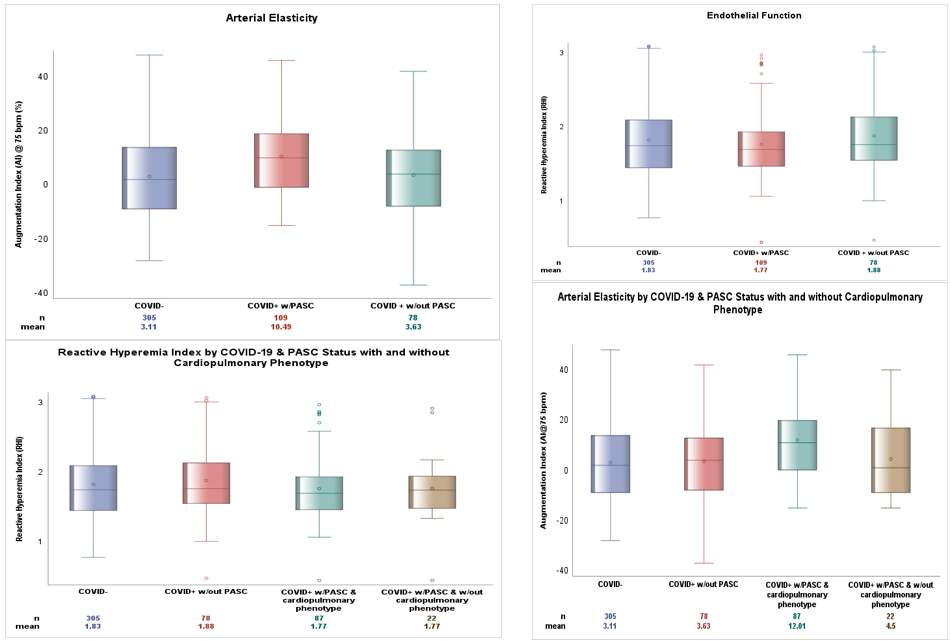
We included 491 participants with 109 of the 186 with confirmed COVID+ experiencing PASC. Median number of days between COVID diagnosis and study visit was 249 days (IQR: 144, 510). Among COVID+PASC+, the median number of symptoms was 7.0 (IQR: 3.0,13.0); 97 experienced symptoms categorized as G, 90 as N, and 87 as CP. COVID+ PASC+ had the lowest RHI (1.77±0.47) and the largest proportion [46.79% (n=51)] with RHI≤1.67 (Figure). AI@75 was the lowest in COVID- (3.11±15.97) followed by COVID+PASC- (3.57 ± 16.34). Within COVID+PASC+, the mean AI@75 among G was 10.11±14.85, 11.36±14.67 with N, and highest (12.01 ± 14.48) with CP. Symptoms’ number was positively associated with AI@75 (p=0.01). The estimated mean difference in AI@75 between COVID+ PASC+ with CP and COVID+ PASC- was 8.44±2.46 (p=0.001), between COVID+ PASC+ with CP phenotype and COVID- was 8.9±1.91 (p< .0001), and between COVID+ PASC+ with CP phenotype and COVID+ PASC without CP phenotype was 7.51±3.75 (p=0.04)
Conclusions:
PASC was associated with worse arterial elasticity and within PASC, the cardiopulmonary phenotype had the highest arterial stiffness.