South Africa has the largest ART programme globally and is currently transitioning to WHO recommended dolutegravir (DTG) first-line ART. As there were initial safety concerns for women who conceive while receiving DTG, we compared DTG rollout between sexes.
We analyzed routine data from 59 primary care clinics in KwaZulu-Natal, South Africa, between DTG introduction, in Dec 2019, to Jun 2020. Initially, DTG was prioritised for ART initiations, and women of child-bearing potential were required to sign a South African Health Products Regulatory Authority (SAHPRA) ‘acknowledgement of risk’ form. In Feb 2020, the SAHPRA form was removed, and people receiving first-line ART were also eligible for switch to DTG. We used Poisson regression models with robust standard errors, and Cox proportional hazards models, to assess the association between sex and the outcomes of 1) initiating, or 2) being switched to, first-line DTG.
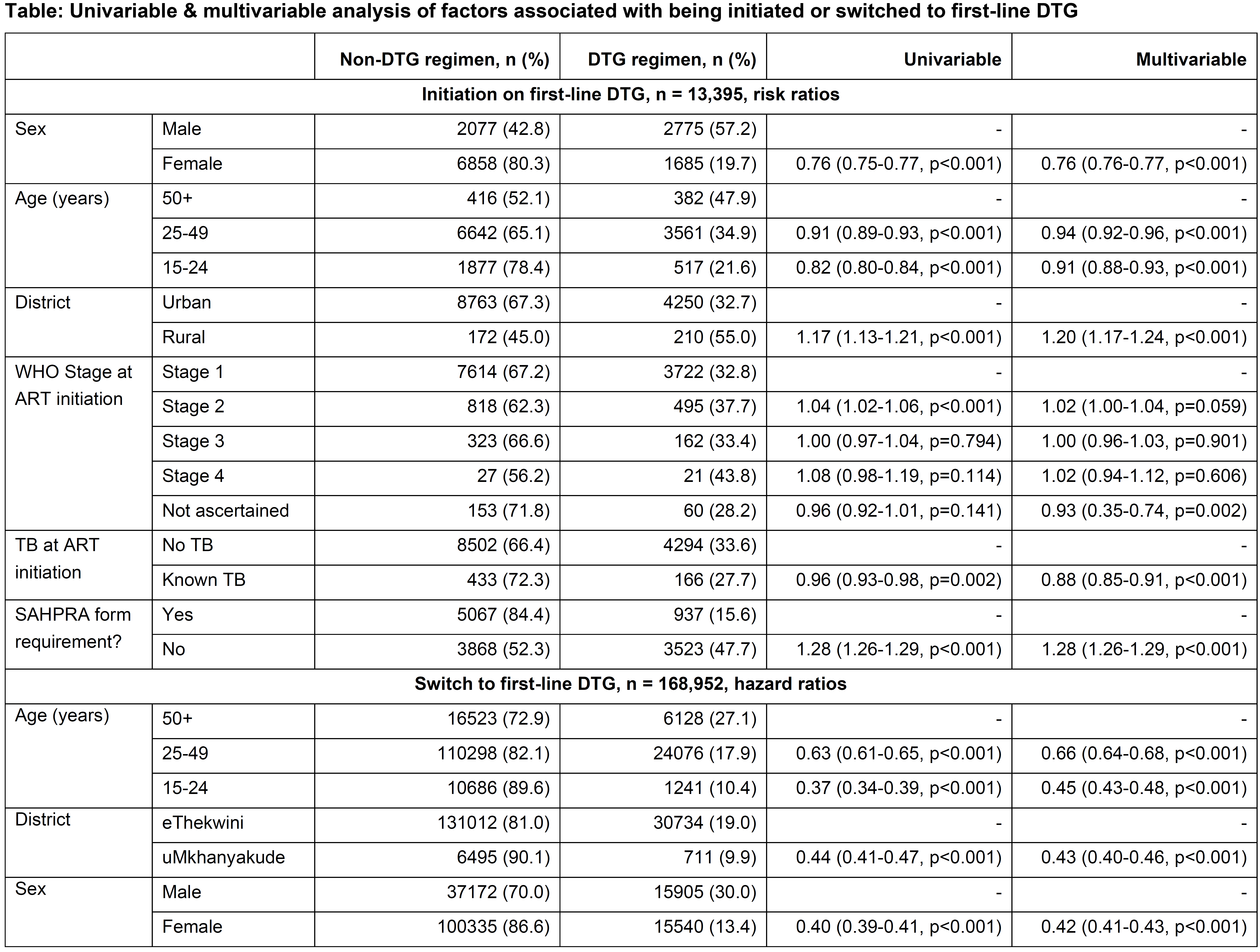
Of 13,395 adults newly initiated on ART, 8543 (63.8%) were women, median age was 32 years (IQR 26-38) and 6004 (44.8%) were initiated after the SAHPRA form was removed. 4460 (33.3%) initiated DTG and 8928 (66.7%) initiated efavirenz-based regimens. DTG initiation was lower in women (adjusted risk ratio [aRR] 0.76, 95% CI 0.76-0.77), younger people (15-24 years aRR 0.91, 95% CI 0.88-0.93; 24-49 years aRR 0.94, 95% CI 0.92-0.96 vs 50+ years) and those with TB (aRR 0.88, 95% CI 0.85-0.91), and higher in the rural district (aRR 1.20, 95% CI 1.17-1.24) and after the SAHPRA form was removed (aRR 1.28, 95% CI 1.26-1.29). Of 168,952 adults already receiving first-line ART, 115,301 (68.6%) were women, median age was 37 years (IQR 31-44) and median time on ART was 3.89 years (IQR 1.97-6.49). By 30 June 2020, 31,445 (18.6%) had been transitioned to first-line DTG. Switching to DTG was lower in women (adjusted hazard ratio [aHR] 0.42, 95% CI 0.41-0.43), younger people (15-24 years aHR 0.45, 95% CI 0.43-0.48; 24-49 years aHR 0.66, 95% CI 0.64-0.68 vs 50+ years), and in rural clinics (aHR 0.43, 95% CI 0.40-0.46). In sensitivity analyses testing for interactions, the effect of sex was largest in women younger than 50 years old in both the ART initiation (p<0.001) and first-line switching models (p<0.001).
In South African clinics, women were less likely to receive DTG than men. Efforts to improve DTG uptake among women should be strengthened, especially as recent evidence suggests lower risks from conceiving on DTG than originally feared.