Background:
Replacing routine clinic visits with differentiated service delivery (DSD) models for HIV treatment could benefit DSD clients and the health system, but its value depends on maintaining or improving patient outcomes. South Africa’s DSD models include facility pick-up points, external pick-up points and adherence clubs, which facilitate easier access to medication. We conducted a prospective record review to compare outcomes of DSD clients to those eligible but not enrolled in DSD in South Africa.
Methods:
Among adults initiating ART between 2016-2021 at 18 primary healthcare facilities, we compared retention and viral suppression for DSD clients to those DSD eligible but not enrolled using TIER.Net records. For reference we also included those not DSD eligible. DSD eligibility was defined per guidelines (2016-2019: 2 suppressed viral load (VL) (<400c/mL) and ≥12 months ART; 2020-2021: 1 suppressed VL (<50c/mL) and ≥6 months ART). DSD enrollment was defined as any DSD interaction in the previous 12 months before the 12, 24, or 36 month time point. DSD eligibility and enrollment were reclassified every 12 months. Outcomes were assessed at 12, 24, and 36 months after ART initiation. 12, 24 and 36 month retention was defined as attending a visit 13-24 months, 25-36 months and 37-48 months after ART initiation, respectively. Outcomes after 12 months were conditional on being retained in the previous period.
Results:
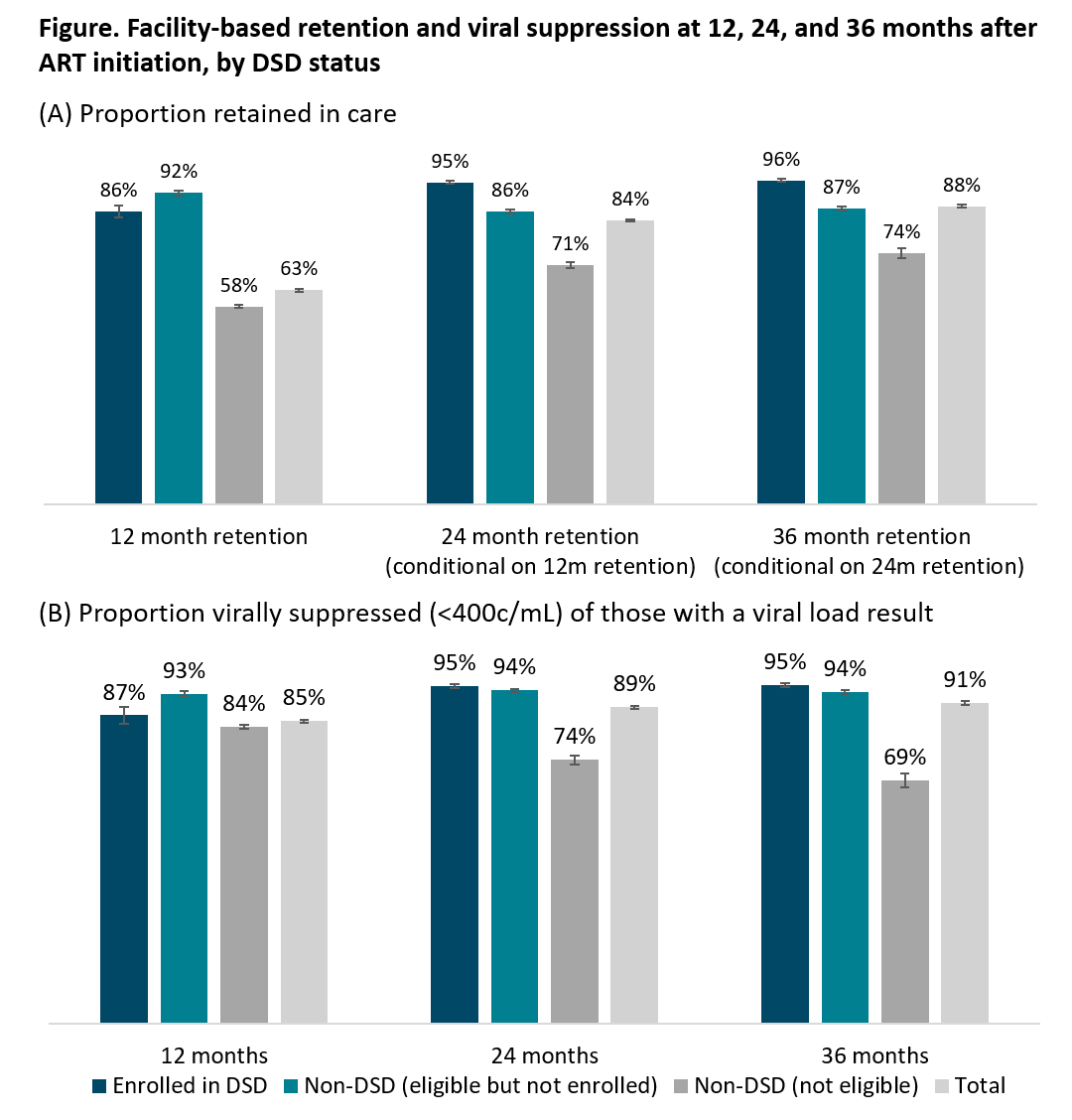
59,118 clients (67% female, 17% age 18-24) initiated ART during the study period. Proportion enrolled in DSD was 2% (N=1,431), 23% (N=7,238), 37% (7,845) by 12, 24 and 36 months; eligible but not enrolled was 12% (N=7,339), 48% (N=15,087), 46% (N=9,761) by 12, 24 and 36 months. Retention and viral suppression at 12 months were lower for those in DSD vs eligible. Retention at 24 and 36 months was higher for those in DSD vs eligible (relative risk: 1.10 [95% confidence interval 1.07-1.13]; 1.09 [1.06-1.13]). Viral suppression among those with a VL at 24 and 36 months was similar between those in DSD vs eligible. There were no differences in outcomes by gender or age group.
Conclusions:
South African DSD clients had higher retention and similar viral suppression at 24 and 36 months after ART initiation. The observed decrement to outcomes for DSD clients at 12 months requires further examination, particularly as new guidelines allowing DSD enrollment ≥4 months on ART. There was a missed opportunity for DSD enrollment as most of those eligible were not enrolled ≤ 3 years on ART.