Background:
Following WHO recommendations, most countries have transitioned to Dolutegravir (DTG)-based regimens as first-line antiretroviral therapy (ART). Despite documented adverse metabolic effects from developed countries, limited information is available from resource-limited settings. We explored changes in body weight before and after switch to a DTG-based regimen and assessed the association between switch to DTG and significant weight gain (≥10% increase) over a 12-month period in adults living with HIV (ALHIV) on ART in West Africa.
Methods:
We first included all ALHIV followed in the IeDEA West Africa cohorts with a documented switch to DTG-based ART during 2019-2021. Participants had to be in care ≥36 months at the day of switch, with ≥1 weight measure during the 24-months pre-switch period (P1) and the 12-months post switch period (P2). Weight change was estimated with a linear mixed model within P1 & P2, stratified by body mass index (BMI) class. A secondary analysis compared significant weight gain (≥10%) in ALHIV on ART, prior and after the date of DTG introduction (site level dependent) between ALHIV who switched to DTG and those who did not at the date of database closure (control group), through a multivariate logistic regression with random effect analysis.
Results:
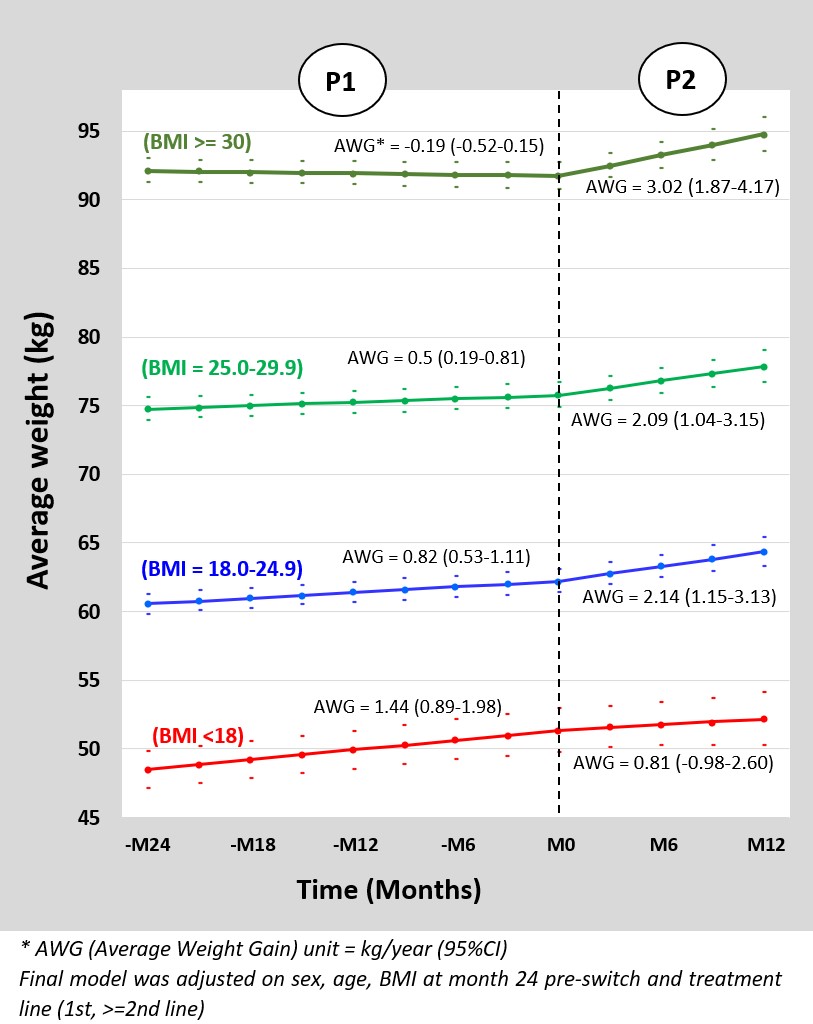
In the first analyses, 5,294 ALHIV were included from three countries (Burkina, Côte d’Ivoire, Nigeria); 63% were women. Median age at day of switch was 48 years (IQR: 42-54) and median follow-up was 9 years (IQR: 6-12). Patients switched mainly from NNRTIs (83%) and PI-based (15%) ART regimens. Weight gain increased significantly during P2 compared to P1 period with significant interaction with BMI during both P1 & P2 periods. While AWG was not significant in underweight patients (0.81 [95%CI: -0.98-2.60]), it increased significantly in normal weight (2.14[CI: 1.15-3.13]), overweight (2.09 [CI: 1.04-3.15]) and obese (3.02 [CI: 1.87-4.17]) ALHIV during P2 period. In logistic regressions analyses, adjusted for sex, age and baseline ART regimen, switching to DTG was associated with weight gain≥10% (aOR=1.77 [95%CI: 1.38-2.26]).
Conclusions:
In West African ALHIV, a 12-month DTG exposure was associated with a significant weight gain, particularly among those with a high BMI. As transition to DTG proceeds, close monitoring of weight and metabolic profile should be supported to characterize long-term health impact of DTG. Alternative ART regimen may be considered in individual with or at-risk for cardiometabolic disorders.
Figure 1. Linear mixed model predictions of weight evolution from month-24 pre-switch to month-12 post switch to a DTG-based ART regimen in ALHIV by body mass index (BMI) class. The IeDEA West Africa collaboration.