Background:
HIV self-testing (HIVST) has the promise to efficiently reach vulnerable populations who are hesitant or unable to visit healthcare locations for testing, especially as more affordable tests become available. We implemented a novel web-based HIVST service in India, which reached many who had never tested before and with high positivity. To understand how to scale HIVST and maximize efficiency, we assessed barriers and facilitators of the experience through a brief online survey.
Methods:
The HIVST web-based service was launched in July 2021. HIVST kits were couriered to clients or picked up at select locations. Virtual counselors (VCs) were available to clients for pre/post-test counseling and assistance with using the kits, including interpreting and uploading results to the website, and linkage to appropriate services. For clients who agreed to be contacted later about their experiences, an automated WhatsApp message with a link to a web-based self-administered survey was sent. The survey included basic demographics and their experiences with ordering, taking the test, reporting results, and interactions with VCs.
Results:
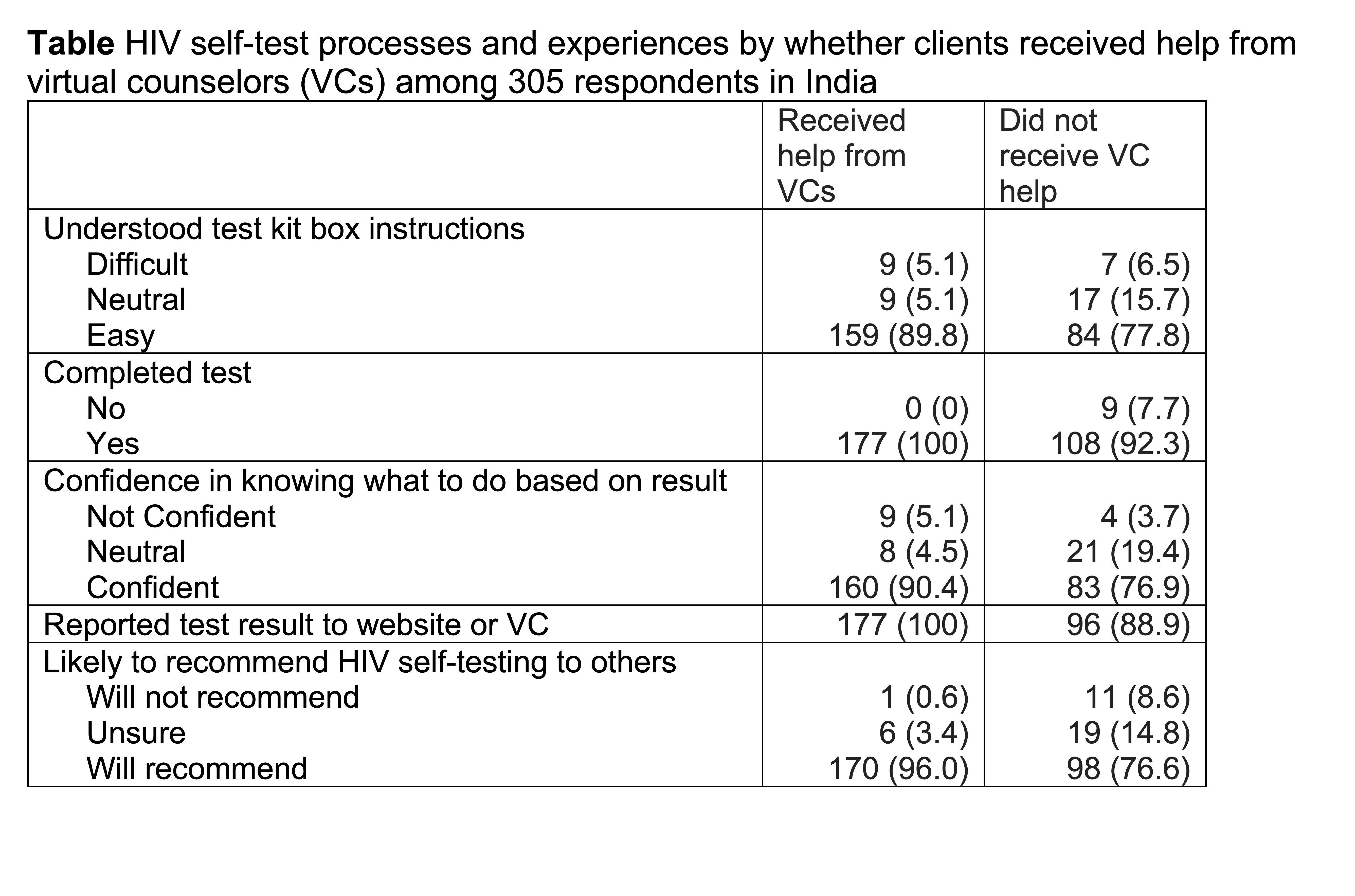
As of August 2022, 5014 clients ordered an HIVST, of whom 87% received the kit, 82% uploaded their result, and 5% screened positive; 74% were male, 64% 18-30 years of age, and 45% of kits were sent via courier. From October 2021-August 2022, 305 clients completed the survey; 85% of respondents were men and 81% had kits couriered. Nearly a quarter had ordered more than one kit and 5% had a verified positive HIVST result. A majority (87%) reported that it was easy using the website for ordering and receiving the kit. While most (85%) reported understanding the kit instructions and confidence about what to do with the result, the majority (81%) also reported receiving help completing the test – 76% from VCs and 14% from a friend. Most (88%) would recommend HIVST to others. Compared to those that did not get help from VCs, clients helped by VCs were more likely to understand kit instructions, complete the test, be confident in knowing what to do based on result, report the result, and recommend HIVST to others (Table).
Conclusions:
Clients were able to easily order, receive, and use HIVST kits from a web-based service. However, it is notable that most had interaction with a VC who facilitated the process. Virtual support by trained counselors could improve efficiency, uptake, and linkage of both virtual and in-person HIV prevention and treatment services.
HIV self-test processes and experiences by whether clients received help from virtual counselors (VCs) among 305 respondents in India