Background:
Neuropsychiatric post-acute sequelae of COVID-19 (N-PASC) include cognitive impairment, mood changes, headache, and neuropathy. Biomarkers of endothelial and platelet dysfunction are elevated in patients with acute COVID-19, but it is unknown if this persists in individuals with N-PASC. We investigated for vascular inflammation in N-PASC and controls.
Methods:
Participants with N-PASC (ongoing neuropsychiatric symptoms >3 months after COVID-19) and controls underwent cross sectional clinical assessment and blood collection. Plasma samples were tested via multiplex bead-based ELISA for the following analytes: a-2 macroglobulin, α1-acid glycoprotein (AGP), C-reactive protein (CRP), Fetuin A36, haptoglobin, L-selectin, platelet factor 4 (PF4), and serum amyloid protein (SAP) A (Eve Technologies). Non-parametric multiple Mann-Whitney testing was used with False Discovery Rate adjustment made to address multiple comparisons.
Results:
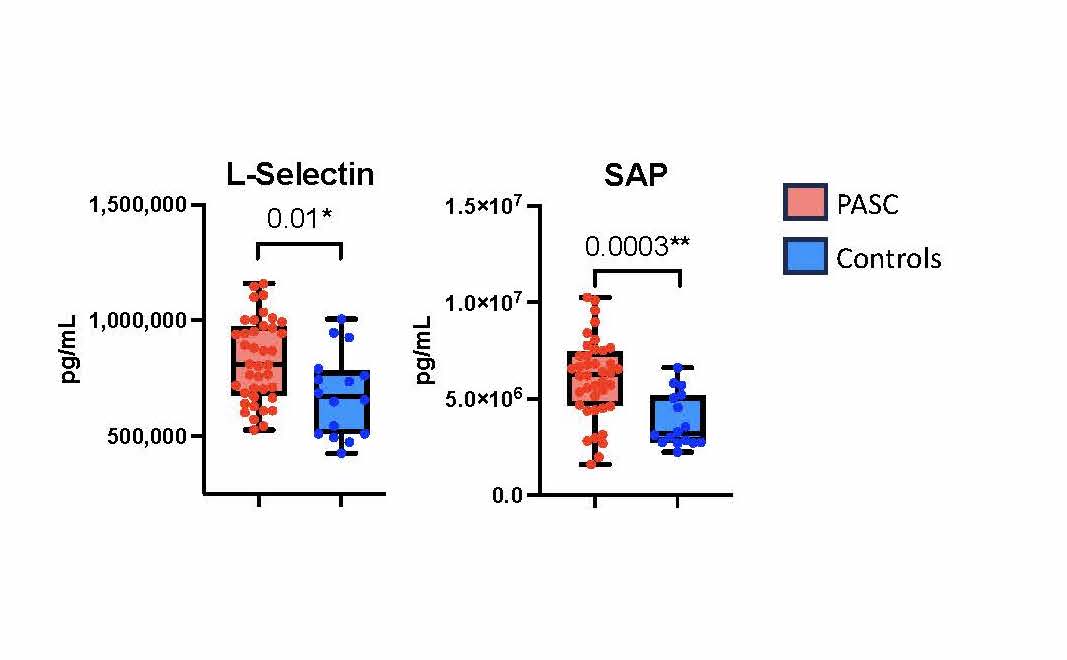
The N-PASC (N; n=40) and control (C; n=16) groups were similar in age (N: 45 years, C: 40 years, p=0.15), gender (N: 73% female, C: 69% female, p=0.76), race (N: 20% non-white, C: 37% non-white, p=0.19) and cardiovascular risk factors (diabetes, smoking, hypertension, obesity, and cardiac disease, p>0.05). The groups had similar time from acute COVID-19 to study visit (N:325 days, C:418, p=0.95). N-PASC symptoms included cognitive issues (72%), new or worsening anxiety or depression (67%), and headache (61%). Five markers were elevated in N-PASC: a-2 macroglobulin (N: 994,143 ng/mL, C: 749,109, p=0.04), CRP (N: 8,851,400 pg/mL, C: 3,625,000, p=0.01), haptoglobin (N: 194,735 ng/mL, C: 99,319, p=0.046), L-selectin (N: 808,346 pg/mL, C: 670,940, p=0.01), and SAP (N: 6,252,000 pg/mL, C: 3,186,650, p=0.0003) (Figure). Fetuin A36 was reduced (N: 132,476 ng/mL, C: 207,355, p=0.05). There were no differences in the other biomarkers tested.
Conclusions:
We report key differences in vascular inflammatory plasma biomarkers in individuals with N-PASC, including elevations in plasma proteins that indicate ongoing systemic inflammation (CRP, haptoglobin, SAP), endothelial dysfunction (a-2 macroglobulin), and atherosclerosis (L-selectin, fetuin A36, SAP). These findings suggest the N-PASC population may be at risk of persistent vascular inflammation and/or atherosclerosis. Further studies should longitudinally investigate endothelial inflammation and atherosclerosis in individuals with N-PASC.