Background:
To maintain HIV care continuity during the COVID-19 pandemic, most HIV care facilities across the United States adopted telehealth. However, research on the impact of telehealth use on HIV care outcomes is conflicting. This study assessed variation in viral load (VL) testing and outcomes related to visit type patterns among people living with HIV (PWH) receiving care from a large university-based clinic in North Carolina (NC) during the first year of the COVID-19 pandemic.
Methods:
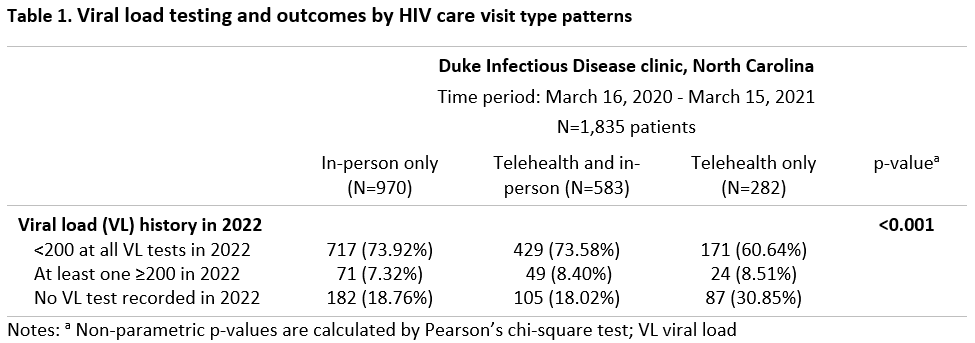
Aggregated electronic health record (EHR) data from the Duke University Infectious Disease clinic in NC were extracted using Epic’s SlicerDicer tool to assess bivariate differences between visit type patterns and VL testing history and outcomes. Visit type patterns were categorized as PWH who have used only in-person, a combination of in-person and telehealth, or only telehealth HIV care between March 16, 2020 and March 15, 2021. Nonparametric Pearson’s chi-square (χ2) tests were used to assess variation in VL testing history and outcomes in 2022 (i.e., not having any VL test recorded in 2022, VL was suppressed at all tests in 2022 [<200 copies per ml blood], or at least one VL test was unsuppressed in 2022 [≥200 copies]) by visit type pattern.
Results:
EHR data from 1,835 PWH were included. Telehealth use steeply increased in the first months of the pandemic, surpassing in-person visits, and decreased thereafter, stabilizing approximately one year after the beginning of the pandemic with <3% of PWH receiving telehealth per month. Between March 16, 2020 and March 15, 2021, 970 PWH used in-person HIV care only, 583 used telehealth and in-person HIV care, 282 used telehealth only. χ2 tests indicated that telehealth only users were more likely to not have any VL test recorded in 2022 as compared to PWH using in-person only or a combination of in-person and telehealth HIV care (p<0.001; Table 1). The proportion of PWH having at least one VL test ≥200 was similar regardless of visit type use.
Conclusions:
This study’s results indicate that VL outcomes among telehealth users who have VL testing results documented in EHR one year later may not be inferior as compared to exclusive in-person HIV care users. However, VL testing uptake is lower among telehealth only users. As VL testing is crucial to monitor treatment success, strategies such as remote VL testing at home or a local lab are needed to ensure regular VL testing among PWH who use telehealth HIV care.