Objective measurements of antiretroviral adherence may be clinically useful for promoting interventions to improve prevention or treatment outcomes. In people receiving oral antiretrovirals containing tenofovir (TFV), recent adherence is correlated with the concentration of TFV in the urine. The purpose of this study was to validate our newly developed semi-quantitative LFA for urine TFV and compare its performance against LC-MS, ELISA and a commercial LFA reader.
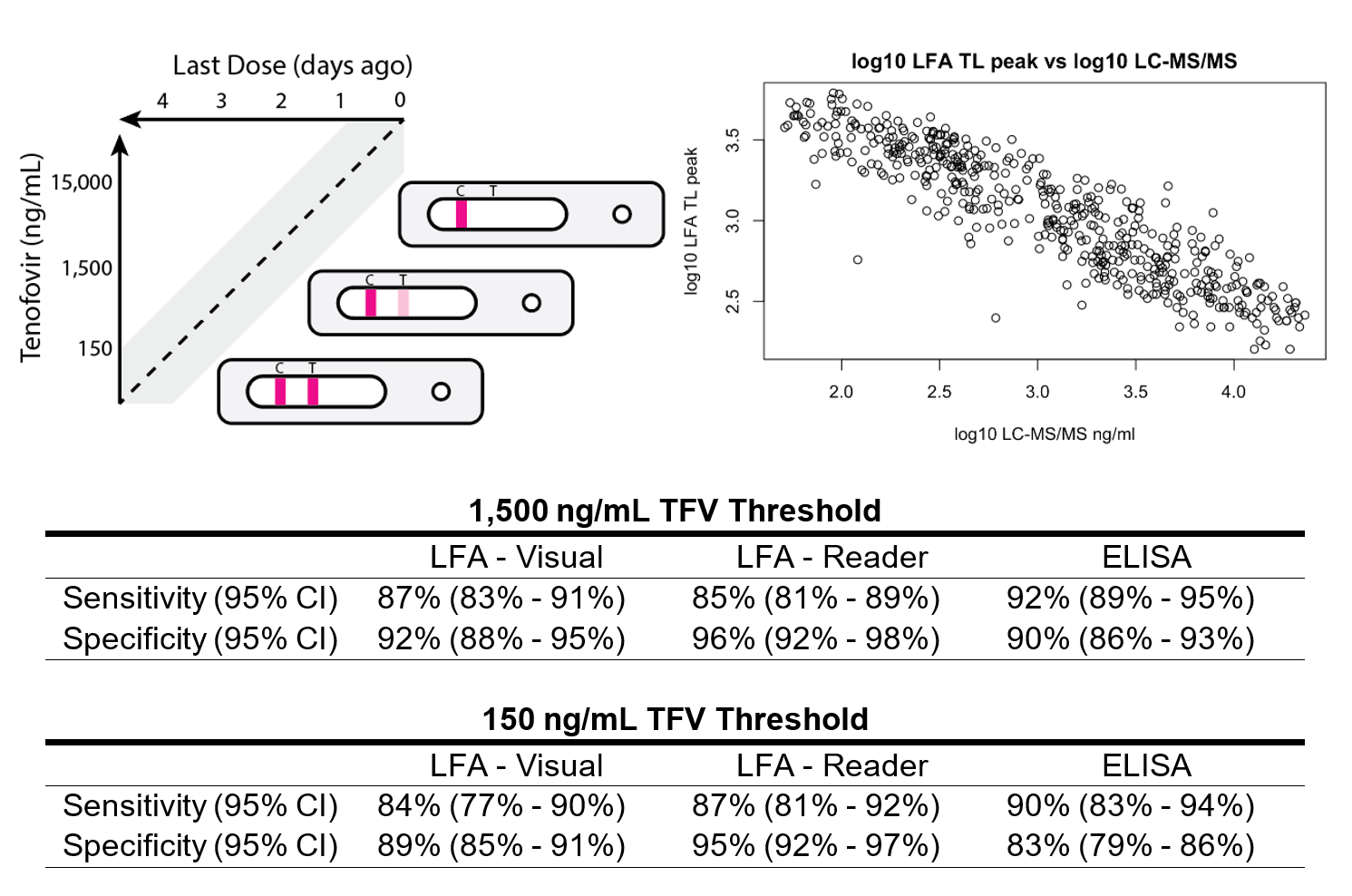
We developed a semi-quantitative competitive lateral flow immunoassay (LFA) for TFV in urine, which classifies TFV levels as one of the three categories ‘adequate/low/undetectable’ by either optical scanner or visual scorecard. These three categories are indicated as TFV either above 1,500 ng/mL, between 150 ng/mL to 1,500 ng/mL, or below 150 ng/mL, and approximately correspond with the last oral dose having been taken 0 to 2, 2 to 4, or >4 days ago, respectively. We assessed the test using urine samples collected in a previous study of TFV pharmacokinetics following directly-observed tenofovir disoproxil fumarate. Samples were tested by LFA and liquid chromatography-mass spectrometry (LC-MS), as well as an enzyme-linked immunosorbent assay (ELISA) which we also developed. Test line intensities were scored visually 0 to 5 and quantitatively by optical LFA reader.
588 urine samples from 28 participants were measured, with TFV concentration ranging from <50 ng/mL to >23,200 ng/mL. LFA test line intensity was inversely proportional to TFV concentration, with a Spearman’s correlation coefficient of -0.91. Visual grading performed independently by two trained personnel were concordant within 1 grade for 96% of samples. The LFA sensitivity & specificity for classifying the 1,500 ng/mL threshold by LC-MS were 87% & 92%, respectively, for the average visual reads, and 95% & 96% when read by the reader. For the 150 ng/mL ‘undetectable’ threshold by LC-MS, the sensitivity and specificity were 84% & 89% (visual) and 87% & 95% (reader). For the ELISA, the sensitivities & specificities for the 1,500 ng/mL and 150 ng/mL thresholds by LC-MS were 92% & 90% and 90% & 93%, respectively.
Our rapid LFA test was sensitive and specific at classifying TFV concentrations into three clinically relevant ranges. These results support the feasibility of our rapid semi-quantitative urine test using either visual score or optical readout to assess recent ingestion of TFV for treatment or prevention.