Background:
Hepatitis C virus self-testing (HCVST) has been recommended by the World Health Organization (WHO). However, data on the feasibility of HCVST in Latin America remain scarce. Therefore, we aimed to assess the usability and acceptability of HCVST among the general population in the Primary Health Care (PHC) in Rio de Janeiro (Brazil).
Methods:
This cross-sectional study was conducted in a Basic Health Unit in Rio de Janeiro from 04-Jul-2022 to 13-Sep-2022. Participants had access to written instructions for use and a video with a step-by-step oral fluid HCVST kit [OraQuick® HCV Self-Test]. A trained healthcare worker (HCW) observed the participant performing the test. After HCVST, the HCW performed a second HCV testing using the same kit. Usability was assessed by observing errors made and difficulties faced by participants. A post-testing questionnaire assessed the acceptability of HCV self-testing. Inter-reader (re-reading) and inter-operator (re-testing) concordance were assessed.
Results:
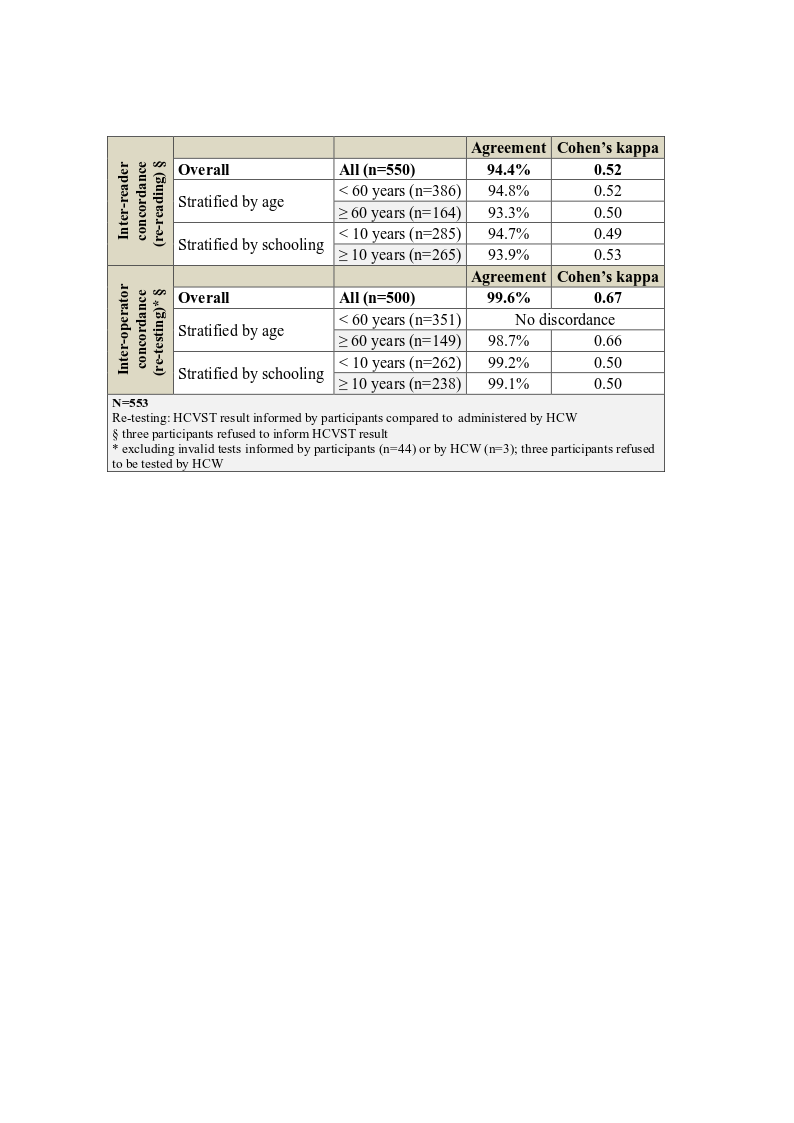
A total of 553 participants [75% female; median age=52 (IQR,39-61) years, 51.7% with schooling ≤ 10 years; 16.8% with diabetes] were included. People correctly opened the kit package, inserted the tube in the tube support, and collected oral-fluid samples in 95.1%, 90.2%, and 69.3%, respectively. After sample collection, correct insertion of the flat pad in the tube and correct timekeeping for result interpretation were observed in 86.8% and 93.5% of cases, respectively. A total of 62.2 % (n=344) of participants completed the HCVST process without assistance from an HCW. Inter-reader agreement of HCVST results was 94.4%, with a Cohen’s kappa of 0.52 (n=550) (Table). The agreement between participant-reported HCVST results and HCW-administered oral fluid HCV rapid test results was 99.6%, with a Cohen’s kappa of 0.67 (excluding invalid tests, n=500) (Table). A total of 91.5% felt safe performing HCVST. Most participants rated the HCVST process as easy (74.1%) or very easy (23.3%), 98.7% reported that they would be willing to use HCVST again, and 99.6% would recommend HCVST to their family, sexual partners, or friends. A total of 70.7% would prefer to perform HCVST in a health unit, and few people would like remote/digital (14.8%) or presential (28.6%) assistance by an HCW for HCVST.
Conclusions:
We demonstrated high usability and acceptability of oral fluid HCVST in a large sample of the population in a PHC in Rio de Janeiro.
Table. Inter-reader (re-reading) and inter-operator (re-testing) concordance of HCVST stratified by age and schooling (n=553)