Background:
South Africa has been introducing dolutegravir (DTG) into its large ART programme. We aimed to evaluate uptake and outcomes of first-line DTG, particularly in the context of initial safety concerns for women of child-bearing potential.
Methods:
We analyzed de-identified, routine data from two separate cohorts at 59 primary care clinics in eThekwini Municipality, South Africa, from DTG introduction in Dec 2019 to Feb 2022. In the ‘initiator’ cohort, we used multivariable Poisson regression models with robust standard errors to evaluate the likelihood of being initiated on DTG vs non-DTG ART, and of attrition (loss to follow up/death) and viraemia >50 cps/mL, at 12 months post-initiation. For the ‘transition’ cohort we used multivariable Cox proportional hazards models to assess the transition from non-DTG to DTG-based first-line ART.
Results:
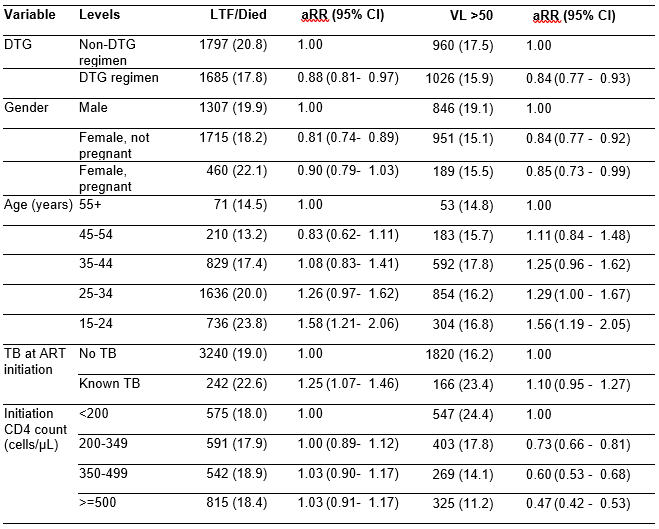
Of 33,533 adults initiating ART, 21,362 (63.7%) were women, median age was 32 years (IQR 26-38), and 23,445 (69.9%) initiated DTG. Overall, DTG initiation was lower in women vs men (adjusted risk ratio [aRR] 0.77, 95% CI 0.75-0.79). While this difference by gender was largest in younger people (e.g. 15-24 years: women vs men aRR 0.68, 95% CI 0.0.62-0.74), it was not present in older age groups (≥55 years: aRR 0.94, 95% CI 0.80-1.09). Lower DTG initiation in women vs men occurred early in the rollout (Dec 2019-Feb 2020: aRR 0.30, 95% CI 0.27-0.34), disappearing by Jun-Aug 2021 (aRR 0.94, 95% CI 0.87-1.03). Among people with 12-months of follow-up, attrition (aRR 0.88, 95% CI 0.81-0.97) and viraemia (aRR 0.84, 95% CI 0.77-0.93) was lower in DTG initiators. Of 177,082 adults already receiving first-line ART in Dec 2019, 122,004 (68.9%) were women and median age was 38 years (IQR 32-45). Median time on ART was 4.2 years (IQR 2.3-6.8) with the majority receiving efavirenz (98.6%) based first-line ART. By Feb 2022, 73.8% (118,253/160,171) of those remaining in care were transitioned to first-line DTG. Transition to DTG was lower in women (adjusted hazard ratio [aHR] 0.61, 95% CI 0.61-0.62) and in pregnancy (aHR 0.50, 95% CI 0.45-0.55). Again, the effect of gender on DTG transition was only evident in younger people, and before Jun-Aug 2021.
Conclusions:
In this first, large analysis of first-line DTG use and outcomes in South Africa, pregnancy safety concerns likely led to young women being particularly disadvantaged, early in the rollout. As initiation with DTG was associated with better treatment outcomes, efforts to increase DTG use should be renewed.
Table: Univariable and multivariable analysis of DTG initiation and associations with 12-month attrition and viraemia, adjusted for potential confounders