Background:
People with HIV (PWH) not on ART are at high risk for TB and low CD4 counts. TB screening and CD4 count measurement are recommended at ART initiation or re-initiation. In South Africa, estimated undiagnosed TB prevalence is 5-10% in PWH not on ART. An interim analysis of an ongoing cohort study of intensive TB screening in ART initiators found <1% TB prevalence. We used a urine tenofovir (TFV) assay to objectively assess the prevalence of undisclosed ART use as a potential explanation of the low TB prevalence in the cohort.
Methods:
Adults with confirmed HIV reporting no ART use within 90 days had CD4 count testing and were systematically tested for TB at the time of ART initiation at 2 public clinics in KwaZulu-Natal, South Africa using sputum TB culture, sputum Xpert Ultra and urine TB-LAM testing. Remaining urine was frozen and stored. Participants were followed for >6 months to identify incident TB. We tested thawed urine samples for TFV, indicating undisclosed ART use, using a novel lateral-flow urine assay (96% sensitive, 100% specific vs. LC-MS/MS). TB was defined as a positive Xpert Ultra or culture, or initiation of TB treatment within 3 months. We assessed predictors of ART nondisclosure and the relationship between ART nondisclosure and TB.
Results:
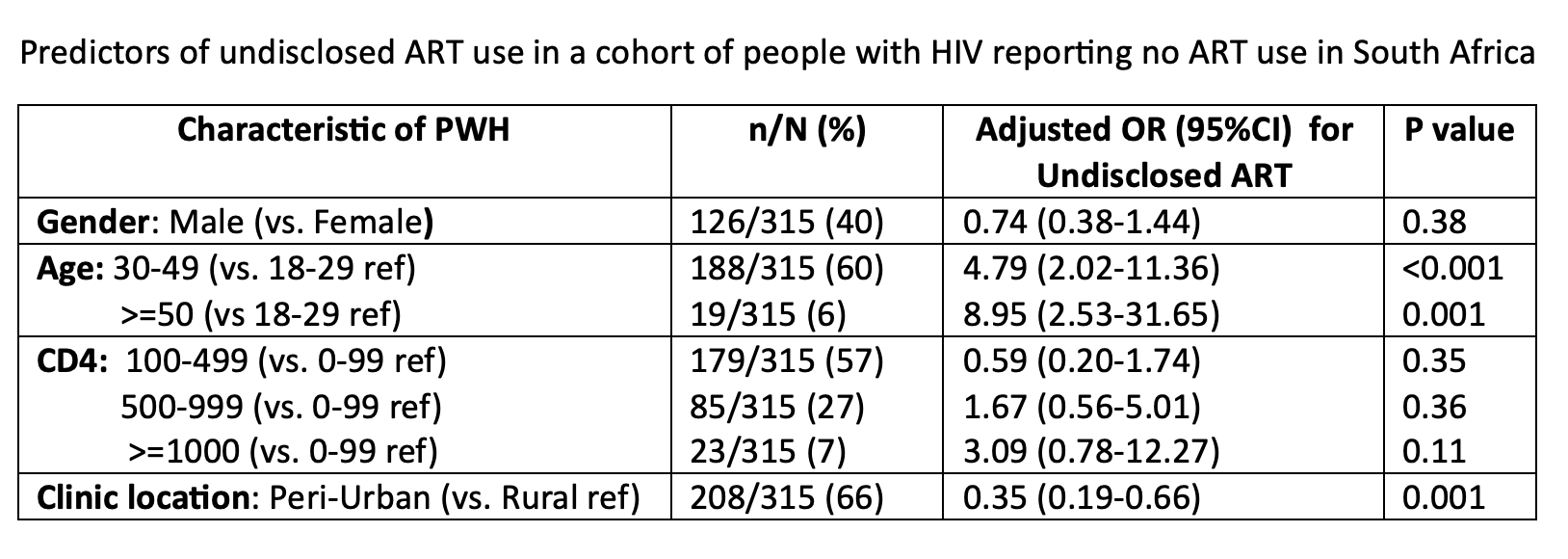
Between 12/2021-8/2023, 315 PWH (126, 40% male) reporting no ART use presented for ART initiation and provided urine; of these 63 (20%) had detectable TFV indicating undisclosed ART use. Median CD4 count among persons with vs. without undisclosed ART was 503 cells/mm3 (IQR 280-637) vs. 336 (IQR 178-510, p=0.001). Undisclosed ART was more common in PWH attending a remote rural vs. a peri-urban clinic (35% vs 12.5%, p<0.001). In a multivariable model, undisclosed ART was associated with older age, rural clinic site, and increasing CD4 count, but not with gender, education, or employment. TB screening identified 15 (5%) PWH with undiagnosed TB (11/15 male, 15/15 reporting TB symptoms, 8.7% prevalence in men). There was weak evidence for undisclosed ART being more common in persons with undiagnosed TB, after adjusting for gender (aOR 2.70, 95% CI 0.91-8.03).
Conclusions:
In the mature South African ART program, undisclosed ART use is common at 20% but is not associated with a reduced risk of undiagnosed TB. Undisclosed ART use may result in inappropriate use of resources and baseline testing. Use of a point-of-care urine assay to assess TFV could triage costly CD4 testing, however TB testing among all ART initiators should continue.