Background:
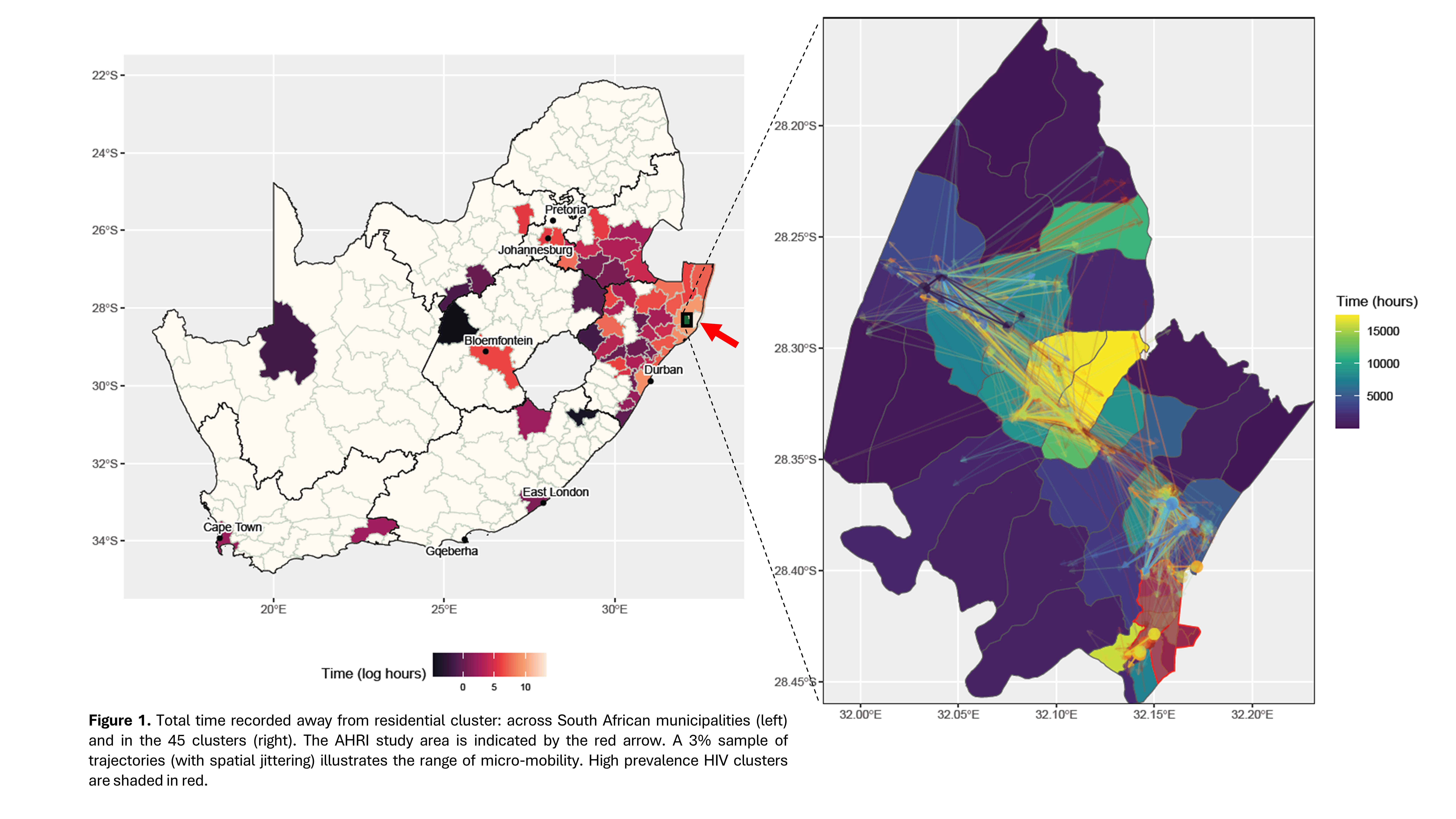
Mobility, including both short-term travel and migration, has been linked to increased risk of HIV infection. Ultra-high resolution GPS data collected from study participants who carry smartphones during their daily activities offers new insights into the mobility patterns of a representative sample of young adults in an HIV hyper-endemic setting in rural KwaZulu-Natal, South Africa.
Methods:
This study involved a random sample of adults aged 20-30 years who were consented and tested for HIV in the 2019 Africa Health Research Institute survey. Between 6/2021 – 3/2023, participants either received a smartphone with a customized Ethica mobile app or installed the app on their own devices. Positional data were recorded at a frequency of up to ~1 second (depending on internet connectivity and movement) over a six-month period. Data was analyzed to explore space-time dimensions of mobility and to quantify time spent in known high HIV prevalence areas. In this analysis, the cluster where each individual recorded the most time spent was considered to be their residential cluster.
Results:
In total, 27,151,329 time-stamped location records were collected for 202 individuals (median 74,864.5 data points), spatially distributed across 45 clusters within the study area and 57 municipalities across South Africa. Participants recorded a median of 129.7 days (IQR 71.8-161.8) inside the study area versus a median of 17.2 days (IQR 3.0-48.1) outside the study area. Nearly all (97.0%) made at least one trip outside the study area during this time. Similar proportions spent greater than 50% of their recorded time outside their own residential cluster: either in other clusters within the study area [internal mobility: 13.4%] or outside the study area entirely [external mobility: 14.4%]. Over half (88/157, 56.1%) of those participants who did not reside in a geographical HIV cluster spent time in those areas. Median percent of recorded time by non-residents in the HIV clusters was 0.6% (IQR 0.04-5.8).
Conclusions:
Young adults in rural KwaZulu-Natal display highly dynamic patterns of mobility both locally and farther afield. Over forty percent of this population moved through clusters in the study area with known high HIV prevalence but did not reside in those places. Determining typologies of movement in this age group and quantifying movements in and out of known HIV hotspots can facilitate designing location-intelligent, real-time precision interventions for those at high risk of HIV acquisition.