Background:
Drug-resistant tuberculosis (DR-TB) remains a global health threat. Drug susceptibility testing (DST) is essential for diagnosing and treating DR-TB effectively, but culture-based methods are time and resource-intensive. Culture-free targeted next-generation sequencing (tNGS) can comprehensively detect drug resistance mutations but its practicality in routine settings requires further exploration. We tested Oxford Nanopore Technologies’ tNGS assay for TB in two laboratories in sub-Saharan Africa.
Methods:
The study was conducted at two sites, Johannesburg/South Africa and Lusaka/Zambia, as part of an ongoing prospective cohort study. On-site lab procedures included automated DNA extraction, amplification of 25 gene regions linked to drug resistance across 18 TB drugs, and real-time Nanopore sequencing and analysis with compact MinION sequencers. Native sputa and decontaminated sediments of 70 TB-positive patients with a GeneXpert MTB/RIF Ultra result of ‘low’ to ‘high’, were sequenced. Sequencing results were compared to local routine DST (phenotypic MGIT DST to first-line drugs and GeneXpert MTB/XDR).
Results:
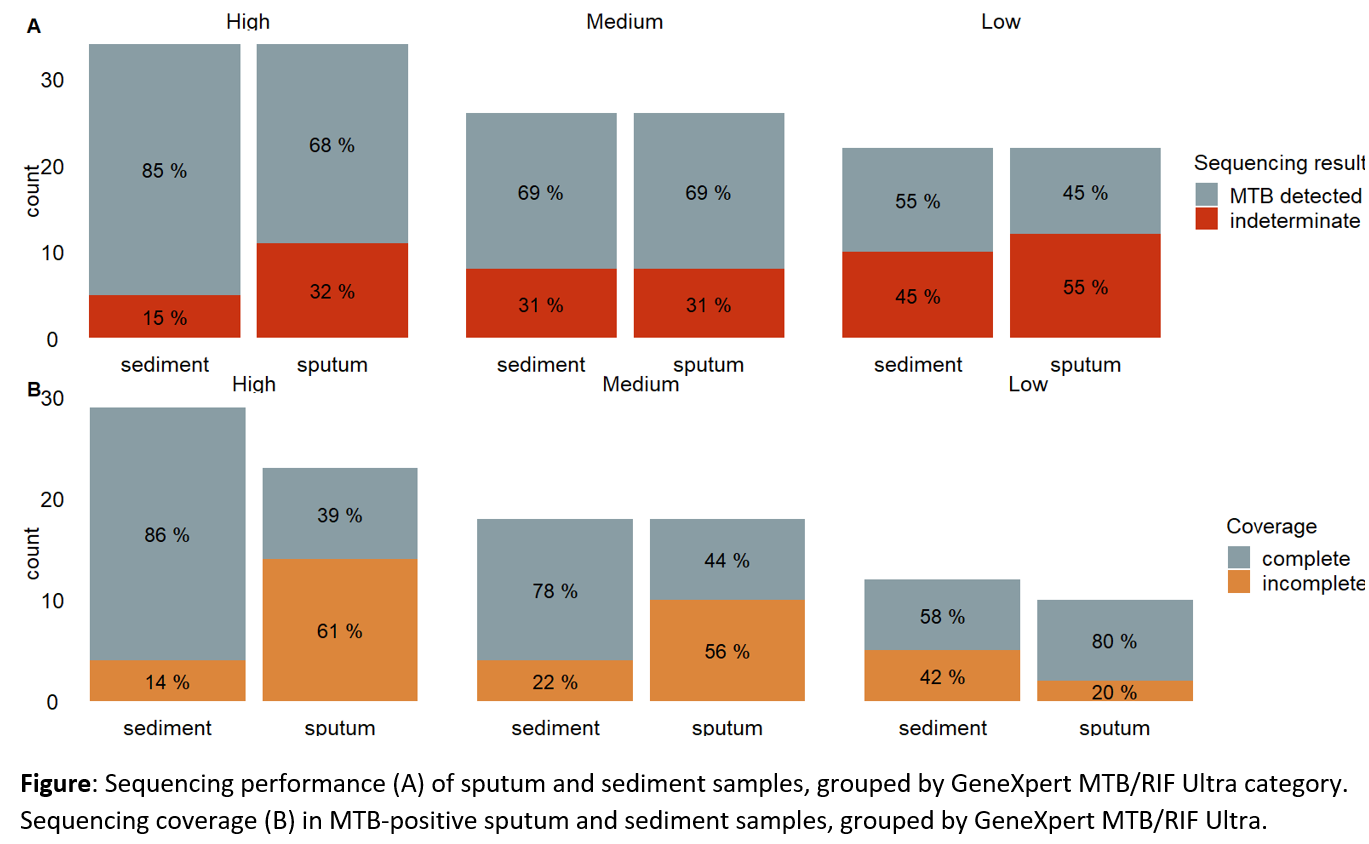
Predicted DR results were available 24 hours after initiating DNA extraction. We obtained sequencing results for 51/82 (62%) native sputum and 59/82 (72%) sediment samples (p=0.25, Fig. A). Complete sequencing results, covering all 25 targets, were obtained for 25/51 (49%) sputum and 46/59 (78%) sediment samples (p<0.01, Fig. B). For incomplete samples the median number of targets missed in sputum and sediment samples was similar (9 vs. 11). Among five samples with rifampicin resistance detected by GeneXpert MTB/RIF Ultra and confirmed by phenotypic DST, sequencing predicted resistance in 3 of these samples, was indeterminate in one sample, and missed resistance in one. Sequencing also predicted resistance to isoniazid and ethionamide in four and one samples, respectively, all confirmed by local DST. Xpert MTB/XDR results were available for a subset of 40 samples, for which predicted DR profiles were all concordant. Recruitment, sequencing, and reference testing, using local routine DST are ongoing.
Conclusions:
Nanopore tNGS was implemented successfully at both sites. Sequencing from sputum and sediment samples was comparable and detected TB and DR-associated mutations. Nanopore tNGS promises a feasible and rapid sequencing approach for comprehensive genotypic DR profiling in TB high-burden countries but technical and logistic challenges complicate its routine implementation.