Background:
People living with HIV (PWH) are at elevated risk for suicidality (i.e., suicidal ideation, plans, attempts), though little is known about population-specific factors driving potential disparities in Emergency Department (ED) visits in the context of suicide. Using longitudinal data from a large Bronx, NY health system, we measured trends and disparities in suicide-related ED visits between PWH (N=7,903) and people without HIV (N=560,977).
Methods:
Using the Einstein-Rockefeller-CUNY CFAR’s Clinical Cohort Database, we identified all ED visits among patients age 17+ years at 4 EDs in the Montefiore Health System between 2016 and 2022, and determined suicide-related visits using ICD-10-CM diagnosis codes for suicidal ideation/behavior. We measured rates of suicide-related visits by HIV status. Rates were annualized per 1,000 ED visits, age-standardized to the 2000 US Standard Population and stratified by gender, age, race/ethnicity and HIV transmission factor.
Results:
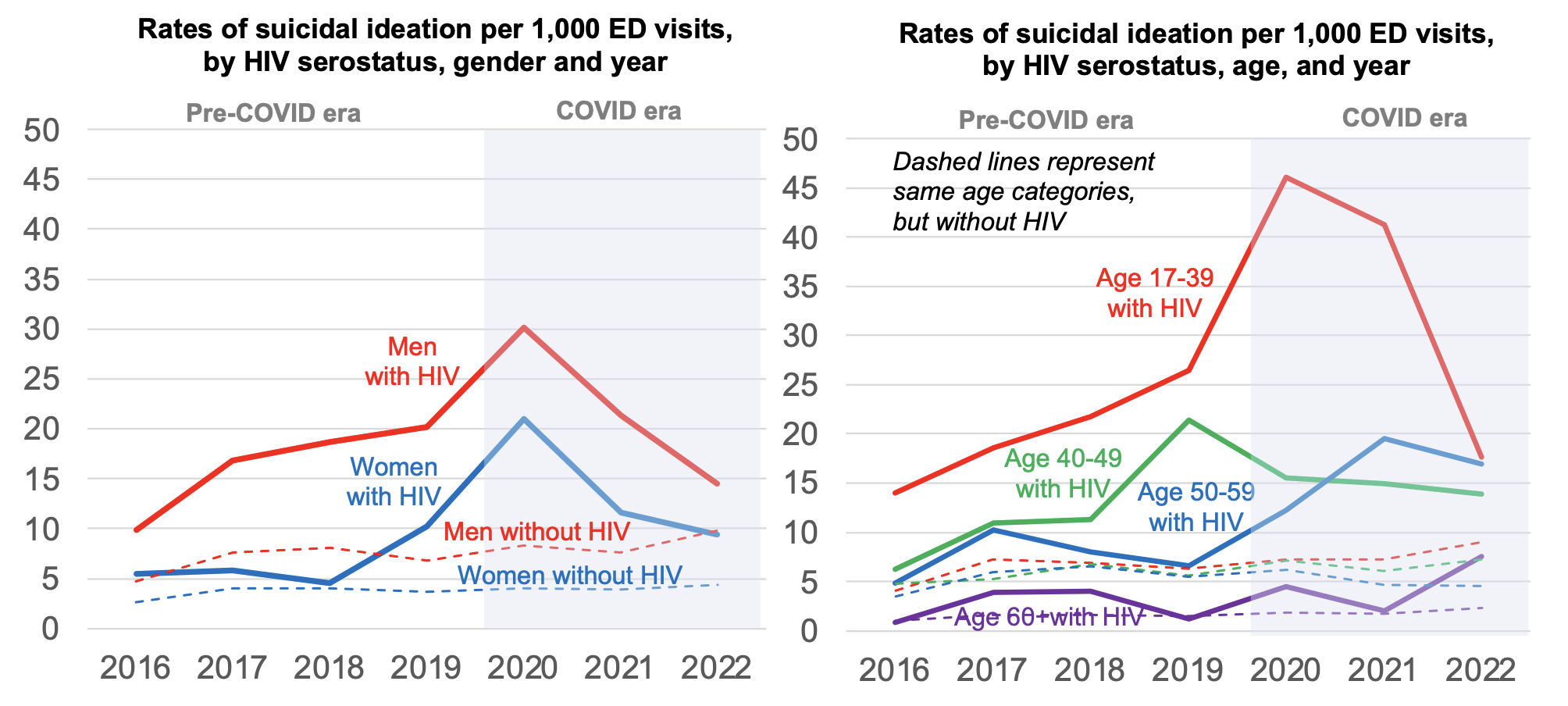
Among 1,760,143 unique ED visits (40,475 among PWH) between 2016-2022, 8,994 (506 among PWH) were suicide-related. The overall rate of suicidal ideation/behavior among PWH was 14.9/1,000 ED visits (95% CI 13.3-16.4), compared with 5.2/1,000 (95% CI 5.1-5.3) among those without HIV. Rates were consistently higher among PWH versus those without HIV across gender and age categories (Figure). Among PWH, the highest rates were observed among those age 17-39 years (25.6/1,000, 95% CI 22.4-28.9), cisgender men (18.5/1,000, 95% CI 16.4-20.7, vs cisgender women, 6.6/1,000, 95% CI 5.0-8.3), and non-cisgender individuals (30.0/1,000, 95% CI 16.8-45.0). Before the COVID-19 pandemic, both the annual number and rate of suicide-related ED visits had increased steadily over time among PWH, from N=39 (7.8/1,000) in 2016 to N=74 (16.7/1,000) in 2019. Trends showed a further increase as COVID-19 became established, to N=86 (27.4/1,000) in 2020, particularly among PWH age 17-39, before decreasing in 2021 and 2022. Temporal increases in suicidal ideation/behavior were less pronounced among people without HIV.
Conclusions:
Suicide-related visits were nearly 3-fold higher among PWH compared with those without HIV in this large, urban ED setting, and increased differentially over time, even after accounting for temporal changes associated with the COVID-19 pandemic. Younger PWH and transgender individuals may be at particular risk for suicidality; more research into associated factors is needed to help info