Background:
Universal Test and Treat (UTT) has expanded antiretroviral therapy (ART) access globally, but population-based studies of longitudinal HIV treatment outcomes following UTT are rare. We characterized population-level trends in durable HIV viral load suppression (VLS) and persistent and intermittent viremia after UTT scale-up in Rakai, Uganda.
Methods:
We ascertained viral load status among Rakai Community Cohort Study participants in 4 hyperendemic fishing villages and 36 lower-prevalence inland communities across 3 survey rounds (2015 to 2020), coinciding with UTT rollout. For each participant, viral load was assessed over 2 study visits (i.e., visit-pair, ~1.8-year interval between visits), and classified as follows: persistent viremia (≥1,000 copies/ml across visits), durable VLS (< 1,000 c/ml across visits), new/renewed VLS (≥1,000 c/ml at index visit only), or viral rebound (≥1,000 c/ml at follow-up only). Prevalence estimates for viral load outcomes in each visit-pair were assessed over calendar time and by age and gender. Individual- and community-level predictors of persistent HIV viremia were also identified using multivariable robust Poisson regression with generalized estimating equations, reported as adjusted risk ratios (aRR) with 95% confidence intervals (95%CI).
Results:
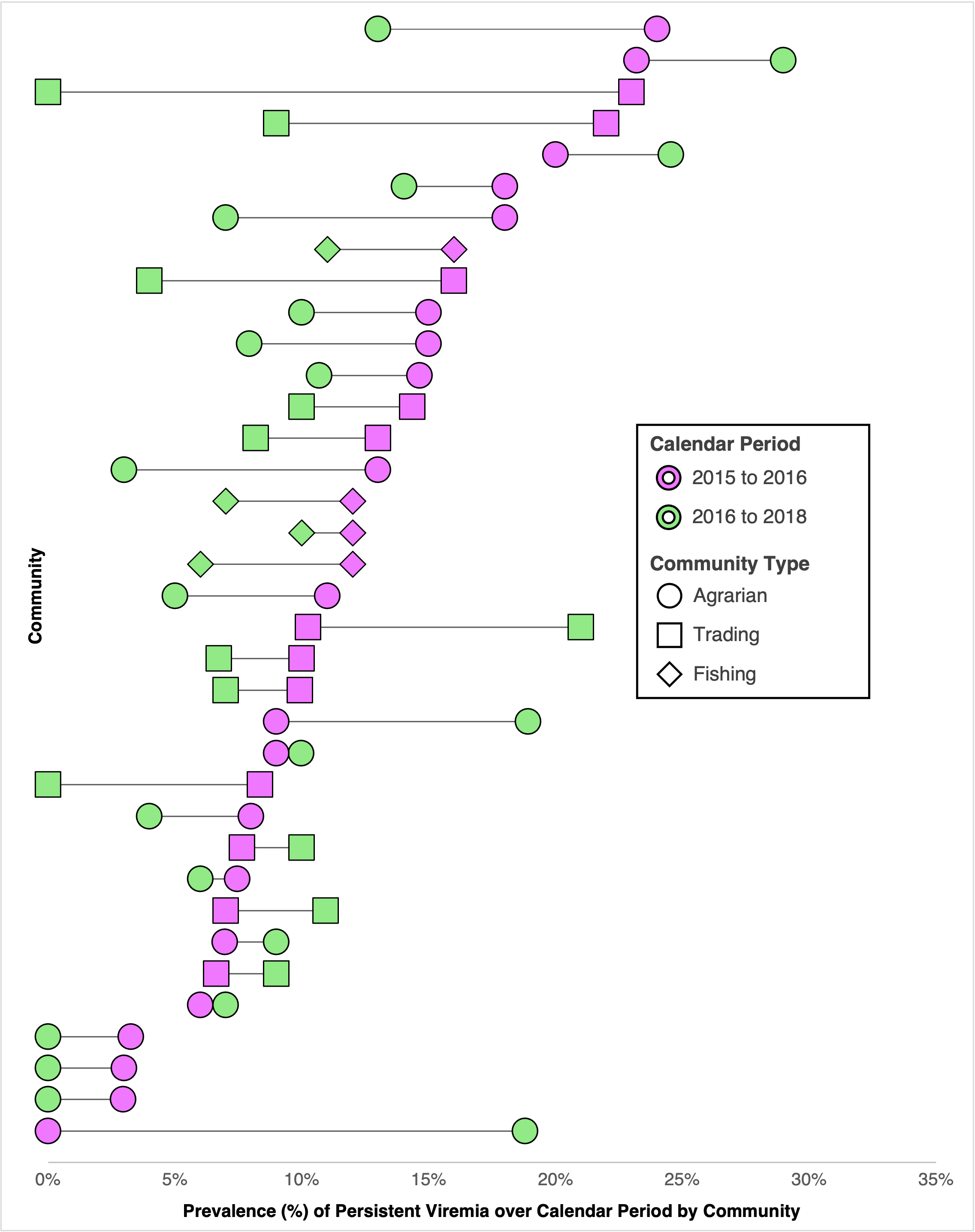
Overall, 3,080 persons (mean age: 34 years, 62% women) contributed 4,604 visit-pairs to the analysis. One-fourth of visit-pairs exhibited any viremia, of which 42% were persistently viremic, and 10% had viral rebound. Among visit-pairs with persistent viremia, 21% were in persons reporting ART use for >1 year. Significant increases in durable VLS prevalence over time (71% to 80%) accompanied declines in persistent viremia (12% to 8%); however, the magnitude of these declines varied substantially across communities (Figure 1). Persistent viremia was significantly higher among youth (≤29 vs. 40-49 years: aRR 2.96, 95%CI 2.21–3.96), men (aRR 2.40, 95%CI 1.87–3.07), and individuals reporting inconsistent condom use with non-stable partners (aRR 1.38, 95%CI 1.10–1.74) and hazardous alcohol use (aRR 1.09, 95%CI 1.03–1.16).
Conclusions:
Durable VLS increased with UTT, but 42% of viremic visit-pairs, nearly one-fourth of which were in persons on ART, remained unsuppressed for >1 year. Given the concentration of viremia in groups with known barriers to HIV care and elevated risks of onward HIV transmission, UTT alone may be insufficient to optimize clinical outcomes and achieve HIV epidemic control in this setting.
Community-level prevalence of persistent HIV viremia, by calendar period