Background:
Treatment of hepatitis C virus in the postpartum period is delayed until after the completion of breastfeeding due to lack of data on infant exposure and safety. Our objectives were to describe breast milk transfer of sofosbuvir (SOF), GS-331007 (SOF inactive metabolite) and velpatasvir (VEL) in postpartum women being treated for HCV with SOF/VEL who were not intending to breastfeed.
Methods:
Women undergoing postpartum HCV treatment with SOF 400mg/VEL 100mg daily for 12 weeks and willing to provide pumped breast milk were eligible for the study. SOF/VEL treatment was started within 36 hours of delivery. Paired maternal blood and breast milk were obtained at 2 or more pharmacokinetic (PK) visits. VEL, SOF and GS-331007 concentrations in plasma and breast milk were measured using validated UPLC-MS/MS assays (LLOQ 5 ng/mL for VEL in plasma and breast milk and SOF/007 in plasma; 1 ng/mL for SOF/007 in breast milk). The infant daily dose was calculated using drug concentrations in the milk and considering that the amount of milk ingested by an exclusively breastfed infant is 150 mL/kg/day and reported relative to the adult dose normalized to 70 kg weight and the child dose normalized to 13 kg weight. Data were summarized using descriptive statistics.
Results:
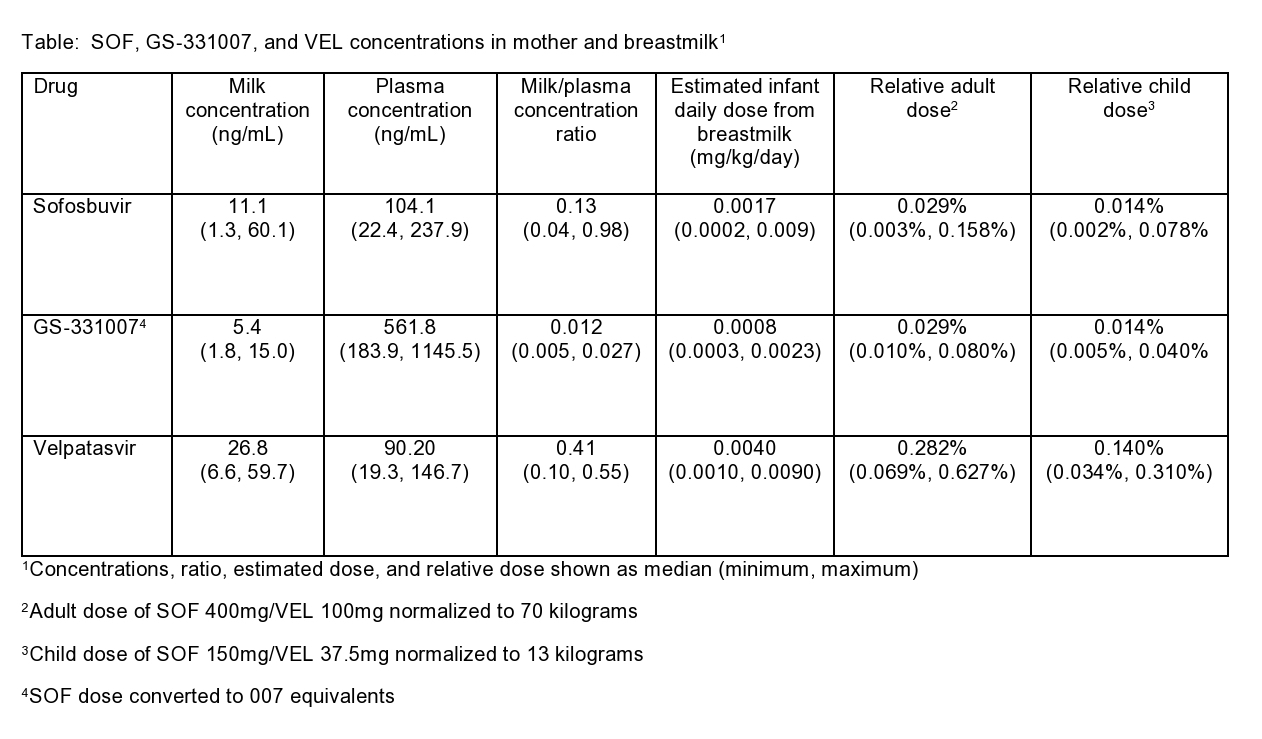
Four participants were enrolled with a median (range) age of 29.5 years (27-36); 3 white, 1 multiple races; all were multiparous with median (range) weight of 69 kg (58-88) and median creatinine of 0.5mg/dL range (0.5-0.6). The participants had their first PK visit within 24 hours of initiating SOF/VEL and had 2 to 7 PK visits each yielding a total of 17 paired samples for analysis occurring a median (range) time of 1.99 days (0.19-6.13) after treatment start. VEL and GS-331007 were quantifiable in all paired samples; SOF was quantifiable in 9 breast milk and 7 plasma samples due to its short half-life (Table). SOF, GS-331007, and VEL concentrations in the breast milk were lower than maternal plasma concentrations. The estimated infant daily dose from breastmilk is less than 0.7% of the daily dose in an adult and a child adjusted to weight.
Conclusions:
Based on our findings, exposure to SOF/VEL via breastmilk is minimal and reassuring for infant safety and low potential for development of HCV resistance with perinatal transmission. Clinicians should consider expedited HCV treatment in the postpartum period during breastfeeding to improve linkage to HCV care.