Background:
Torque Teno Virus (TTV), a small, circular, single-stranded DNA virus, is an integral part of the human virome, whose implications in terms of immune response are barely understood. Recently, studies have suggested its potential use as an immunological marker in immunocompromised patients. The aim of this study was to measure TTV viral load in a cohort of perinatally HIV-infected patients (PHIV) and explore its association with immune reconstitution.
Methods:
Chronic PHIV on stable antiretroviral treatment (ART) and with sustained undetectable HIV viral load were selected from the Spanish Cohort of PHIV (CoRISpe/FARO), and compared to a cohort of uninfected controls. Plasma samples and peripheral blood mononuclear cells (PBMCs) were obtained from the Spanish HIV BioBank. Plasma TTV detection and quantification was assessed by qPCR and T-cell phenotype was studied by multiparametric flow cytometry on PBMCs. Correlations with baseline CD4 and CD8 and long-term immune and HIV VL evolution were analysed.
Results:
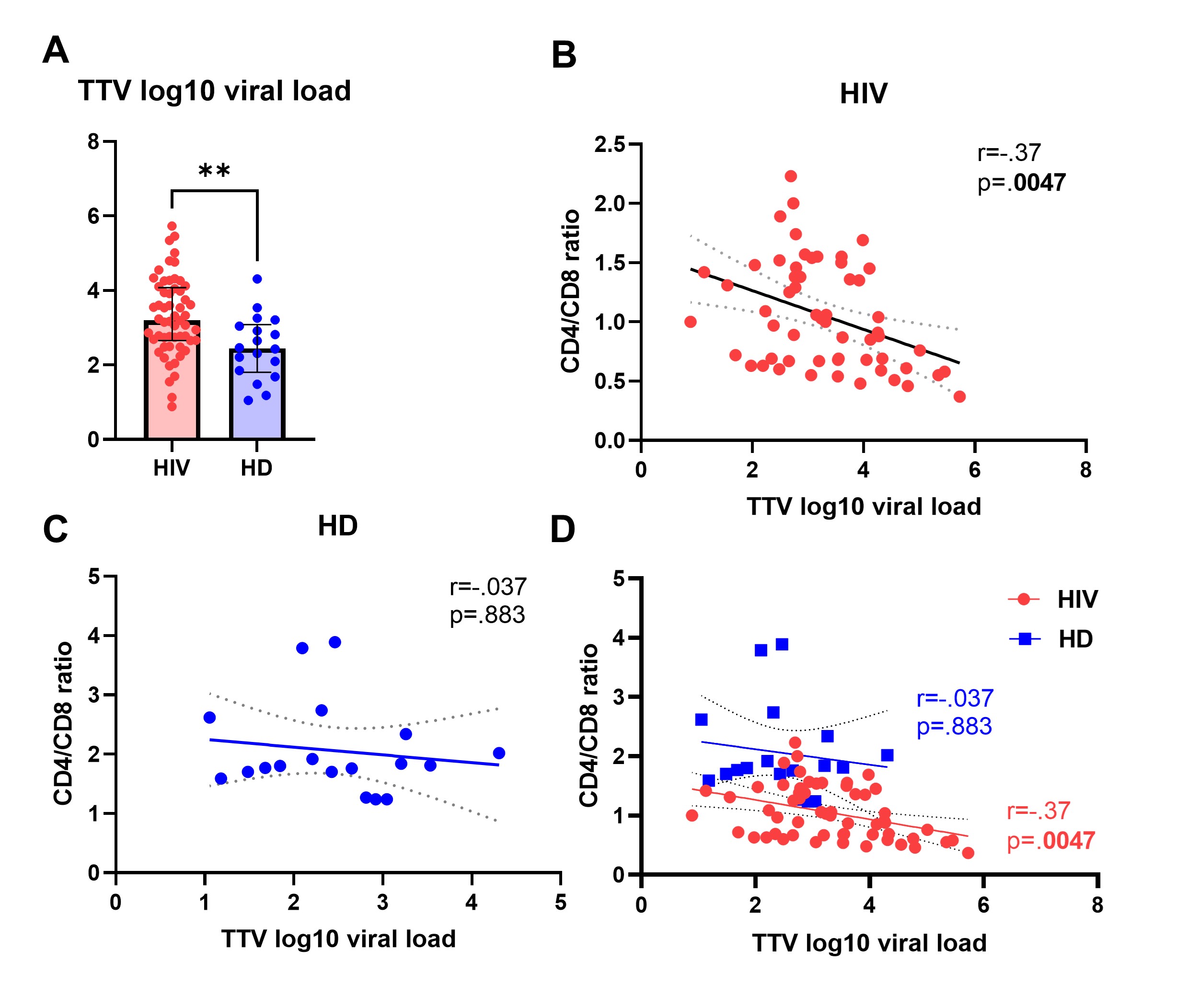
A total of 57 PHIV (44% males) were included and compared to 23 HIV-uninfected healthy donors (34% males) (HD). At baseline, PHIV were younger (20 [17-24] vs 26 [24-27] years, p < 0.001). Their median CD4-T cells was 736 [574-906] and had a median of 17 years [14-20.5] since ART initiation and 65 months [39-116] under virological control. TTV viral load in plasma was significantly higher among PHIV (Fig.A) and in males compared to females (p=0.02). TTV viral load correlated with CD4 and CD8 T-cell and the CD4/CD8 ratio (p=0.002; r=-0.39, p=0.037; r=0.277, p=0.005; r=-0.37 respectively) among PHIV (Fig.B-D), but not with CD4 nadir, age at ART initiation or time under HIV suppression. Among PHIV, TTV viral load positively correlated with the co-expression of HLA-DR/CD38 in CD4 T-cells (p < 0.01, r=0.39) and the soluble proinflammatory biomarker IL-6 (p=0.04, r=0.37). Baseline TTV viral load was higher in patients who lost HIV suppression during the follow-up (p < 0.05). After three and five years of follow-up, changes in CD4/CD8 ratio from baseline time-point, inversely correlated with TTV levels (p=0.09; r=-0.33 and p=0.06; r=-0.56 respectively).
Conclusions:
TTV viral load was significantly higher among PHIV. Despite associations with T-cell activation and IL-6 were mild, TTV viral load strongly correlated with the CD4/CD8 ratio, suggesting its potential value as an immunological predictor.
TTV viral load in PHIV vs HD (A) and correlations with CD4/CD8 ratio in PHIV and HD (B-D).