Hypertension (HTN) in pregnancy is an important cause of adverse maternal and fetal outcomes. Dolutegravir (DTG) has been associated with excess weight gain and adverse cardiometabolic effects in non-pregnant adults, which could lead to increased HTN during pregnancy. We therefore compared the risk of HTN in pregnancy among women on DTG to women on efavirenz (EFV), and to women without HIV (WWoH).
Tsepamo birth surveillance study data was used to emulate a hypothetical (target) trial where women would have been randomized to DTG- vs. EFV-based ART pre-conception and followed to delivery along with an observational arm of WWoH enrolled during pregnancy. The target trial included >18 y/olds who conceived 0.5-3 yrs after starting DTG- or EFV-based ART and delivered at one of the original 8 Tsepamo sites. WWoH were matched 2:1 to women with HIV by maternal age, gravida, site of delivery, and calendar yr of delivery. The primary outcome was gestational HTN, defined as onset of HTN (SBP >140 or DBP >90) after 20 weeks gestational age (GA) excluding those with chronic HTN. Secondary outcomes included women with chronic HTN and 1) any HTN (SBP >140 or DBP >90 at any GA), 2) severe HTN (SBP >160 or DBP >110 at any GA) and 3) early HTN (onset of hypertension before 34 wks GA). We fit multivariable log-binomial regression models to estimate the RR of each hypertensive outcome.
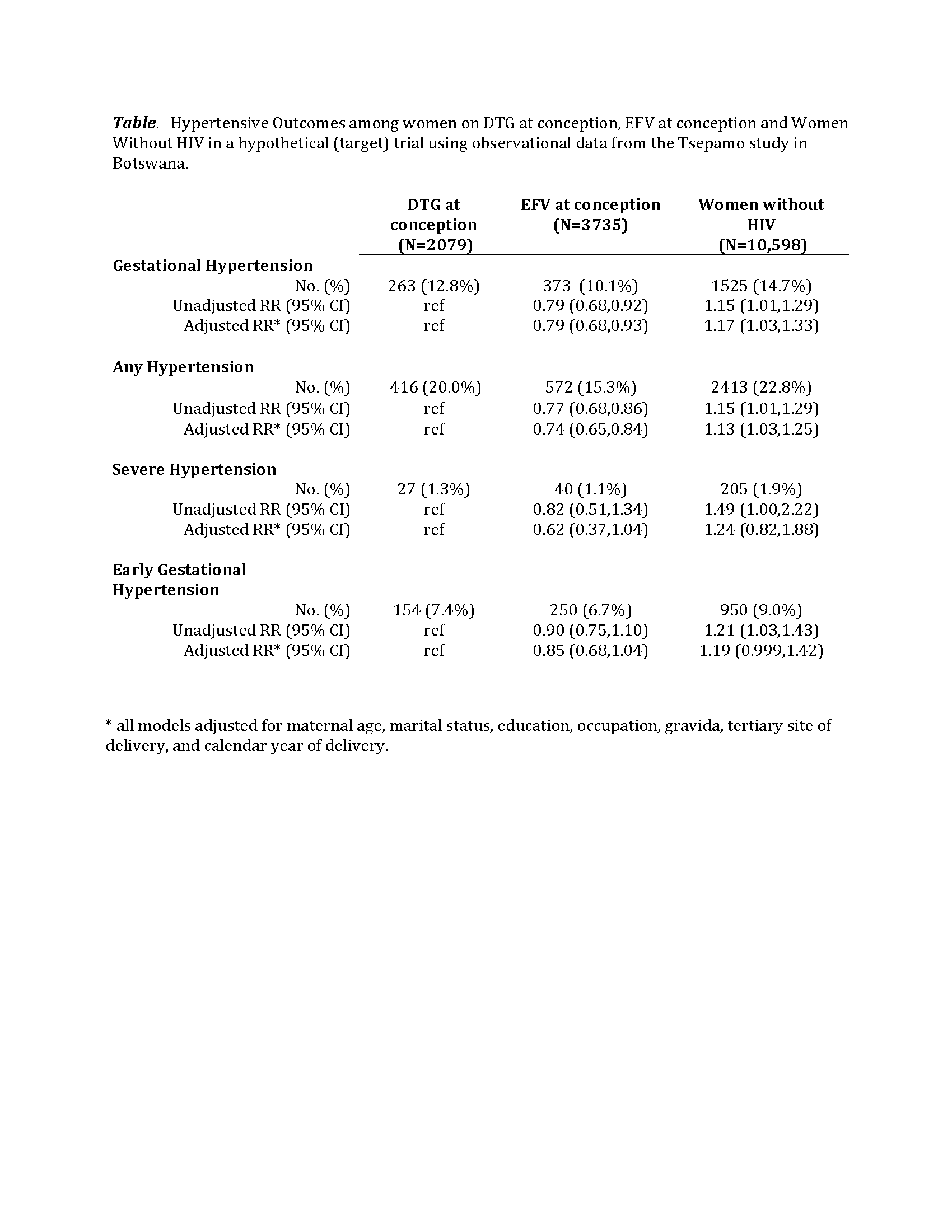
Of 176,321 deliveries between Aug 2014-Oct 2020, 16,412 fit criteria for the target trial, including 2079 women conceiving on DTG, 3735 women conceiving on EFV and 10,598 WWoH. Women in the DTG and EFV groups were less likely to be married than WWoH (7.6% vs. 9.3% vs. 18.8%) while women on DTG and WWoH were more likely to be nulliparous than women on EFV (15.0% vs. 12.1% vs. 9.2%). Maternal age, history of chronic HTN, number of prenatal visits and GA at first blood pressure measurement were similar across arms. Gestational HTN occurred in 12.8% of women on DTG, 10.1% of women on EFV, and 14.7% among WWoH. Compared with DTG, the risk of gestational HTN was lower with EFV (aRR 0.79, 95% CI 0.68,0.93) and higher among WWoH (1.17, 95% CI 1.03,1.33). Any HTN, severe HTN and early HTN were also less common among EFV-conception and more common among women without HIV than DTG-conception (Table).
Gestational HTN is more common among women on DTG at conception than women on EFV at conception, but less common than in WWoH. Further research is needed to determine if this is related to maternal weight.