Background:
In several recent studies, MSM HIV incidence was >5/100 person-years in Peru, where PrEP scale-up is urgently needed. The Motivational PrEP Cascade (MPC) explains dynamic movement on a PrEP continuum including planning, uptake, and persistence. We aimed to describe key MPC steps and interest in tailored mHealth interventions among Peruvian MSM, at the time the National PrEP Program (NPP) began in mid-2023.
Methods:
We conducted an online survey from June to August 2023. MSM were recruited through social media ads. Following informed consent, respondents answered a survey on demographics, sexual behavior, key MPC steps, smartphone use, and mHealth intervention preferences. Only PrEP candidates based on NPP guidelines (HIV negative by self-report with condomless anal sex in past 6 months) were included in this analysis. We describe the distribution of MSM by MPC steps and identified associated factors using multivariate Poisson regression.
Results:
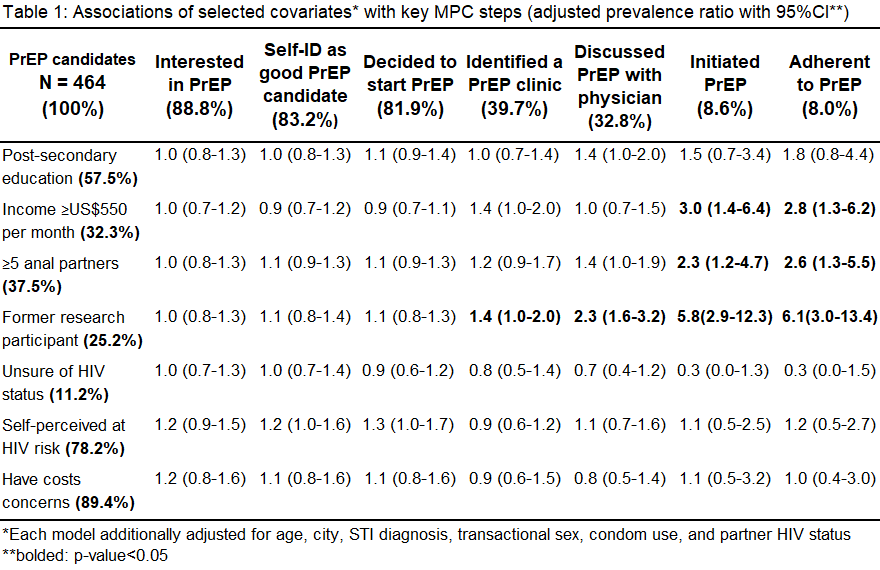
Among the 464 included respondents, median age was 29yo (IQR: 25-35). Most respondents earned <US$550 /month, lived in Lima/Callao, had post-secondary education, and <5 anal sex partners. Most respondents were aware of PrEP (92.0%) but were less aware of existing PrEP access mechanisms (51.1%). There was a steep drop in the MPC from deciding to start PrEP (81.9%) to identifying a PrEP Clinic (39.7%), and from discussing PrEP with a physician (32.8%) to PrEP start (8.6%). Table 1 describes respondent's distribution along the MPC steps and associations with significant covariates, with income, number of sex partners and participation in research as significant covariates. Also, most respondents owned a smartphone (97.8%) and wanted to receive information about PrEP (82.9%), PrEP access mechanisms (84.3%), and PrEP adherence reminders (79.1%) on their smartphones. Respondents were interested in bidirectional communication about PrEP via Whatsapp (87.7%), a customized mobile app (81.2%), phone calls (67.0%), SMS (62.7%), or social media (54.1%).
Conclusions:
Peruvian MSM who completed a PrEP survey when the NPP began showed great interest in PrEP, self-identified as good PrEP candidates, and/or decided to start PrEP. However, most MSM struggled to progress to later MPC steps, highlighting access barriers outside of research studies. The MPC could help identify subgroups with unique informational and/or skill development needs, which can be used in the design of tailored mHealth interventions supporting the NPP implementation in Peru.