Violence is prevalent against women at-risk for HIV; survivors are at increased behavioral risk for HIV, while survivorship is linked to higher HIV susceptibility, via dysregulation of the hypothalamic-pituitary-adrenal (HPA) axis and female genital tract (FGT) microenvironment after physical or psychological trauma. Pre-exposure prophylaxis (PrEP) for HIV can mitigate this risk, but adherence remains challenging. We report findings on the impact of violence on PrEP adherence among at-risk cisgender women taking oral PrEP (daily tenofovir disoproxil fumarate/emtricitabine).
Adherence Enhancement Guided by Individualized Texting and Drug Levels (AEGiS) was an open-label clinical trial of PrEP adherence in cisgender women ?18 years old at-risk for HIV in Southern California. Adherence was supported by two-way text messaging and counseling based on tenofovir diphosphate (TFV-DP) concentrations in dried blood spots. Participants completed a survey inclusive of violence history at weeks 0, 4, 12, 24, 36, and 48. TFV-DP concentrations consistent with ?4 doses/week were considered to be ‘high adherence.’ Logistic regressions were used to assess odds of adherence.
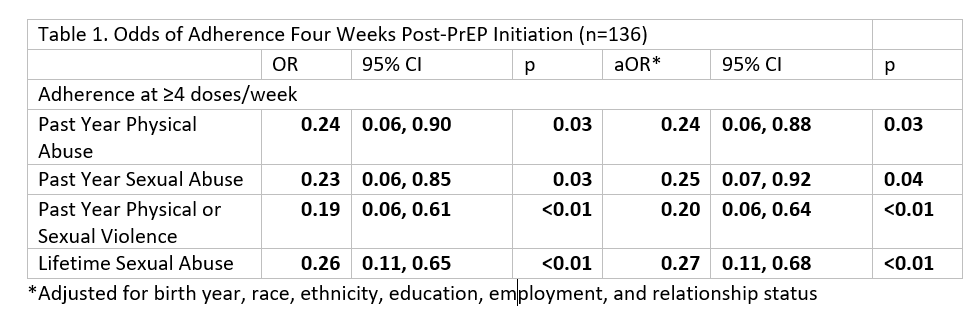
Of 136 participants, 38% were non-Hispanic Black, and 19% identified as Latina; mean age was 40 (SD:11). 22% (n=29) reported past year violence; 16% (n=21) reported physical and 15% (n=20) sexual violence. Sexual violence over lifetime was reported by 30% (n=39). Odds of high adherence at four weeks post-PrEP initiation are presented in Table 1; 50, or 43%, of participants with available data were highly adherent at week 4. Odds of high adherence were lower among women with past year physical violence by 76% (aOR: 0.24, p=0.03), past year sexual violence by 75% (aOR: 0.25, p=0.04) and past year sexual or physical violence by 80% (aOR: 0.20, p<0.01), compared to non-exposed women. Participants with lifetime sexual violence had 73% lower odds of high adherence than those without (aOR: 0.27, p<0.01).
Cisgender women with experiences of violence have lower odds of having TFV-DP concentrations reflective of high or near-perfect adherence one-month post-initiation, compared to women not reporting violence. Providing support through comprehensive trauma services may improve both adherence and immune functioning. Given the prevalence of violence among women at-risk for HIV, PrEP programs should emphasize trauma screening and care in service delivery.