Background:
In South Africa, the HIV care cascade remains suboptimal among men. In a 2×2 factorial cluster randomized controlled trial, “Home-Based Intervention to Test and Start” (HITS), we previously demonstrated the effectiveness of small conditional financial incentives (CFI) on home-based HIV testing uptake and the moderate effect of CFI or a gender-sensitised HIV-specific decision-support app (EPIC-HIV) on early linkage to care (< 6 weeks). Leveraging 20 years of on-going HIV surveillance program in the trial area, we aim to assess the impact of HITS interventions on the HIV care cascade.
Methods:
In 2018, in uMkhanyakude district of KwaZulu-Natal, 45 communities were randomly assigned to one of four arms: (i) CFI for home-based HIV testing and linkage to care within 6 weeks (R50 [$3] food voucher each); (ii) EPIC-HIV which is based on self-determination theory; (iii) both CFI and EPIC-HIV; and (iv) standard of care. EPIC-HIV was individually offered to men via a tablet at the point of HIV test offer or 1 month after home-based HIV testing if individuals who tested positive had not linked to care. Linking HITS trial data to national ART programme data and HIV surveillance program data, we estimated HIV status awareness, ART status 3 month after HITS and viral load suppression one year later. Analysis included all known HIV positive individuals in the study area including those who did not participated in the HITS trial
Results:
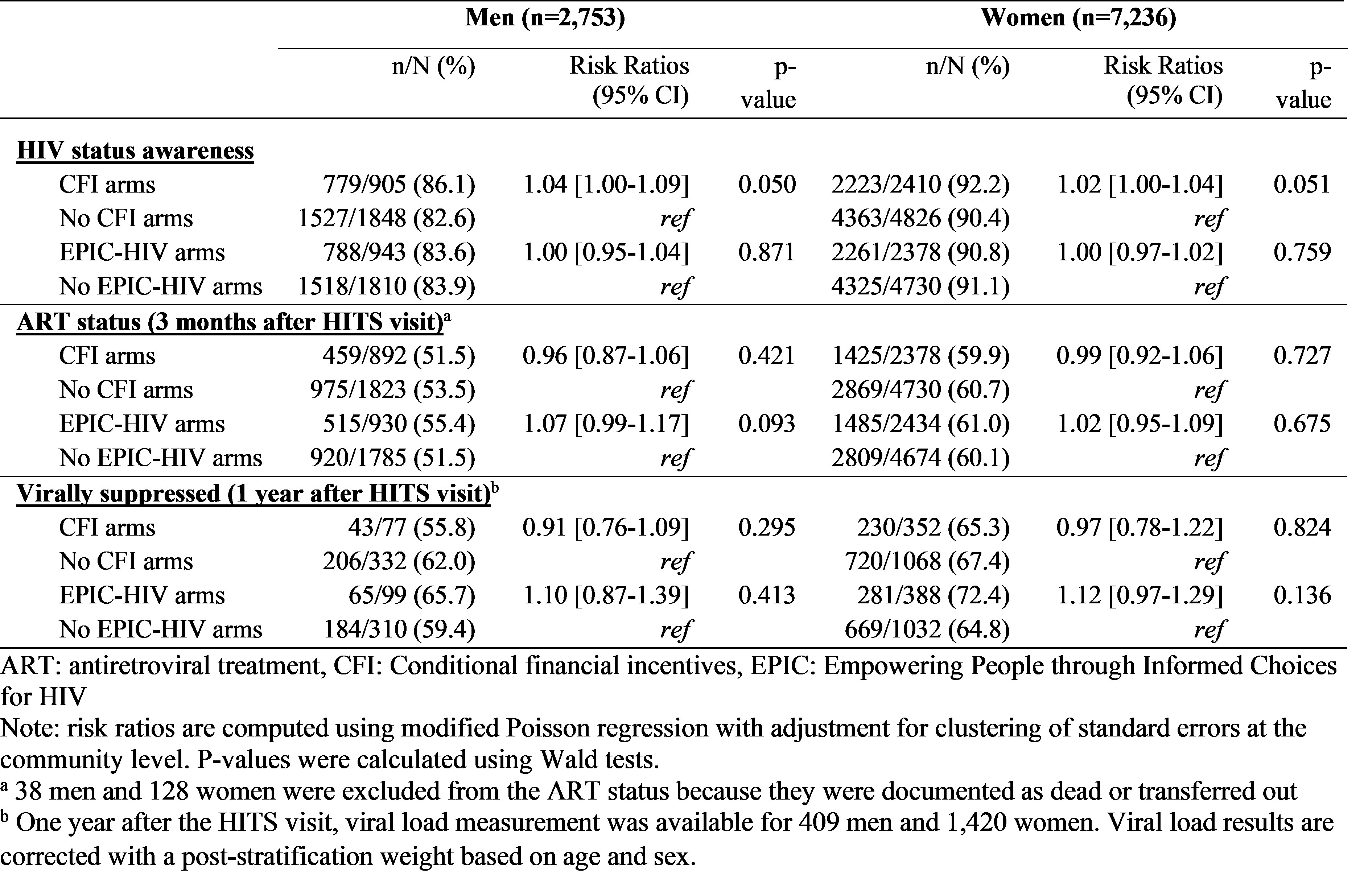
On the 33,776 residents in the surveillance area, 2,753 men and 7,236 women were documented as HIV positive. No significant difference was found for HIV awareness, linkage to ART and viral suppression between arms at baseline. Compared to control arms, individuals aware of HIV-positive status were more in CFI arms among men (86.1% vs 82.6%, RR 1.04 [1.00-1.09], p=0.05) and women (92.2% vs 90.4%, RR 1.02 [1.00-1.04], p=0.05) but not in the EPIC-HIV arms (table 1). Three months after the intervention, no differences were found for linkage to ART between arms. On the 3,150 and 1,829 viral load measurements available in 2018 and 2019 respectively, viral load suppression increased but not significantly among both men (60.2% vs 57.4%, p=0.45) and women (67.4% vs 66.4%, p=0.64) with similar increase between arms.
Conclusions:
Small CFIs were associated with a reduction in the proportion of HIV-infected people unaware of their result in the surveillance area. However, neither CFIs nor EPIC-HIV were sufficient to increase linkage to ART and viral suppression at a community level.
Table 1. Factorial analysis of risk factors for HIV status awareness, linkage to ART and viral suppression following HITS visit among HIV positive men and women, 2018-2019 (n=9,989).