Background:
Medicaid serves as the largest single source of insurance for people with HIV (PWH) in the US, with approximately 40% of PWH covered by Medicaid. Not only does Medicaid represent a large, diverse population of PWH in US, it also represents some of the most vulnerable PWH, since eligibility is based on low income or disability. While the HIV care cascade is well characterized among all PWH in the US and among those linked to HIV care clinics, less is known about the state of the care cascade among PWH on Medicaid or how the cascade has changed over time.
Methods:
We analyzed data from 273,799 Medicaid beneficiaries with HIV, enrolled in 14 US states, 2001-2015. All beneficiaries identified as having HIV through claims records are aware of their diagnosis and linked to care; thus, we focused on the later steps of the care cascade. We estimated prevalence of 4 levels of the HIV care cascade: retained in care and adherent to ART; retained but not on ART; not retained but on ART; not retained and not on ART. Beneficiaries were considered retained in care if they had an office visit, viral load measurement, or CD4 cell count every 6 months. Adherence to ART in each month of follow-up was defined as having a medication possession ratio of at least 80%. Prevalence of each state in each month 2001-2015 was estimated using a non-parametric multi-state approach, accounting for death as a competing event and for loss of Medicaid coverage using inverse probability of censoring weights. Analyses were conducted overall and by US state.
Results:
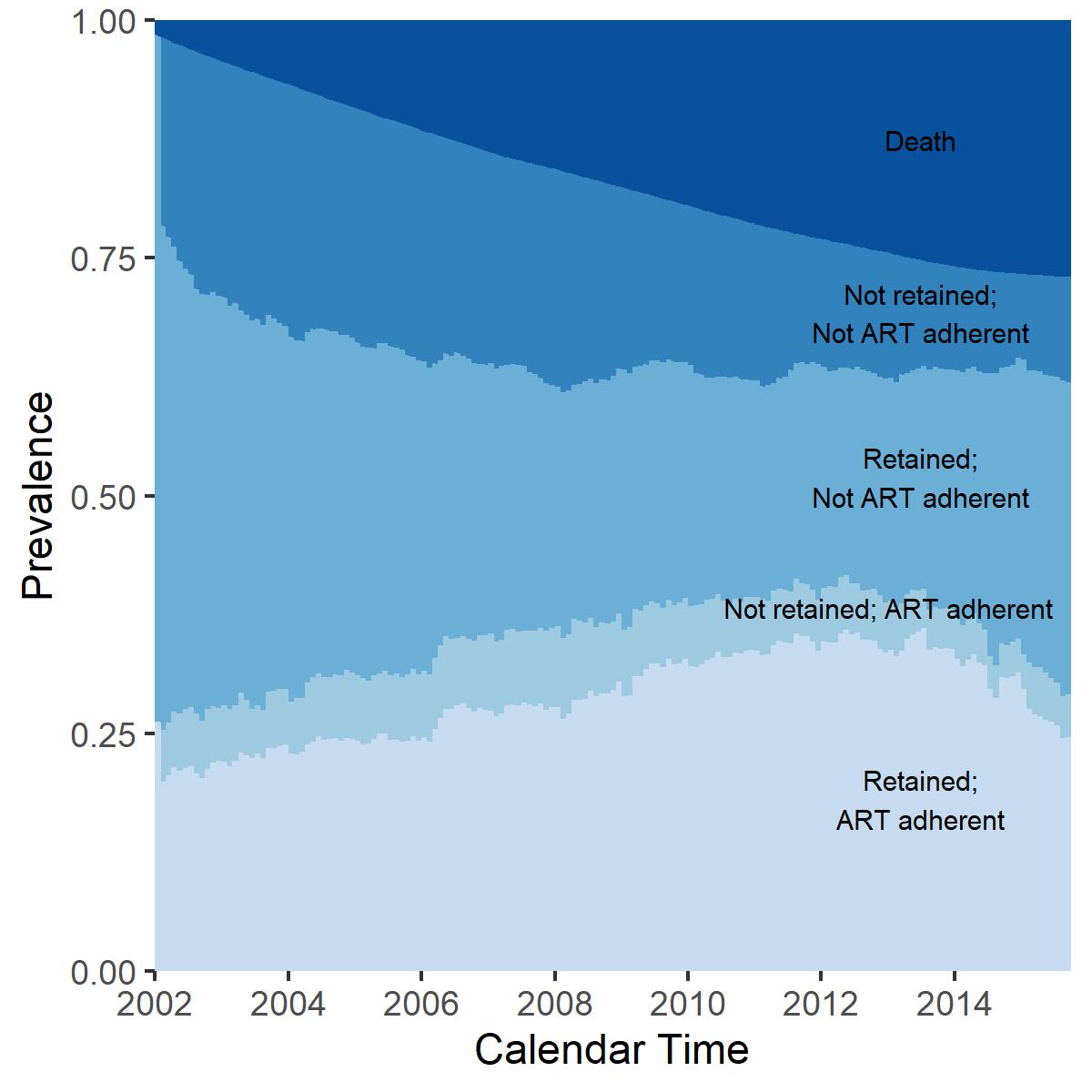
As shown in the Figure, 20% of beneficiaries with HIV were retained and ART adherent in 2001; this proportion reached a peak of 36% in 2013. The proportion not retained in care but ART adherent did not meaningfully change across follow-up (5-8%). In contrast, the proportion retained in care but not ART adherent decreased from 53% to 32%, and the proportion not retained in care and not ART adherent decreased from 20% to 13%. Death remained an important competing event in this era, with a cumulative incidence of 27% by 2015. Results differed by US state.
Conclusions:
Despite being linked to care, less than half of beneficiaries with HIV were classified as ART adherent across all of follow-up, likely indicating that many Medicaid beneficiaries with HIV were not virally suppressed during this time period. These findings were seen even in the post-2012 ‘Treat All’ era. Future work will explore whether HIV care engagement improved between 2015-2021.