Background:
The role of specific immune components in maintaining host-microbial homeostasis remains poorly defined. People with HIV (PWH) and Idiopathic CD4 Lymphocytopenia (ICL) patients exhibit low CD4 T cells in distinct clinical contexts providing a unique opportunity to decipher the role of helper CD4 T cells in skin host-microbial interactions. These patients’ increased risk of comorbidities includes opportunistic fungal, mycobacterial and viral infections, neoplastic, and autoimmune or inflammatory skin disorders. We hypothesized ICL and PWH have prominent skin microbiome shifts, related to immune dysfunction and clinical cormobidities.
Methods:
Skin microbiome topographical diversity (shotgun metagenomics) was analyzed in PWH, ICL and healthy controls (HCs).
Results:
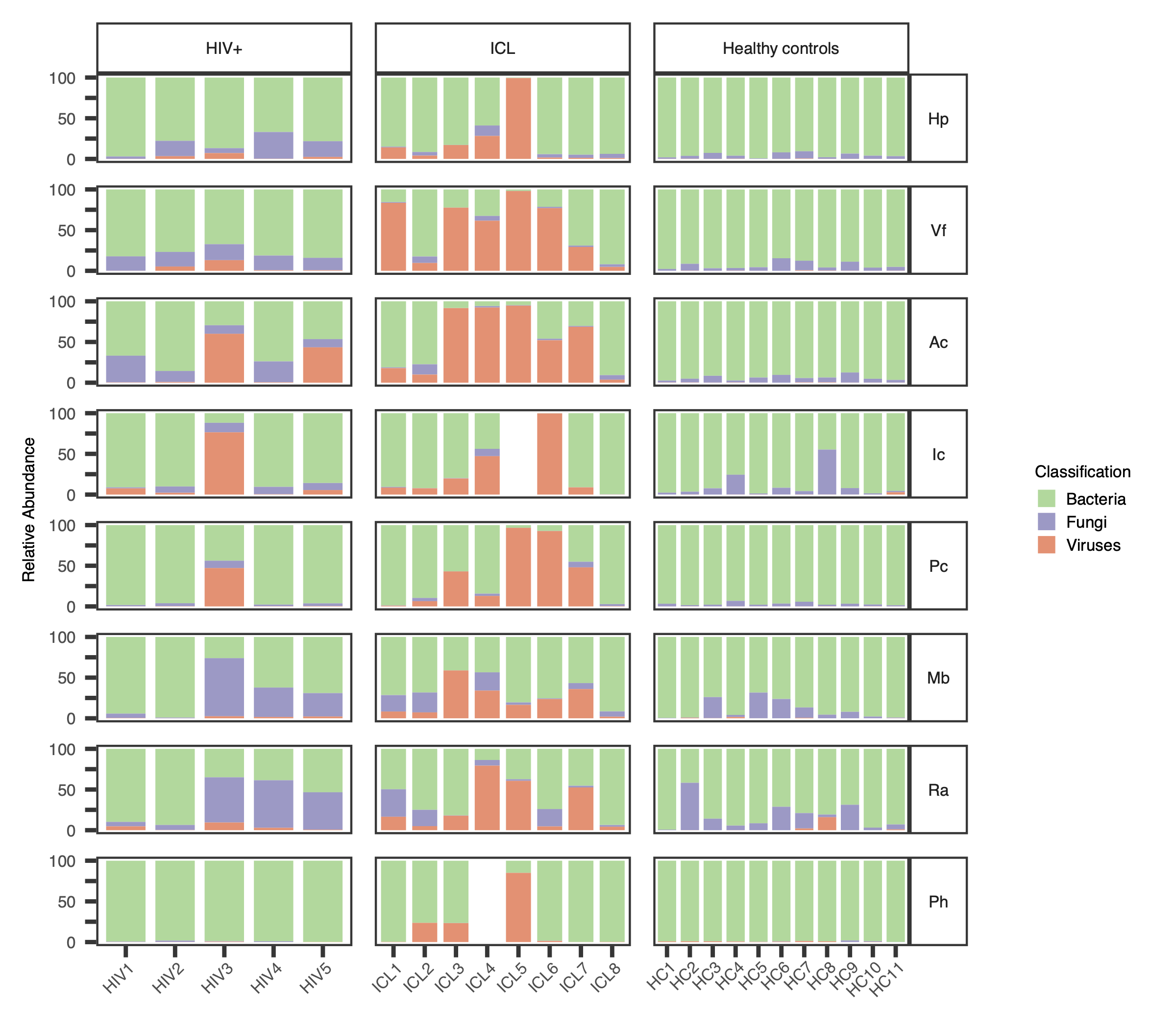
We collected skin samples from PWH naïve to any antiretroviral therapy (ART) (PWH-naïve, n=5, median CD4 48cells/mL, median plasma (p)HIV RNA=361206 copies/mL), ICL (n=8, median CD4 65cells/mL), and HC. PWH samples 2 (n=5) and 15 mos (n=4) after ART initiation were collected. HCs typically demonstrated shared microbiome features; PWH and ICL exhibited greater inter-individual heterogeneity in their microbiomes, consistent with prior studies in immunodeficiencies. As hypothesized, PWH and ICL had notable skin microbiome shifts: PWH-naïve had higher fungal relative abundances, and ICL exhibited higher DNA viral relative abundances. Mean fungal relative abundances of inner forearm were significantly higher on PWH-naïve than on ICL (18% and 3%, respectively; p=0.00002) and HCs (7%; p=0.00009), while mean relative abundances of viruses on PWH-naïve were lower than those on ICL (4% and 55%, respectively; p=0.06). Interestingly, PWH-naïve and HCs across all sites had significantly different microbiomes, compared to PWH on ART (n=4, median CD4 338cells /mL, median time on ART=15 mos, pHIV RNA < 40 copies/mL) and HCs (mean Bray-Curtis distances 0.52 and 0.39, respectively; p=0.0004).
Conclusions:
Our data suggest that CD4 T cell lymphopenia may differentially affect skin microbiomes and consequent clinical manifestations based on underlying immune deficiency. ART plays a pivotal role in shifting PWH skin microbiomes towards HCs. Studying human skin microbiomes in such contexts can provide insights into susceptibility to microbial diseases (i.e. viral vs fungal) as well as the interactions between the skin microbiome and host immune deficiency and reconstitution.
Skin microbiomes of HIV, ICL, and healthy controls