Background:
The development of HIV cure strategies depends on our capacity to predict HIV control when antiretroviral therapy (ART) is stopped. Motivated by the recent expansion of noninvasive cell-free DNA (cfDNA)-based cancer diagnostics, we performed multi-dimensional profiling of plasma cfDNA obtained from individuals who maintain HIV suppression following ART cessation termed post-treatment controllers (PTCs), to identify quantitative, genetic, and epigenetic signatures of PTC status.
Methods:
cfDNA was extracted from 1 ml of plasma collected prior to ART cessation from 20 PTCs (HIV RNA maintained at < 400 copies/ml for >24 weeks post-ART) and 20 non-controllers (NCs) enrolled in ACTG treatment interruption studies, and from 20 uninfected individuals enrolled in the SCOPE cohort. Plasma cfDNA was quantified using the Qubit fluorometer, and whole genome bisulfite sequencing (WGBS) was performed using the IDT Xgen Methyl-Seq kit and the Illumina NovaSeq platform. BSMap, BSBolt, and Metilene software tools were used for sequence alignment, methylation calls, and identification of differentially methylated regions (DMRs), respectively. Statistical analyses and data visualization were performed using the R computing environment.
Results:
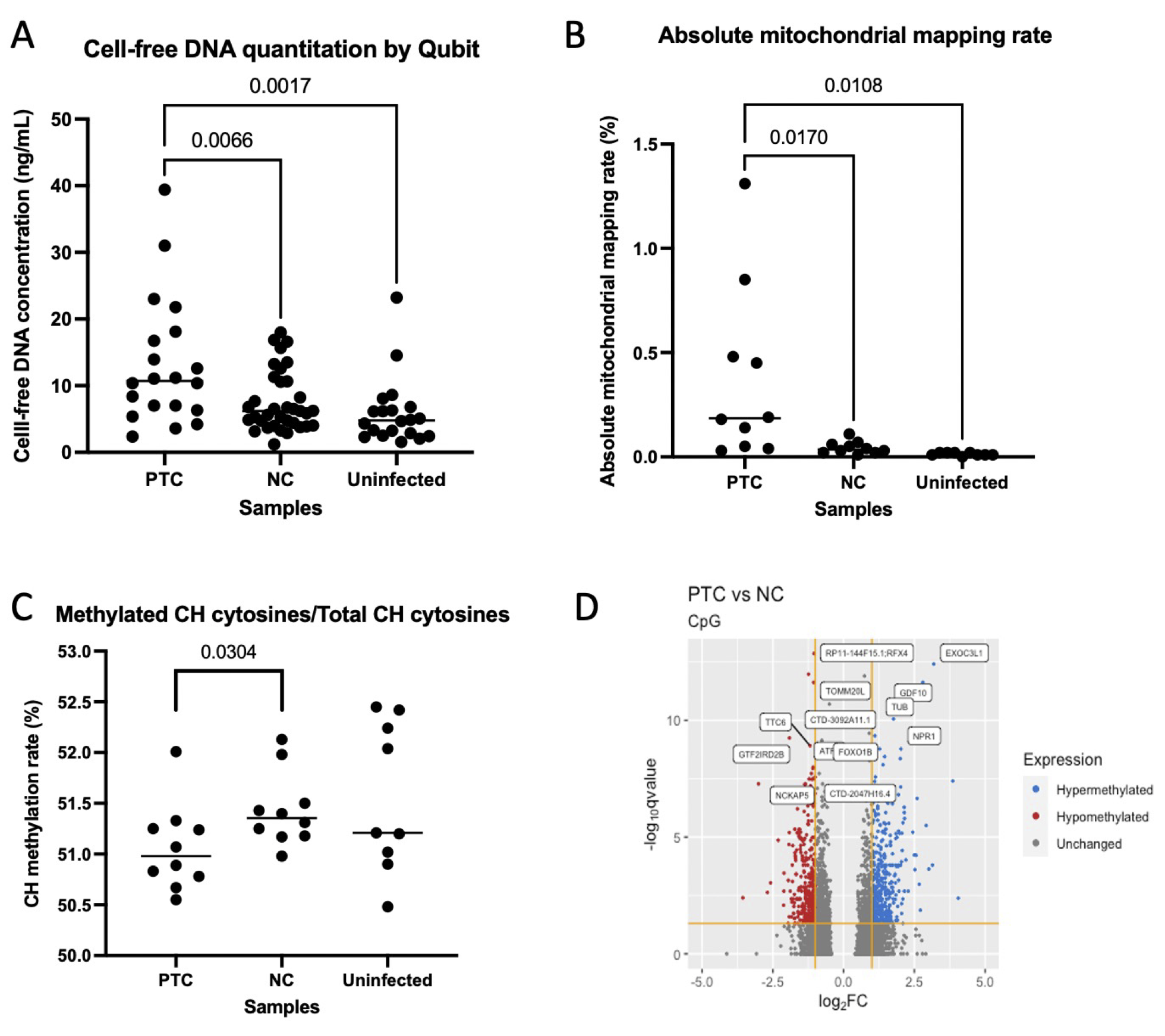
PTCs exhibited elevated levels of plasma cell-free DNA as compared to NCs (p=0.007, Mann-Whitney test) and uninfected individuals (p=0.002) (Fig.1A). Sequencing data revealed higher amounts of circulating mitochondrial DNA (mtDNA) in PTCs as compared to NCs (p=0.017) and uninfected individuals (p=0.011) (Fig.1B). WGBS data demonstrated that PTCs had significantly lower genome-wide cytosine methylation rates as compared to NCs (p=0.03) (Fig.1C). 503 genes (DMRs) were hypermethylated and 397 genes were hypomethylated at CpG sites in PTCs as compared to NCs (using FDR q< 0.05 and log2 fold change >1 cutoff) (Fig.1D).
Conclusions:
Elevated circulating levels of cfDNA and mtDNA during ART are predictors of HIV post-treatment control. Reduced genome-wide methylation and an abundance of cfDNA DMRs distinguishing PTCs from NCs further demonstrate the prognostic potential of cfDNA as a predictive biomarker of natural HIV control following ART cessation. Elevated levels of circulating hypomethylated DNA may reflect the death of infected cells, and may promote innate immune control of HIV via interactions with innate DNA sensors including TLR-9. Our data warrant continued investigation into cfDNA as a marker and modulator of HIV persistence and controlin vivo.
Figure 1. Plasma cell-free DNA-based signatures of HIV post-treatment control.