There are few data on how tenofovir diphosphate (TFV-DP) in dried blood spots (DBS) predicts future viral load (VL) in people living with HIV on antiretroviral therapy (ART).
We conducted a nested case-control study within a trial of differentiated care for postpartum ART (NCT03200054). Women were >18 years, started ART (TDF+3TC+EFV) in pregnancy and were enrolled <10w postpartum with a recent VL<400 cps/mL. Samples for VL and TFV-DP assays were taken 3-6 monthly over 24m. Cases were women with >1 VL>20 cps/mL and controls were a random sample of women with persistent viral suppression (VS; VL<20cps/mL). We analysed how absolute TFV-DP levels during VS predicted subsequent risk of VS; results are expressed as sensitivity (SE), specificity (SP) and test likelihood odds ratios (LORs). We also compared fluctuations in TFV-DP levels in cases (prior to elevated VL) and controls.
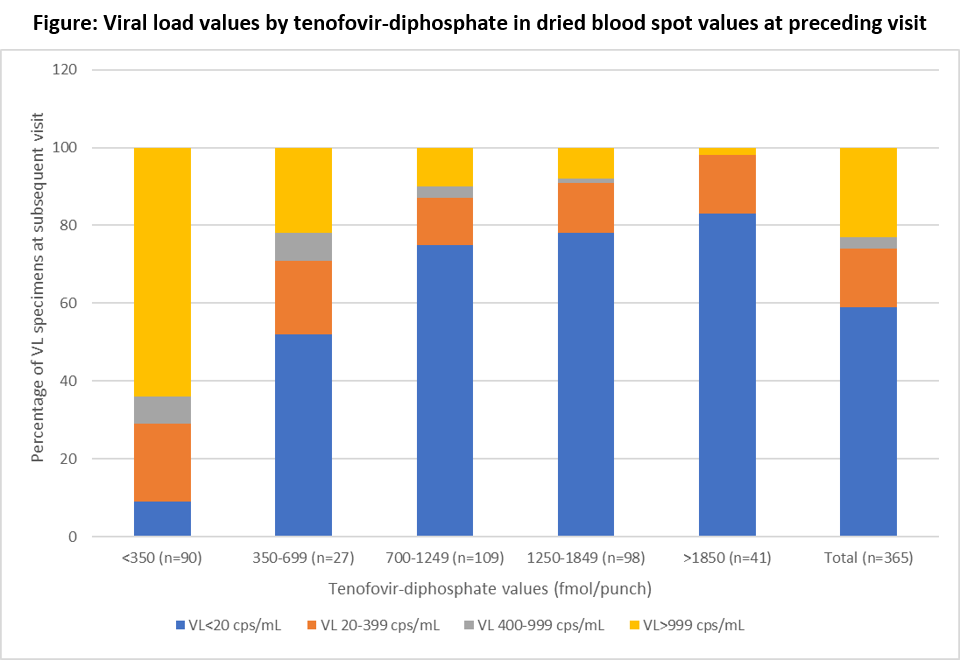
Overall 81 women and 365 visits were included (median age: 29y, median time on ART: 6m; median time postpartum: 19d). The median duration between each TFV-DP and VL measure was 175d (IQR: 92–184). TFV-DP levels measured during VS were associated with risk of viraemia 3-6m later in a dose-response manner: 17% of women with TFV-DP >1850 fmol/punch had a VL>20 cps/mL at the next visit, compared to 23%, 25%, 48% and 91% of women with TFV-DP levels 1250-1849, 700-1249, 350-699 and <350 fmol/punch, respectively (Figure). Variance in TFV-DP levels during VS was significantly higher in cases vs controls (p<0.05). SE of TDF-DP >350 to predict VS at the next visit was 96% (95% CI: 93-98) and did not vary by time between measures or preceding VL values. SP of TDF-DP >350 fmol/punch to predict VS at the next visit was 54% (95% CI: 46-62) and was lower if the DBS was done <120 days before the next VL (36%, 95% CI 21-53). Adjusting for age, ART duration and time between TFV-DP and next VL measure, the LORs of VL>20 cps/mL for TDF-DP levels 1250-1849, 700-1249, 350-699 and <350 fmol/punch compared to TDF-DP>1850 fmol/punch were 1.3 (95% CI, 0.6–3.2), 1.6 (95% CI, 0.7-3.3), 3.6 (95% CI, 1.3-10.0) and 28.8 (95% CI, 9.7-85.6) respectively; the associations persisted using alternate outcome definitions (VL>400 and >1000 cps/mL).
In postpartum women, TFV-DP levels during VS predict viraemia 3-6m later, indicating the potential value of objective adherence markers in high-risk populations.