Background:
Blood telomere length (BTL) attrition is a surrogate biomarker of immunosenescence and aging associated with HIV infection. BTL recovers in long-term virologically suppressed PWH, but it is unknown if recovery is complete compared with persons without HIV
Methods:
Prospective 6-year observational study assessing the evolution of BTL in virologically suppressed PWH and a cross-sectional analysis comparing BTL with age and sex-matched blood donors, and sex matched persons older than 60 from a general population cohort. Relative BTL was determined by monochrome quantitative multiplex PCR assay and expressed as the ratio of telomere to single-copy gene (T/S)
Results:
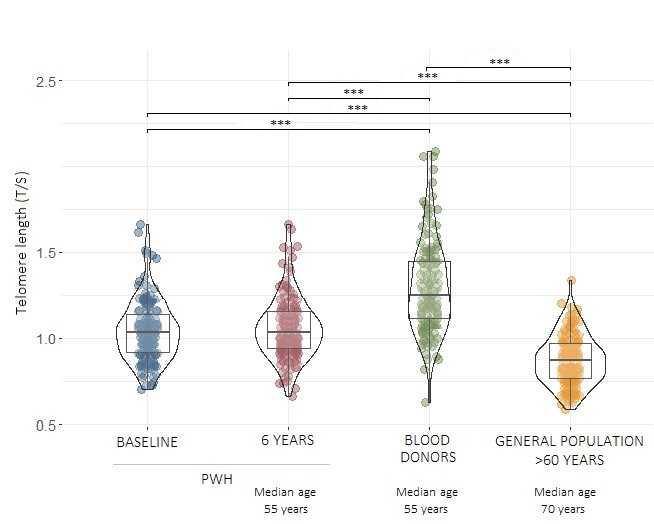
We included 135 PWH, 135 blood donors, and 135 persons over 60. Median age was 55 (IQR: 51-60), 55 (IQR: 51-60), and 70 (IQR: 68-73) years, respectively. 29.6 % were women in each group. In the PWH group 43.7% and 34.8% were active/former smokers, 5.9% had hazardous alcohol consumption, 28.9% had ever been injected drugs users, 92.6% were Caucasian, 33.3% resolved hepatitis C virus infection, 91.1% positive CMV IgG and 70.4% with ≥ 1 comorbidity. At 6 years of follow-up, the median time with known HIV-1 infection and virological suppression was 23.1 (IQR: 18.4-27.6) and 13.4 (IQR: 12.5-14.0) years, respectively. Nadir/current median CD4 count were 180 (IQR: 71.5-258) and 780 (IQR: 535-1000) cells/μL, and the median CD4/CD8 ratio was 1.12 (IQR: 0.79-1.40). In the ederly population 9.6%, 45.2% and 45.2% were active, former and never smokers, respectively. BTL of PWH remained stable after 6 years of virological suppression (median BTL at baseline 1.03 [IQR: 0.92-1.14] vs. 1.03 [IQR:0.94-1.15] after 6 years [p=NS]), without reaching the median BTL of blood donors of the same age and sex (1.25 [IQR: 1.11-1.45]; p < 0.001), but significantly above the median BTL of the older than 60 general population group (0.87 [IQR: 0.77-0.97]; p < 0.001) (Figure 1). 33 (24.4%) of PWH had BTL that was within ± 10% of the BTL of his/her age/sex matched blood donor. 27 (26.5%) of PWH < 60 had BTL that was within the ± 10% of the median BTL of the gender matched ≥ 60 participants from the general population
Conclusions:
During the 6 years of follow-up the median BTL of aviremic PWH remained stable but still was shorter than the BTL of age/sex matched blood donors. However, compared to the elderly population our data do not support that aviremic PWH have a very pronounced BTL shortening
Blood telomere length by group. ***p < 0.001