Background:
The rapid emergence of the SARS-CoV-2 Omicron variant that evades many therapies illustrates the need for antiviral treatments with high genetic barriers to resistance. The small molecule PAV-104, identified through a moderate-throughput screen involving cell-free protein synthesis, was recently shown to target a subset of host protein assembly machinery in a manner specific to viral assembly with minimal host toxicity. The chemotype shows broad activity against respiratory viral pathogens, including Orthomyxoviridae, Paramyxoviridae, Adenoviridae, Herpesviridae, and Picornaviridae, with low susceptibility to evolutionary escape. Here, we investigated the capacity of PAV-104 to inhibit SARS-CoV-2 replication in human airway epithelial cells (AECs).
Methods:
Dose-dependent cytotoxicity of PAV-104 in Calu-3 cells was determined by MTT assay. Calu-3 cells were infected with SARS-CoV-2 isolate USA-WA1/2020 (MOI=0.01). Primary AECs were isolated from healthy donor lung transplant tissue, cultured at air liquid interface (ALI), and infected with SARS-CoV-2 Gamma, Delta, and Omicron variants (MOI=0.1). SARS-CoV-2 replication was assessed by RT-PCR quantitation of the N gene, immunofluorescence assay (IFA) of nucleocapsid (N) protein, and titration of supernatant (TCID50). Transient co-expression of four SARS-CoV-2 structural proteins (N, M, S, E) to produce virus-like particles (VLPs) was used to study the effect of PAV-104 on viral assembly. Drug resin affinity chromatography was performed to study the interaction between PAV-104 and N. Glycerol gradient sedimentation was used to assess N oligomerization. Total RNA-seq and the REACTOME database were used to evaluate PAV-104 effects on the host transcriptome.
Results:
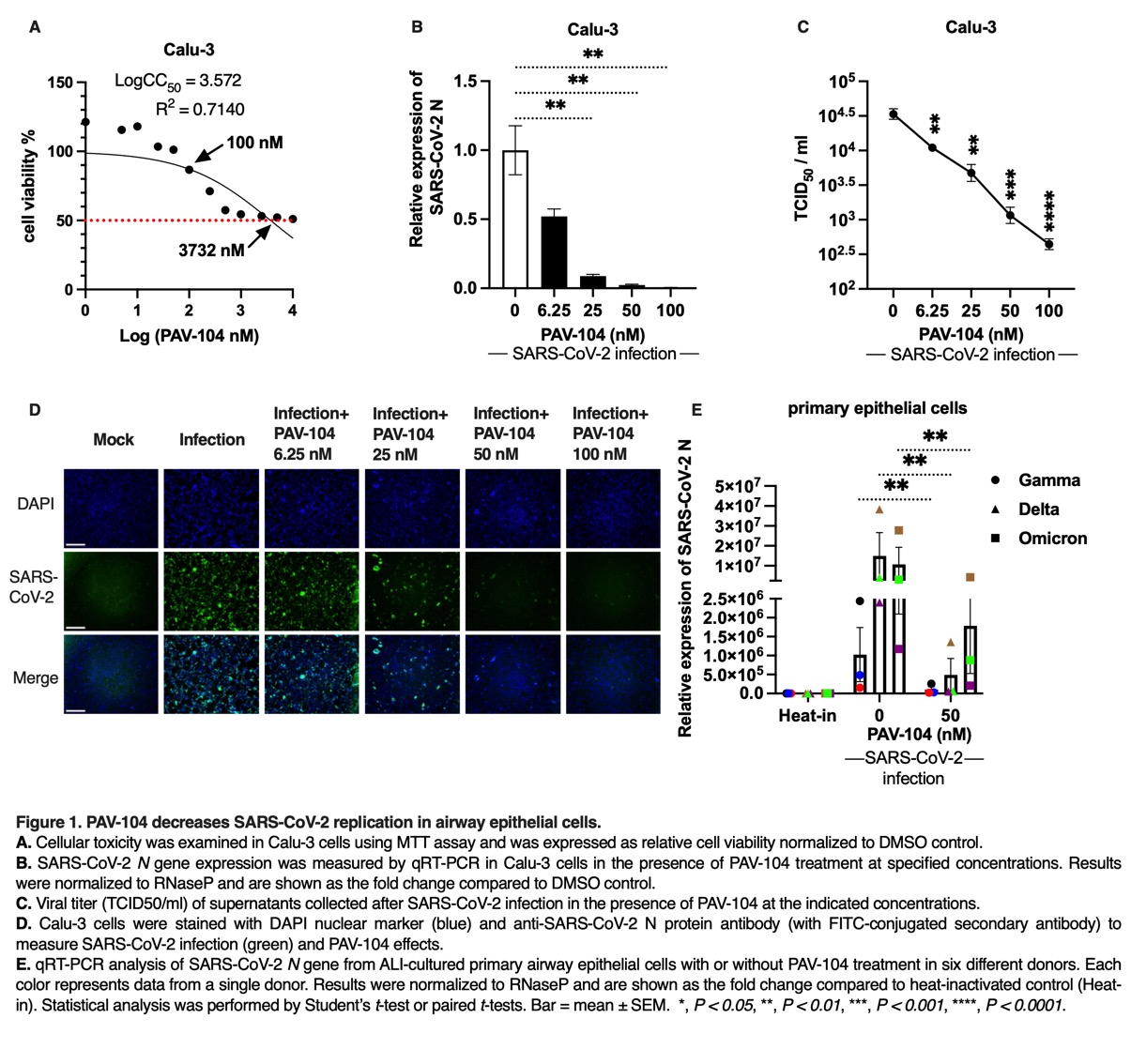
PAV-104 reached 50% cytotoxicity in Calu-3 cells at 3732 nM (Fig.1A). 50 nM PAV-104 inhibited >99% of SARS-CoV-2 infection in Calu-3 cells (p< 0.01) and in primary AECs (p< 0.01) (Fig.1B-E). PAV-104 specifically inhibited SARS-CoV-2 post entry, and suppressed production of SARS-CoV-2 VLPs without affecting viral protein synthesis. PAV-104 interacted with SARS-CoV-2 N and interfered with N oligomerization. Transcriptome analysis revealed that PAV-104 treatment reversed SARS-CoV-2 induction of the interferon and “maturation of nucleoprotein” signaling pathways.
Conclusions:
PAV-104 is a pan-respiratory virus small molecule inhibitor with promising activity against SARS-CoV-2 in human airway epithelial cells that should be explored in animal models and clinical studies.
Figure 1. PAV-104 decreases SARS-CoV-2 replication in airway epithelial cells.