Background:
Persons with HIV (PWH) have persistent changes in T cell subsets that can also be modified by aging, and may contribute to the high burden of comorbid conditions, including type 2 diabetes (DM), in older PWH. While studies in persons without HIV have found few associations between T cell subsets and DM or pre-DM, a recent study of US veterans with HIV found higher frequencies of effector memory and senescent CD4+ T cells associated with incident DM. Here, we examined associations of T cell subsets measured at a uniform time post-ART initiation with incident DM among PWH in the AIDS Clinical Trials Group study A5001.
Methods:
DM was defined as: 2 consecutive non-fasting glucose >200 mg/dl or fasting glucose >126 mg/dl; DM diagnosis; or oral antiglycemic or insulin use for >30 days. We used Cox proportional hazards models to evaluate associations of T cell subsets measured 1 yr post-ART with incident DM. PWH with prevalent DM (≤ 1yr post-ART) were excluded. Multivariable models included age at ART start, sex at birth (gender not available), self-reported race/ethnicity, smoking status, time-updated BMI, triglycerides, and history of hypertension. We explored effect modification by demographic and clinical factors by including interaction terms between each T cell subset and effect modifier in multivariable models.
Results:
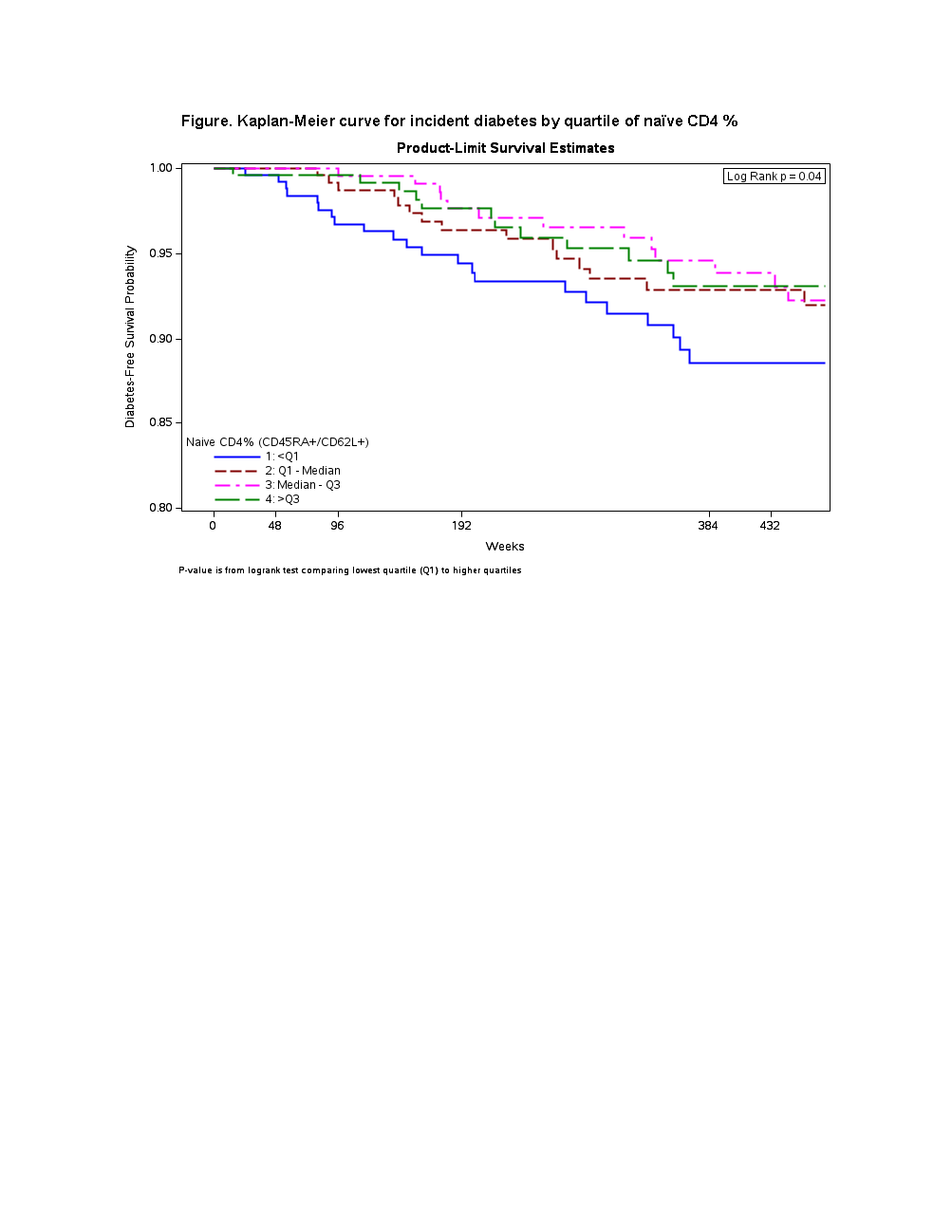
1015 PWH had ≥1 subset (% activated CD4 or CD8 [HLA-DR+/CD38+], % senescent CD4 or CD8 [CD28-], % memory CD4 [CD45RA-/CD45RO+], % naïve CD4 [CD45RA+/CD62L+]) measured 1yr post-ART. Most (82%) participants were male; 48% White non-Hispanic, 31% Black non-Hispanic, and 21% Hispanic/other ethnicity. Median age was 36 years (Q1,Q3=31,43). There were 62 DM events. PWH with DM were older, had higher triglycerides, higher BMI, and were more likely to have hypertension or low CD4/CD8 ratio than those without DM. PWH in the lowest quartile of % naive CD4 cells had a higher incidence of DM than those in higher quartiles (Figure). The association for lowest vs higher quartiles (combined) was observed in PWH <45 years (aHR=2.08 95% CI=1.00,4.34) but not ≥45 years (aHR=1.17, 95% CI= 0.44,3.11), though the interaction by age was not significant (p=0.32). There were no associations with other T cell subsets and DM.
Conclusions:
A lower proportion of naïve CD4+ T cells, potentially reflective of reduced naïve cell replenishment or increased memory cell inflation, may be associated with increased diabetes incidence in PWH, particularly among younger persons.