Background:
Patients on second-line boosted PI-based regimens in resource-limited settings have high rates of NRTI resistance, but this information is unknown in routine clinical care. This study compared continuing boosted PI + NRTIs vs bictegravir/tenofovir alafenamide/emtricitabine (B/F/TAF) in PWH on second-line ART with no prior drug resistance testing.
Methods:
This prospective, open-label trial conducted at GHESKIO in Port-au-Prince, Haiti, randomized adults (≥18 years) with viral suppression on second-line PI/r-based ART to continue their current regimen vs. switch to B/F/TAF. The primary endpoint was the proportion of participants with HIV-1 RNA ≥200 copies/mL at week 48 using the FDA snapshot algorithm, the difference between groups was assessed with a non-inferiority margin of 4%.
Results:
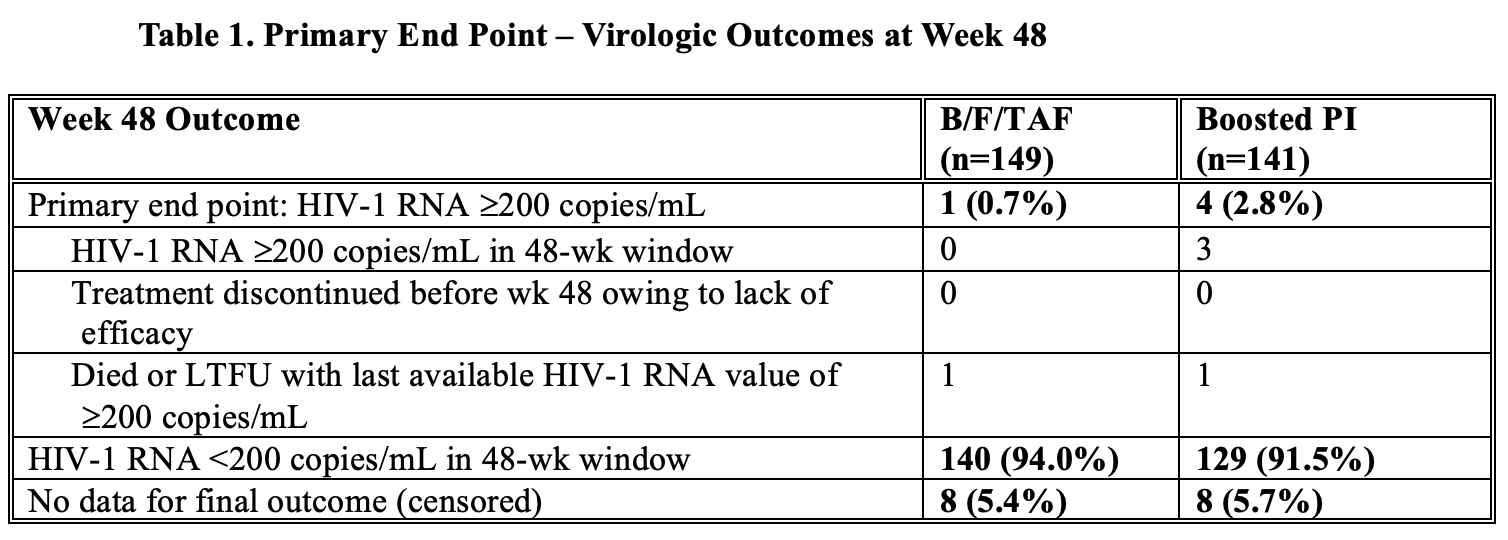
Between October 2020 and March 2023, 290 participants were randomized and treated (B/F/TAF: 149; bPI: 141). Median age was 50 years (IQR 42, 58) and 165 (57%) were women. At enrollment, 175 (60%) were taking lopinavir/r and 115 (40%) atazanavir/r; 226 (78%) were taking tenofovir disoproxil fumarate, 51 (18%) zidovudine, and 13 (4%) abacavir; all were taking lamivudine or emtricitabine. The median time on PI/r was 3.7 years (IQR 2.2, 5.7) years. At week 48, the proportion with HIV-1 RNA ≥200 copies/mL was 0.7% (1/149) and 2.8% (4/141) in the B/F/TAF and PI/r groups, respectively: difference -2.1 (95% CI: -6.7 to 1.2), meeting non-inferiority for B/F/TAF compared to PI/r (Table 1). 140 (94.0%) and 129 (91.5%), respectively had 48-week HIV-1 RNA <200 copies/mL. Eight in each group were censored – all had HIV-1 RNA <200 copies/mL at latest test (B/F/TAF: 4 completed study with no 48-week viral load; 1 died; 3 lost or left country; PI/r: 2 completed study with no 48-week viral load; 1 stopped study due to pregnancy; 2 died; 3 were lost or left country). There were no study drug discontinuations due to adverse events in either group. Baseline archived proviral DNA (B/F/TAF group) and genotypic resistance testing for virologic failures (both groups) are pending. This study was conducted during both COVID-19 and severe civil unrest and gang-related violence in Haiti. Follow-up was enabled by community health workers and neighborhood drug distribution when travel in Port-au-Prince was not safe or not possible for participants.
Conclusions:
Switching virally suppressed adults on a second-line PI/r regimen to B/F/TAF is non-inferior to continuing PI/r-based ART. Rates of viral suppression were high in both groups.