Background:
The characterization of response to direct antiviral agents for rare or novel HCV subtypes is important for global elimination strategies. Genotypes (GT) 1, 2, 3, 4 and 6 are comprised of multiple subtypes and display a high degree of genetic variability. Here, we describe the identification of novel GT-4 subtypes and a GT-7 HCV isolate distinct from 7a and 7b and their sustained virologic response (SVR) outcomes.
Methods:
ACTG study A5360 [MINMON] was a phase 4 open-label study of minimal monitoring with 12 weeks of sofosbuvir/velpatasvir for treatment-naive HCV infection. Four hundred participants were enrolled across 38 sites in Brazil (n=131), South Africa (n=12), Thailand (n=110), Uganda (n=15) and the USA (n=132). Amplicon-based deep sequencing analyses of NS3, NS5A and/or NS5B were conducted for all baseline samples. HCV full genome using random primer Nugen amplification followed by Illumina MiSeq sequencing was performed on plasma samples which failed standard amplification. Nucleotide Blast analysis followed by phylogenetic analyses was used to confirm HCV subtype.
Results:
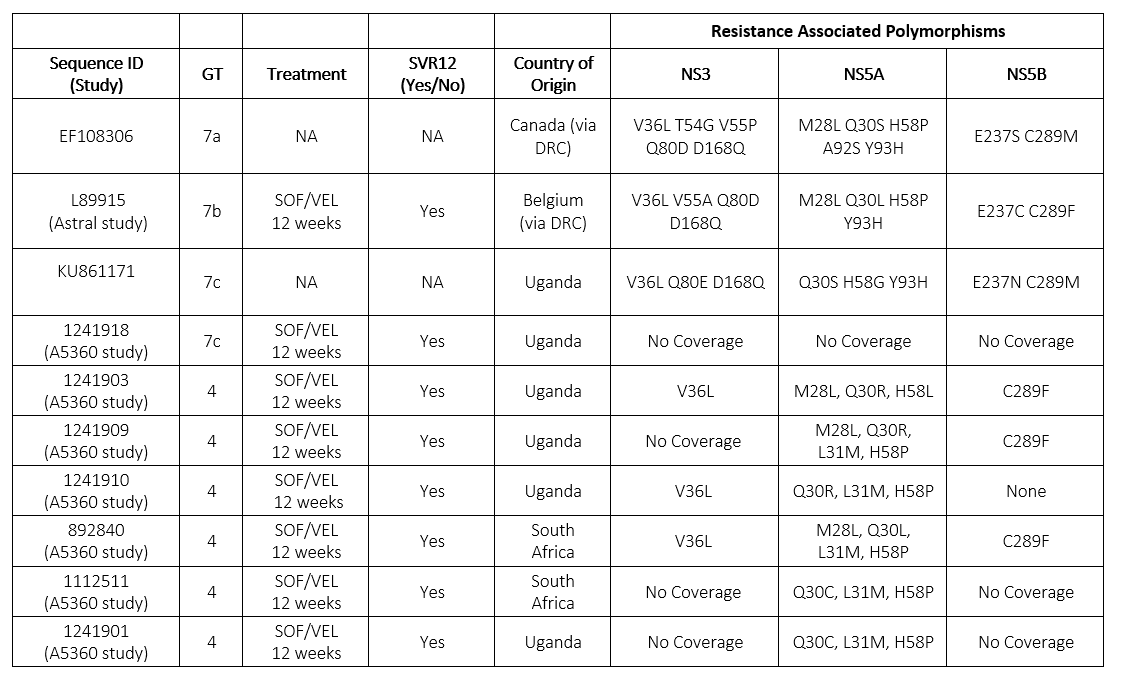
In MINMON study, SVR12 was achieved in 96% (379/399) of participants treatment. For most participants enrolled, a specific HCV subtype was assigned based on a close genetic relationship to previously described subtypes. However, for 1 patient from Uganda, sequences obtained from plasma HCV RNA showed < 85% sequence homology to all known HCV subtype reference strains. Blast analyses of publicly available datasets revealed close homology to a provisional GT-7c HCV isolate also originating from Uganda (KU861171). In addition, there were Nf5 patients from Uganda and South Africa with GT-4 HCV that showed < 85% amplicon homology to all known GT-4 subtypes. Presence of NS3, NS5A and NS5B resistance associated polymorphisms in GT-4 with novel subtypes and GT-7 HCV isolates are summarized in Table 1. All participants with novel subtypes of GT-4 and GT7 HCV treated with sofosbuvir/velpatasvir achieved SVR12 despite the presence of NS5A RAVs and NS5B nucleos(t)ide RAVs (100% SVR12).
Conclusions:
A new strain of HCV subtype 7c and novel subtypes of GT-4 were identified. Sofosbuvir/velpatasvir treatment for 12 weeks was efficacious against these novel strains of HCV. These findings highlight even greater genetic diversity of HCV subtypes than previously recognized. Global HCV elimination strategies need to account for a growing understanding of HCV diversity.
Table 1. NS3, NS5A and NS5B Resistance Associated Polymorphisms in novel genotype 4 subtypes and genotype 7 HCV isolates.