Background:
Cryptococcal meningitis (CM) primarily affects those with advanced HIV disease. Regardless of antiretroviral therapy status, roughly 15-20% of those diagnosed with CM die within 2 weeks even with the best available antifungal treatment. Despite advances in the management of CM with combination antifungals, there is still a poor understanding of the possible compromised immune responses contributing to this high mortality. There have been very few studies in humans, and these have tended to focus on a handful of biomarkers. In this study, for the first time, we use whole transcriptome RNA sequencing to identify the gene expression signature in blood and CSF from those who died from CM compared to those who survived.
Methods:
We performed bulk RNA-sequencing on whole blood and CSF collected from the first 200 consecutively recruited participants with HIV and CM into the AMBITION-cm trial in Botswana, Zimbabwe and Malawi. After sequencing we analysed differential gene expression and Gene Ontology pathway analysis from 99 CSF and 162 blood samples comparing those who died within 2 weeks (CSF; n = 10, Blood; n = 18) to those that survived at 2 weeks (CSF; n = 89, Blood; n = 144).
Results:
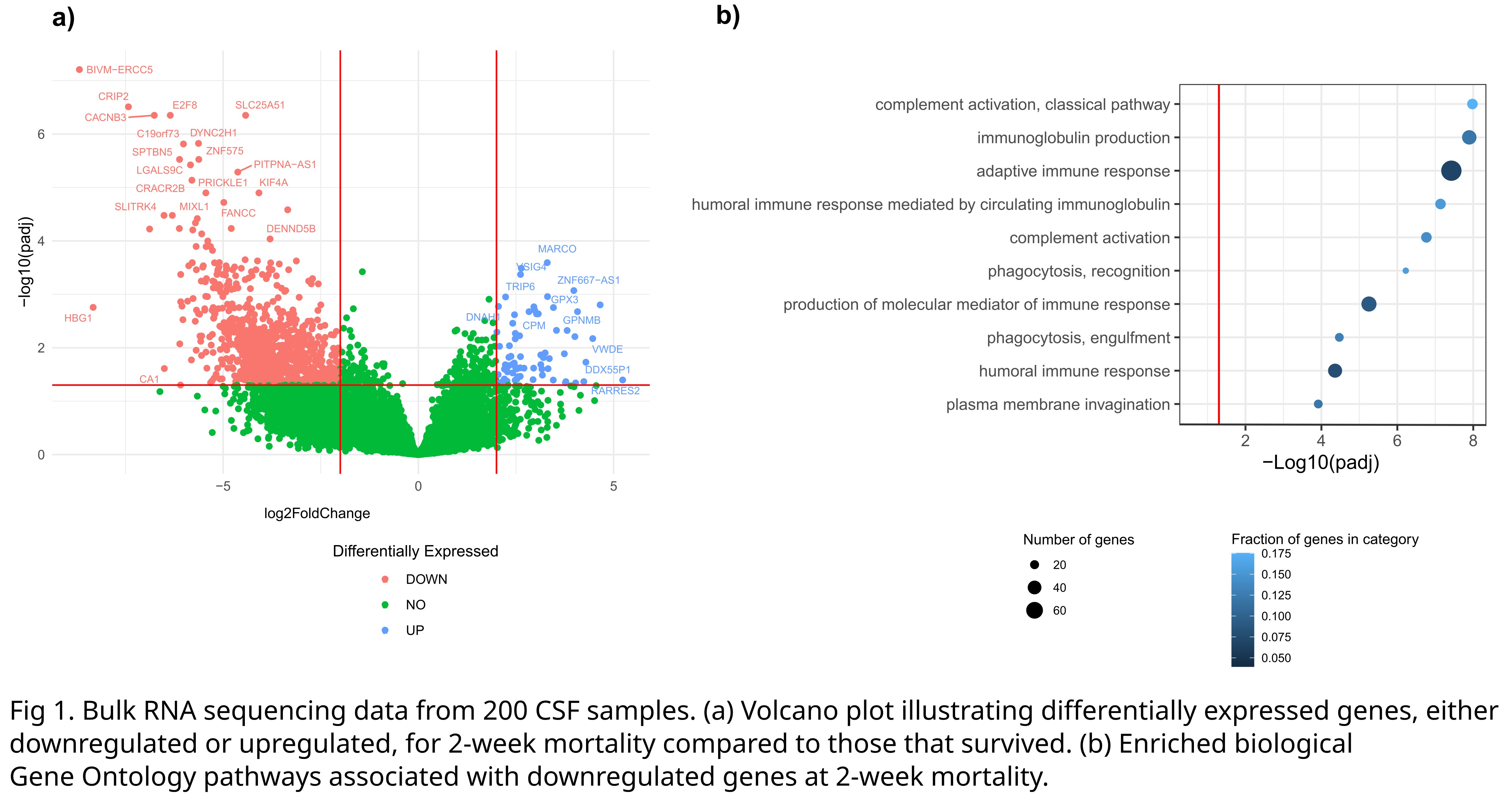
We identified a robust transcriptional signature in the CSF where 1010 genes were significantly differentially expressed when comparing survivors to the deceased (Fig 1a). The majority of these differentially expressed genes (DEGs) were downregulated in participants who died within 2 weeks. Gene ontology analysis of these downregulated genes indicated that it was suppression of pathways associated with immunoglobulin production as well as complement and B cell activation that were all significantly associated with mortality (Fig 1b). From these pathways we identified 21 DEGs responsible for immunoglobulin production and structure expressed in participants that survived and absent in those that died. Analysis of whole blood did not reveal any significant transcriptional responses.
Conclusions:
This study is the first of its kind to identify a unique CSF transcriptional signature that differentiates CM survivors from deceased. This was unique to CSF and was not seen in blood. We found an impaired adaptive immune response and diminished B cell response that is common in advanced HIV disease and that may lead to an inability to clear the fungus. This work can now be applied to develop better prognostic tests and improve targeted treatments for severe CM and other neurological infections.