Background:
Persons with HIV (PWH) are at increased risk for metabolic diseases compared with the general population, due, in part, to alterations in body fat distribution and the preferential expansion of visceral adipose tissue (VAT). While dysregulation of the subcutaneous adipose tissue (SAT) is thought to promote VAT expansion, the cellular mechanisms that link SAT health with VAT expansion in PWH remain unknown.
Methods:
We performed single-cell RNA sequencing (scRNA-seq) on SAT biopsies from individuals with long-term virologic suppression and a spectrum of metabolic fitness. Computed tomography was used to measure VAT volume, VAT attenuation, liver attenuation, pericardial adipose tissue volume, SAT volume, and SAT attenuation. We assessed the relationships between morphometric measurements and the proportions of select cell types in SAT from single-cell data, including fibroblasts, macrophages, and T cells. Statistical analysis was performed using partial Spearman’s adjusted for age, sex, body mass index (BMI), and diabetes status.
Results:
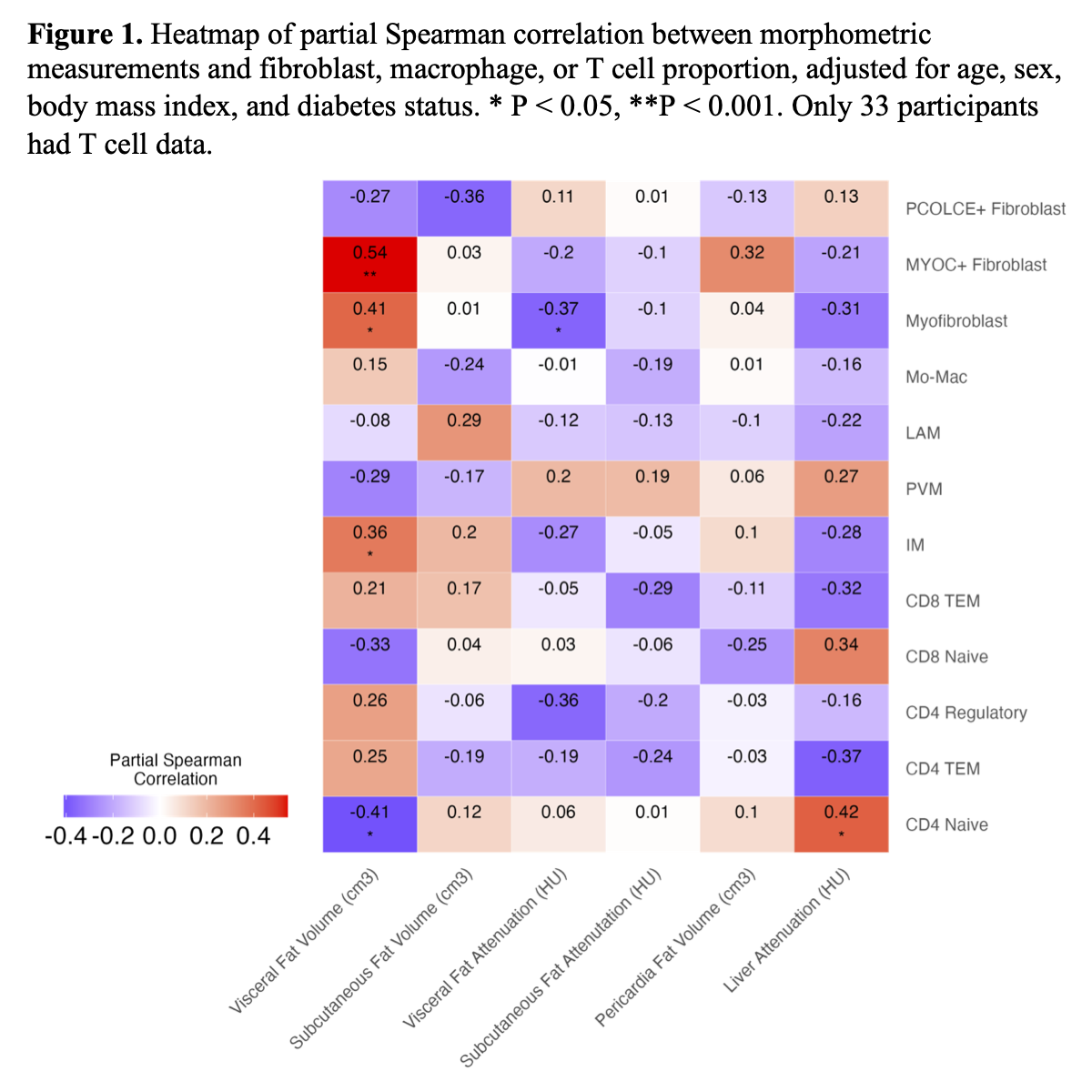
A total of 44 participants were included in this study (non-diabetic = 13, prediabetic = 13, diabetic = 18). The median age was 51.5 years, BMI 32.0 kg/m2, 70% male, 53% White, 77% treated with an integrase strand transfer inhibitor-based regimen, and 18% with thymidine analogue exposure. VAT volume was significantly associated with proportion of intermediate macrophages (IMs) (radj = 0.36, p = 0.03), myofibroblasts (radj = 0.41, p = 0.02) and MYOC+ fibroblasts (radj = 0.54, p < 0.001). CD4+ naïve cells were associated with liver attenuation (radj = 0.42, p = 0.02) and inversely associated with VAT volume (radj = - 0.41, p = 0.02). Myofibroblasts were also inversely associated with VAT attenuation (radj = -0.37, p = 0.02). Other fibroblast, macrophage, and T cell populations were not significantly associated with morphometric measurements (Figure 1). Adjusting for thymidine analogue exposure did not alter these findings.
Conclusions:
In PWH, increased proportion of myofibroblasts (a marker of fibrosis), anti-adipogenic MYOC+ fibroblasts, and IMs are independently associated with VAT volume even after adjustment for BMI. CD4+ naïve T cells were inversely associated with VAT volume. These results support the hypothesis that increased fibrosis and inflammation in SAT impair lipid storage and promote VAT expansion. Longitudinal studies are necessary to investigate causal relationships and underlying mechanisms that contribute to VAT expansion.
Figure 1. Heatmap of Partial Spearman’s Correlation Between Morphometric Measurements and Cell Proportions