Background:
Broadly neutralizing antibodies (bNAbs) provide a useful tool for HIV cure strategies because of their ability to target conserved regions on the envelope (Env) protein in the context of both virions and infected cells. One of the most well studied bNAbs is the CD4 binding site (CD4bs) antibody, VRC01 and related antibodies. Multiple clinical trials infusing VRC01 into people living with HIV (PWH) demonstrated transient viral suppression. The major obstacle to more effective treatment with bNAbs continues to be viral escape. A deeper understanding of escape pathways from VRC01-class antibodies in genetically diverse samples is needed
Methods:
We developed an in vitro viral escape assay to test bNAb and Env combinations. Ex vivo CD4+ T cells were infected with infectious molecular clone 246.F3-NL4.3 (AC) in the presence of varying concentrations of VRC01. Cultures were maintained with suboptimal concentrations of bNAbs to induce escape. Replication kinetics were monitored by p24 every 3 days. Every 14 days, target cells were replenished and cultures tested for genotypic and phenotypic measures of bNAb resistance. This was accomplished by single genome sequencing envs and by TZM-bl neutralization assay. Individual mutations were then tested for their contribution to resistance to CD4bs bNAbs by pseudovirus neutralization assay using mutated env plasmids.
Results:
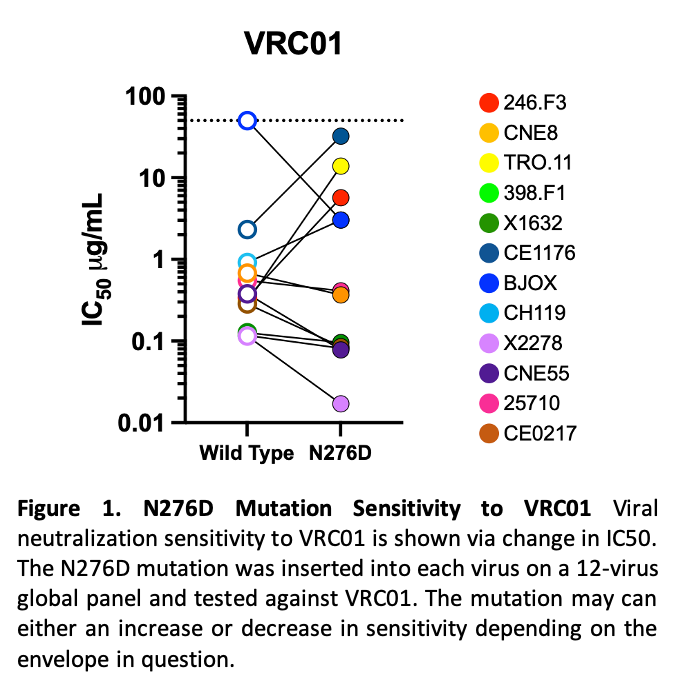
Using our viral escape assay, we observed both previously published and novel escape mutations. Complete resistance to VRC01 was detected in 246.F3 by day 45. A mutation at position N276 that eliminated the glycan conferred complete resistance to VRC01, despite canonically increasing sensitivity. To study the neutralization profile of this mutation in various subtypes, it was inserted into 12-virus global panel of envs and tested for sensitivity compared to wildtype against a panel of CD4bs bNAbs. This mutation was shown to both increase resistance or sensitivity depending on the envelope and bNAb in question, emphasizing a dual role of this glycan in VRC01 class neutralization.
Conclusions:
Our data demonstrate that our viral escape assay can highlight novel pathways, such as the loss of glycan 276 conferring complete resistance to VRC01 in 246.F3 env. The role of this glycan in escape was demonstrated to be dependent on both the context of the env as well as the bNAb. This finding emphasizes the importance of studying viral escape with a genetically diverse library to develop a deeper understanding of various pathways.