Background:
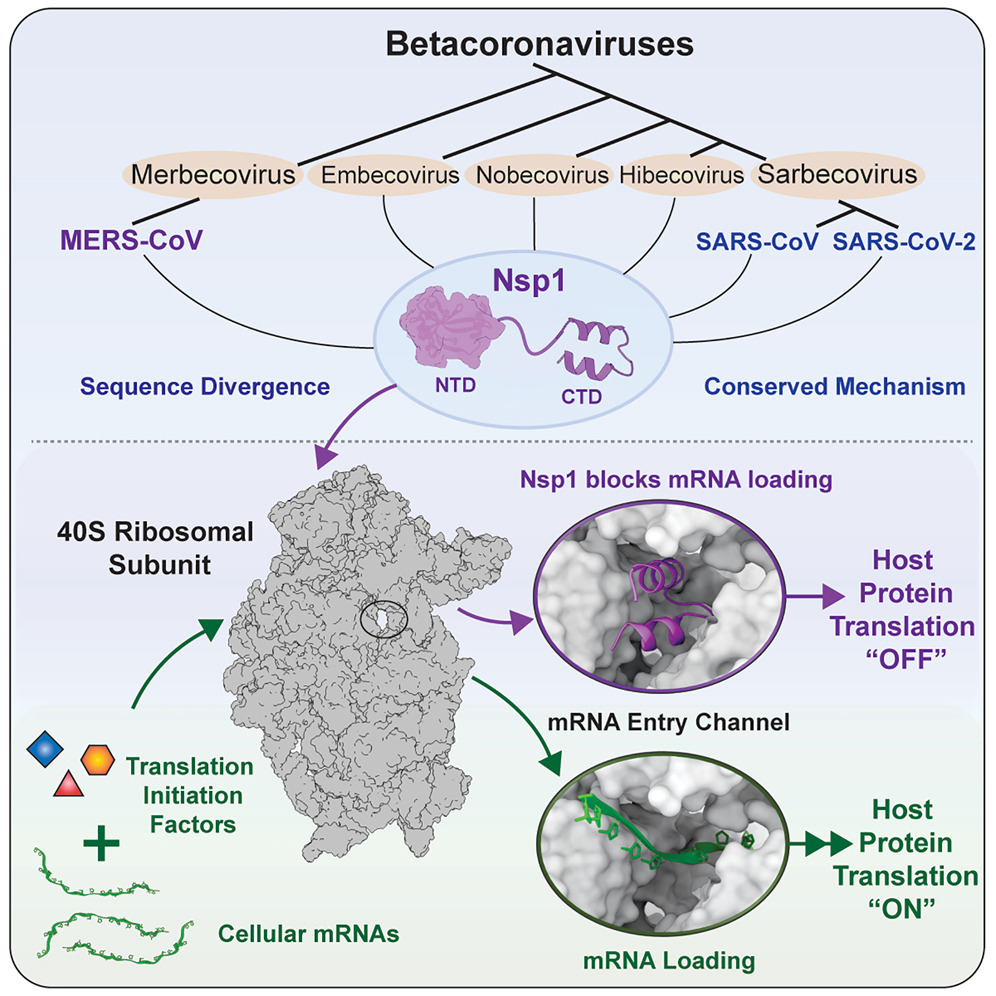
Since 2002, three deadly human betacoronaviruses (β-CoVs) have emerged: SARS-CoV, MERS, and SARS-CoV-2, however our therapeutic arsenal remains inadequate to restrict current and novel β-CoVs. All β-CoVs encode non-structural protein 1 (Nsp1), an essential pathogenicity factor that potently inhibits host gene expression. Three distinct mechanisms are proposed for Nsp1: two cytosolic involving the ribosome and one nuclear stopping mRNA export. Also, across β-CoVs Nsp1 has very low amino acid conservation. Previous literature suggests MERS Nsp1 function is restricted to the nucleus and does not bind 40S ribosome, contrasting SARS-CoV-2 Nsp1. However, due to conserved structure prediction, we hypothesized that Nsp1 function is highly conserved across β-CoVs.
Methods:
Nsp1’s effects on translation were evaluated in-vitro. HeLa cytoplasmic extracts were incubated with an exogenous luciferase reporter mRNA and recombinant Nsp1. Nsp1-40S ribosome binding was evaluated via fluorescence polarization. Fluorescein was conjugated to Nsp1 and incubated against a range of 40S ribosomes. A high-resolution structure of MERS Nsp1 binding the 40S ribosome was obtained by single particle cryo-EM of in vitro assembled complexes.
Results:
Contrary to previous reports, MERS Nsp1 robustly inhibits the translation of luciferase mRNA in-vitro. Compared to MERS Nsp1, SARS-CoV-2 Nsp1 inhibits translation at the ribosomal level more efficiently. However, fluorescence polarization showed that MERS and SARS-CoV-2 Nsp1 bind the 40S ribosome with very similar Kd’s, 40nM and 27nM respectively. We resolved a 2.6-Å structure of MERS Nsp1 binding the 40S ribosome. The CTD of MERS Nsp1 adopts a helix-turn-helix motif binding in the mRNA entry channel of the 40S subunit interacting with the 18S rRNA and ribosomal proteins uS3 and uS5. Mutating this binding interface completely ablates Nsp1 function in vitro.
Conclusions:
We show divergent Nsp1 proteins exhibit a remarkably conserved mechanism by targeting the 40S ribosome to restrict host gene expression. Since SARS-CoV-2 and MERS Nsp1 have similar Kd’s for the 40S ribosome, we speculate the increased potency of SARS-CoV-2 Nsp1 is due to effects beyond initial binding to the 40S ribosomal subunit. Diversified therapeutics targeting multiple stages of the viral life cycle will be critical for containing β-CoV outbreaks. We present that Nsp1 of β-CoVs is an essential pathogenicity factor and an attractive target for therapeutic intervention which can broadly restrict β-CoVs.