Background:
Latency reversing agents (LRAs) have had limited success in vivo, indicating a need for more potent agents. ‘Mukungulu,’ an extract prepared from the bark of Croton megalobotrys and traditionally used for HIV/AIDS management in Northern Botswana (Africa), is an LRA in latent HIV cell lines and contains protein kinase C-activating phorbol esters (PMID: 28970153). However, the properties of Mukungulu ex vivo in ART suppressed cells from PLWH and/or in vivo are not known.
Methods:
Using cells from 12 PLWH suppressed on ART for > 3 years cell pellets and culture supernatants from 20 million PBMC in triplicate independent tests were assessed for p24 protein by Simoa (PMID: 33796087) after 72 hours treatment with Mukungulu (1 μg/mL) or anti-CD3/CD28 positive control. Isolated CD4 T-cells (5 million) were also tested in 3 donors. Intact and defective proviral DNA were assessed by IPDA (PMID: 30700913). 12 BLT-Humanized male mice were infected with HIVSUMA, suppressed with ART for 7 weeks (PMID: 36460646), and injected i.p. with 5 μg/mL Mukungulu (N=7) or PBS vehicle (N=5) and measured after 24 hours for pVL and vRNA from human cells. Analysis was done with Prism software.
Results:
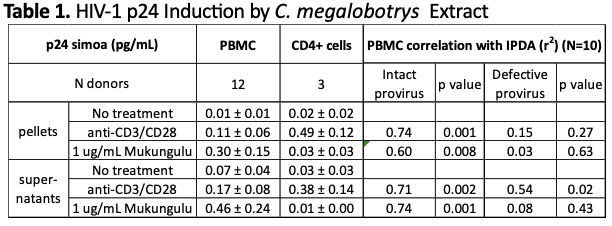
In PBMC from 12 ART suppressed donors, Mukungulu induced 0.30 ± 0.15 and 0.46 ± 0.24 pg/mL of p24 protein in pellets and supernatants, respectively, without cytotoxicity, compared to only 0.11 ± 0.06 and 0.17 ± 0.08 pg/mL of p24 induced by anti-CD3/CD28 (p = 0.06 and 0.07). In contrast, Mukungulu induced no detectable p24 in pellets or supernatants in isolated CD4+ cells, compared to anti-CD3/CD28 inducing 0.49 ± 0.12 and 0.38 ± 0.14 pg/mL of p24. Notably, p24 levels from PBMC pellets and supernatants induced by Mukungulu correlated well with intact provirus reservoir size (r2 = 0.60 and 0.74, respectively) but not with defective provirus reservoir size (r2 = 0.03 and 0.08). Finally, in humanized mice, Mukungulu induced 1336 ± 402 vRNA copies / million human cells plus a pVL of 391 ± 394 copies / mL, compared to no change by PBS, without obvious toxicities.
Conclusions:
Mukungulu is a potent LRA ex vivo and in vivo. It induces virus production from the intact viral reservoir of CD4+ cells with ~2.5 more activity than anti-CD3/CD28. However, this reactivation is dependent on PBMC and not isolated CD4+ cells, indicating that additional cell-types contribute to its mechanism of latency reversal.