Background:
Rifampicin induces genes important in the metabolism and transport of dolutegravir. The resulting drug-drug interaction can be overcome by doubling the daily dose of dolutegravir, but this increases costs and risk of stockouts in high burden settings. We recently presented week 24 findings from the RADIANT-TB trial that showed adequate virological suppression with both standard and double dose dolutegravir in participants on rifampicin-based antituberculosis therapy. Here we present week 48 outcomes in order to detect later emergence of dolutegravir resistance.
Methods:
RADIANT-TB was a phase 2b, non-comparative, randomised, double-blind, placebo-controlled trial of standard versus double dose dolutegravir among adults with tuberculosis on rifampicin-based therapy conducted in Khayelitsha, Cape Town, South Africa. Participants were randomised to receive tenofovir/lamivudine/dolutegravir and either supplemental dolutegravir or placebo continued for two weeks after stopping antituberculosis therapy. Key outcomes at week 48 were proportion with HIV-RNA < 50 copies/mL (by FDA snapshot algorithm modified intention-to-treat and per protocol), treatment emergent dolutegravir resistance, and adherence assessed by tenofovir-diphosphate (TFV-DP) on dried blood spots (DBS).
Results:
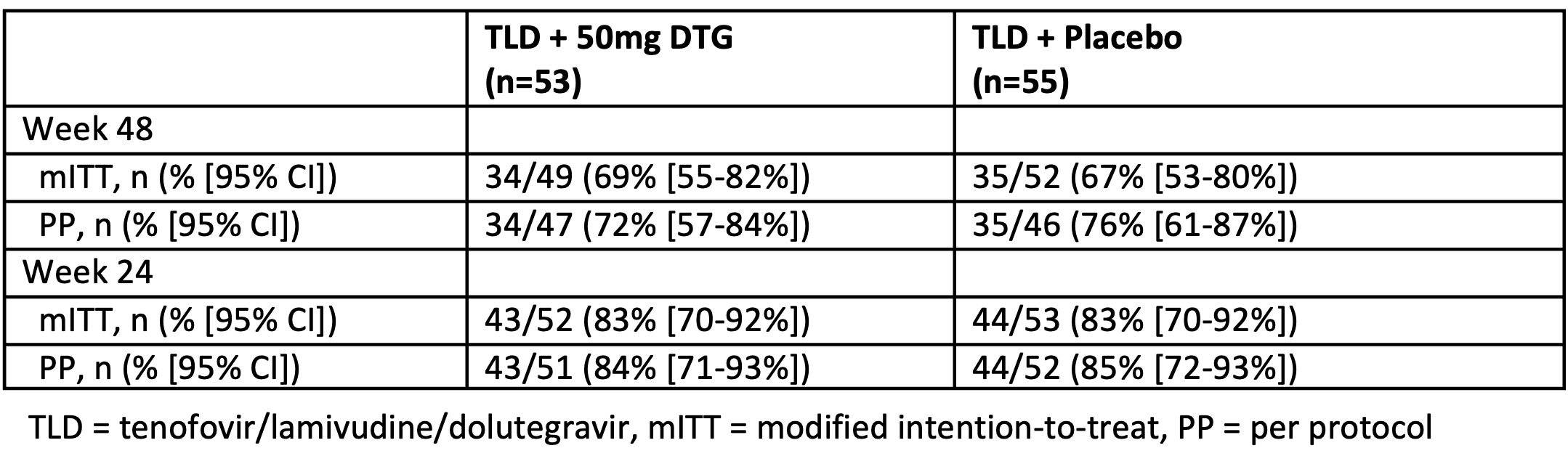
108 participants were enrolled: 38% female, median baseline CD4 cell count 184 cells/mm3 (IQR 145 to 316) and HIV-RNA 5.2 log10 copies/mL (IQR 4.6 to 5.7). Proportions with virologic suppression at weeks 24 and 48 were similar between arms (Table 1), but lower at week 48 than at week 24. One participant in the supplemental dolutegravir arm and 3 in the placebo arm were lost to follow-up by week 48 and deemed not suppressed in the modified intention-to-treat analysis. None of the 19 participants with study defined virological failure developed treatment emergent resistance to dolutegravir. TFV-DP DBS concentrations indicating poor adherence (< 350 fmol/punch) were found in a higher proportion of participants at week 48 than at week 24 (12/93 versus 4/103; P-value = 0.02). Grade 3 and 4 adverse events occurred at similar rates between arms at week 48.
Conclusions:
Virologic suppression was lower at 48 than at 24 weeks for both arms, likely due to declining adherence assessed by TFV-DP DBS. Our findings suggest that standard dose dolutegravir with rifampicin-based antituberculosis therapy might be adequate.
Proportions with HIV-RNA < 50 copies/mL by arm at weeks 48 and 24