Background:
Studies have defined specific penile anaerobic bacteria associated with HIV Seroconversion, Inflammation and Cells (BASICs) in uncircumcised men. However, little is known regarding the colonization dynamics of BASICs in the coronal sulcus, or if they colonize other male genital tract sites outside of the coronal sulcus.
Methods:
Swabs from 97 uncircumcised men were collected at the coronal sulcus, outer foreskin, penis shaft, and distal urethra in a cross-sectional study in Rakai, Uganda; 47 participants were then sampled longitudinally over 8 weeks. We characterized the penile microbiome and determined three key BASICs ([i]Prevotella bivia, Peptostreptococcus anaerobius,[/i] and [i]Dialister micraerophilus[/i]) prevalence, proportional and absolute abundance by 16S rRNA qPCR and V3V4 amplicon sequencing. We compared overall microbiome composition by PerMANOVA and BASIC abundances between sites by pair-wise Mann-Whitney Test. We also compared stability of BASICs in the coronal sulcus to other penile commensal bacteria using residence and return times, which measure the time between disappearance and subsequent re-emergence of a taxon, respectively. We imputed abundance thresholds associated with increased HIV seroconversion risk for [i]P. bivia, P. anaerobius,[/i] and [i]D. micraerophilus[/i] using published data (Prodger et al., 2021) to characterize dynamics of BASICs abundance over the 8-week study.
Results:
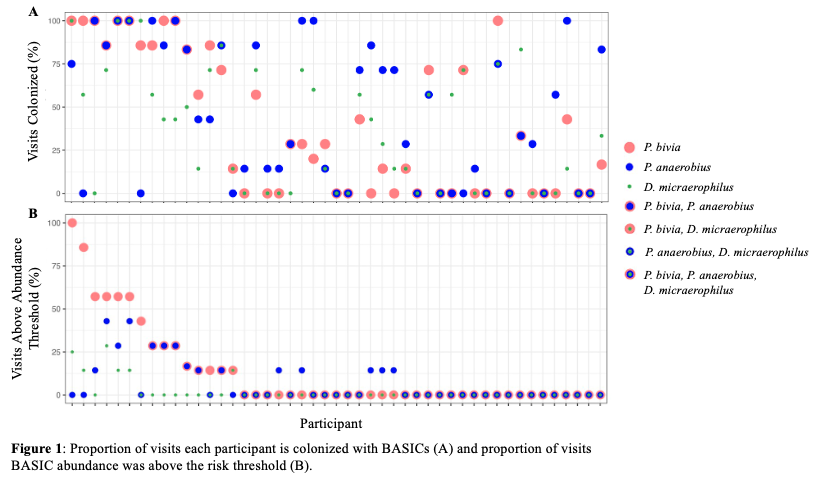
Overall microbiome composition differed significantly across penile sites, with BASICs most prevalent and abundant in the coronal sulcus as compared to other sites. In most study participants, P. bivia, P. anaerobius, and D. micraerophilus were detected at least once over the 8-week study period (62%, 70%, 64%, respectively), but fewer participants were colonized at all visits (17%, 17%, and 9% respectively) (Fig. 1A). All BASICs had shorter residence times in the coronal sulcus than Corynebacterium, a ubiquitous skin-associated bacterium, and 43% of participants had at least one visit with a BASIC above the high-risk abundance threshold (Fig. 1B).
Conclusions:
BASICs were detectable in the coronal sulcus of nearly two-thirds of uncircumcised participants over an 8-week study period, although only 9-17% of individuals were persistently colonized by a single BASIC species. High abundance colonization by BASICs is transient and uncommon. Targeted interventions to reduce BASIC abundance in the coronal sulcus may be an effective approach to decrease HIV risk.