Background:
Despite advancements in antiretroviral therapy, cognitive issues persist in some people with HIV (PWH) and are heterogeneous in nature. Recent research has focused on identifying cognitive profiles present in PWH and identifying factors that distinguish between these profiles; however, neuroimaging metrics of brain structure and function are rarely incorporated into these analyses.
Methods:
We identified cognitive profiles among 225 PWH (mean age=51; 21% female, 67% African American/Black; mean years of education=13.3 ) from a single site (Washington University in St. Louis). Participants completed a standard neuropsychological test (NP) battery of 10 tests (16 outcomes) and magnetic resonance imaging (MRI), including structural MRI to measure regional volumes and resting-state functional MRI to assess brain connectivity. Raw NP test scores were converted to scaled scores and then Kohonen self-organizing maps were used to classify individuals with similar cognitive profiles. Socio-demographic features (including age, race, education, premorbid IQ (WRAT-3), and area deprivation index), HIV clinical factors (nadir and recent CD4 count, recent CD8 count, CD4/CD8 ratio, viral load), hepatitis C co-infection, depression, early life stress, brain volumes, and intra-network resting state values were compared between profiles using random forest models. Distinguishing variables were considered significant at P<0.001.
Results:
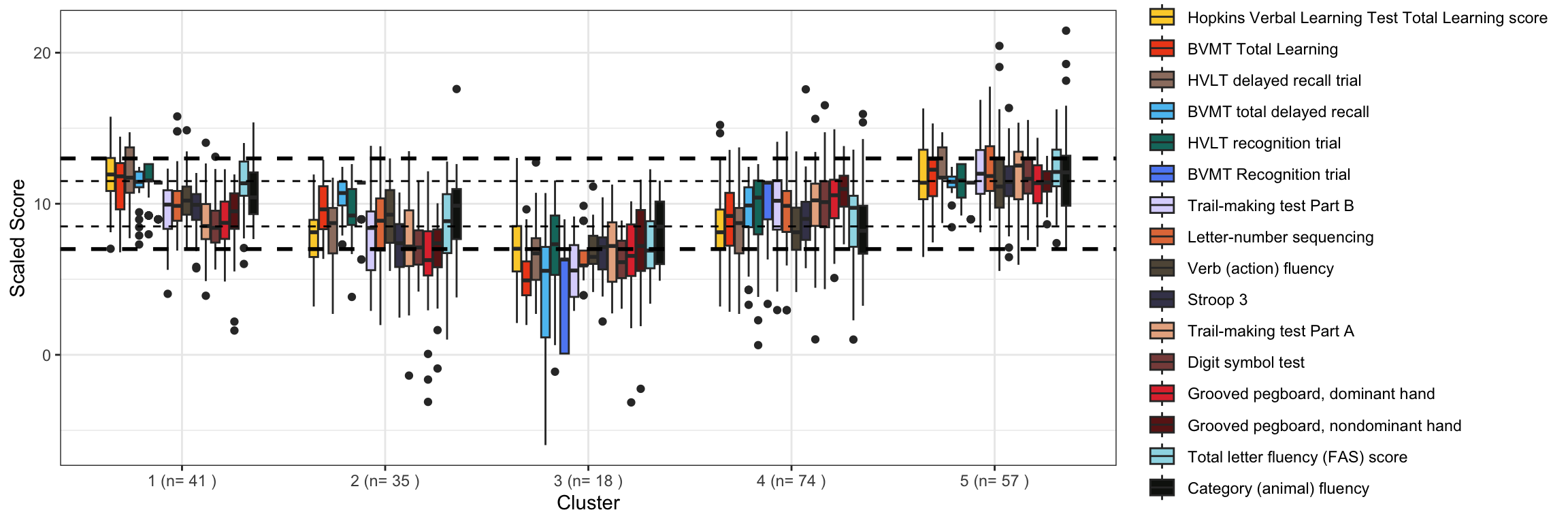
Five cognitive profiles were identified: 1) strength in learning and memory (n=41; 18%), 2) weakness in motor and processing speed (n=35; 15%), 3) impaired globally (n=18; 8%), 4) average globally (n=74; 33%-referent group), and 5) strong globally (n=57; 25%)(Figure 1). Compared to profile 4, profile 1 (relative strength in learning and memory) had a higher premorbid IQ; profile 3 (impaired globally) was older, less educated, and had a lower premorbid IQ; and profile 5 (strong globally) was more highly educated, had a higher premorbid IQ, and was less likely to be Black. Although several neuroimaging features distinguished profiles at P<.01, none reached the P<0.001 threshold.
Conclusions:
Socio-demographic features, not clinical or neurologic features, distinguished cognitive profiles. Future studies are needed that incorporate additional neuroimaging methods that may be more sensitive to subtle changes in brain integrity that can impact cognition in order to evaluate their importance in distinguishing cognitive profiles.