Background:
The U.S. Preventive Service Task Force (USPSTF) recommends smoking screening and cessation strategies as a part of routine care. However, people with HIV (PWH) are more likely to smoke and less likely to quit than the general population. This study aimed to assess factors associated with prescription of smoking cessation medications among smokers seen in care at outpatient clinics of the HIV Outpatient Study (HOPS).
Methods:
We analyzed medical records and risk behavior survey data from HOPS participants enrolled from January 1, 2007 to December 31, 2021. We included persons with evidence of current cigarette use and not receiving smoking cessation medications at HOPS enrollment (baseline). Smoking cessation medications included varenicline (Chantix), bupropion (Zyban), and nicotine products. We identified smoking-related comorbidities based on laboratory results, clinical diagnoses, and treatments at baseline. We assessed associations between sociodemographic and clinical factors and prescription of smoking cessation medications using multivariable Cox proportional hazards analyses.
Results:
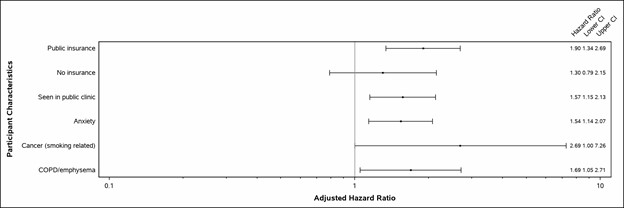
Among 1,019 eligible PWH, 77% were men, 31% White, 48% Black/African American, 18% Hispanic/Latino, 46% aged 40 years and older. At baseline, 36% had smoking-related comorbidities including hypertension, chronic obstructive pulmonary disease (COPD)/emphysema, cardiovascular diseases (CVD), and cancers. During a median follow-up time of 2.6 years (interquartile range: 1.0-6.0), 342 (34%) were prescribed smoking cessation medications (Varenicline 106, Bupropion 53, nicotine products 273), and 241 (24%) quit smoking. In the multivariable analysis, having public insurance (hazard ratio [HR]:1.90, 95% confidence interval [CI]:1.34-2.69), care at a public clinic (HR: 1.57, CI:1.15-2.13), anxiety (HR: 1.54, CI:1.14-2.07)), smoking-related cancer (HR:2.69, CI:1.00-7.26), and COPD/emphysema (HR:1.69, CI:1.05-2.71) were positively associated with prescription of smoking cessation medications (Figure).
Conclusions:
Low percentages of smoking cessation medications prescription and smoking cessation among HOPS patients demonstrate gaps in primary prevention of smoking-related chronic diseases in PWH. Given the high burden of baseline comorbidities, enhanced smoking cessation efforts are warranted for protecting the health of this aging cohort of PWH.
Figure: Final Multivariable Cox Proportional Hazards Analysis Results of Factors Associated with Prescription of Smoking Cessation Medications, the HIV Outpatient Study, 2007-2021, Nf1,019.