Background:
Poor sleep quality and cognitive impairment are associated with HIV infection; however the relationship between sleep and cognition in women living with HIV (WLWH) remains underexplored. We examined associations between measures of sleep quality and domain-specific cognitive function in WLWH to identify potential modifiable factors.
Methods:
In 2018 and 2019, 337 WLWH enrolled in the Women’s Interagency HIV Study (WIHS) completed the Pittsburgh Sleep Quality Index [PSQI]) survey within 12 months of neuropsychological (NP) testing. Linear regression models were used to examine associations between overall sleep quality (total PSQI score 0-21; higher is worse) and NP performance stratified by study-derived cognitive impairment (global T-score < 40 vs. >40), as well as associations between specific potentially modifiable sleep disturbances (e.g., mid-sleep waking, pain, snoring), sleep duration, and sleep medication use, and NP performance. All models adjusted for enrollment site, age, education, race/ethnicity, smoking, drinking, and menopausal status; nadir CD4, log viral load, and body mass index.
Results:
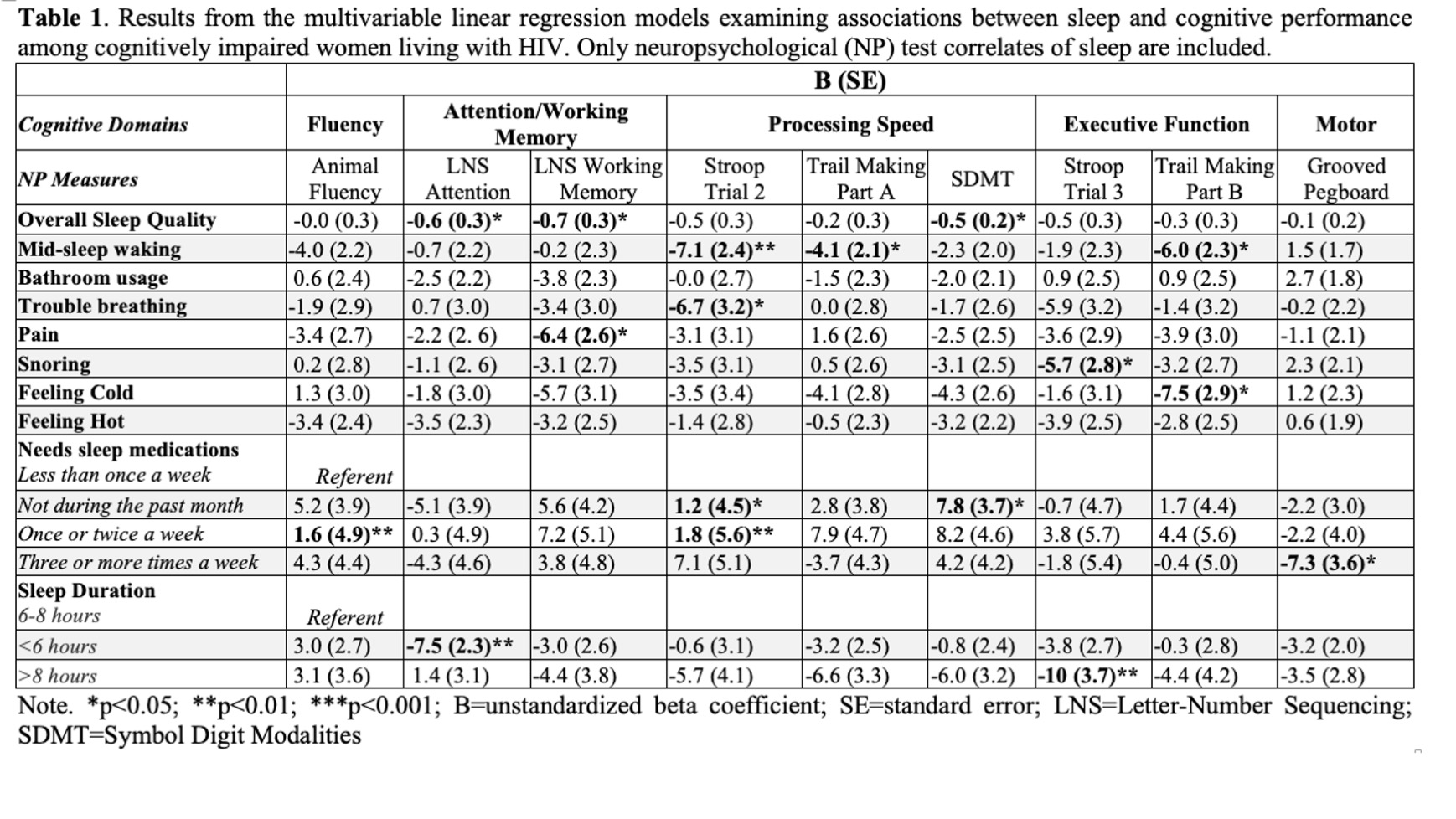
Poorer overall sleep quality was associated with worse NP performance among WLWH who had global NP impairment (n=102; Table 1) but not in those without impairment (n=235; P’s >0.06). Among WLWH with NP impairment, poorer overall sleep quality was associated with poorer attention/working memory and processing speed; moreover, waking up mid-sleep was associated with poorer processing speed and executive function. Pain disturbing sleep was associated with poorer working memory; snoring was associated with poorer executive function; bad dreams were associated with poorer processing speed; and short (< 6 hours) and long ( >8 hours) sleep duration was associated with both poorer attention and executive function.
Conclusions:
We identified distinct measures of poor sleep associated with diminished working memory, attention, and executive function among WLWH demonstrating global cognitive impairment. Given that unimpaired cognition is essential for managing HIV and associated comorbidities, targeted interventions that improve these potentially modifiable aspects of sleep may prevent worsening of cognitive function as WLWH age. Larger longitudinal studies are needed to understand causal relationships and mechanisms between sleep and cognition within the context of HIV especially among women.
Results from the multivariable linear regression models examining associations between sleep and cognitive performance among cognitively impaired women living with HIV. Only neuropsychological (NP) test correlates of sleep are included.