Background:
Sleep apnea negatively impacts health and quality of life. A better understanding of potential differences in sleep apnea incidence and risk factors between people with HIV (PWH) and people without HIV (PWoH) could inform prevention and management strategies.
Methods:
We conducted a study of adult (≥18-years-old) members of Kaiser Permanente Northern California, an integrated U.S. healthcare system. PWH and PWoH with membership between July 2013 and December 2021 were matched 1:20 by age, sex, and race/ethnicity. Sleep apnea diagnoses were identified by ICD codes in electronic health records. Using Poisson regression, incident sleep apnea was compared between PWH and PWoH, overall and with PWH stratified by HIV treatment status. Optimal HIV treatment was defined as being on ART (≥1 ART prescription fill), with undetectable HIV RNA (<200 copies/ml), and without immunosuppression (CD4 count ≥500 cells/µl). Next, both HIV-specific and general (non-HIV-specific) risk factors were evaluated. All models included the following covariates: age, sex, race/ethnicity, body mass index, smoking status, substance use, depression, anxiety, cardiovascular disease, diabetes, cerebrovascular disease, cognitive impairment, and number of outpatient visits in the year before baseline. HIV-specific models also included ART use, HIV RNA level, and CD4 count.
Results:
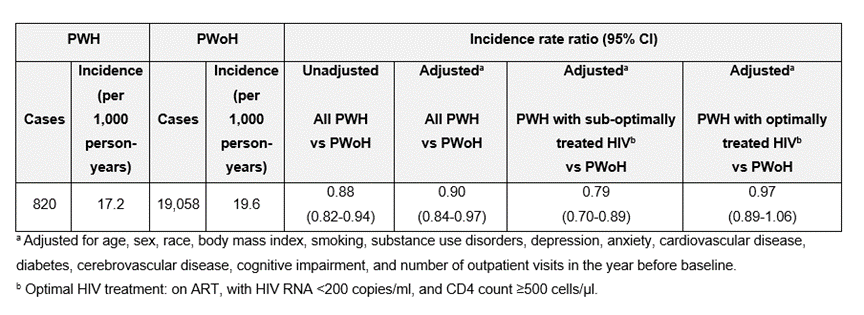
The study included 11,568 PWH and 225,097 PWoH (for PWH: mean baseline age 48 years, 90% men, 48% White, 20% Hispanic, 17% Black, 7% Asian, 8% Other/unknown race/ethnicity; 93% on ART). During follow-up, 820 PWH and 19,058 of PWoH were diagnosed with sleep apnea. Sleep apnea incidence was significantly lower in PWH (vs. PWoH, adjusted incidence rate ratio [aIRR] = 0.90, 0.84-0.97). Notably, in analyses with PWH stratified by treatment status, lower incidence was observed in sub-optimally treated PWH (vs. PWoH, aIRR = 0.79, 0.70-0.89) but not in optimally treated PWH (vs. PWoH, aIRR = 0.97, 0.89-1.06). Among PWH, incidence was lower in PWH with lower CD4 (vs. PWH with CD4 ≥500 cells/µl: CD4 200-499, aIRR = 0.89, 0.75-1.05; CD4 <200, aIRR = 0.58, 0.35-0.99) or with higher viral load (vs. PWH with HIV RNA <200 copies/ml: HIV RNA ≥10,000, aIRR = 0.59, 0.29-1.19). The associations of general risk factors with sleep apnea were similar by HIV status (data not shown).
Conclusions:
Sleep apnea risk is independent of HIV status. Lower overall incidence of sleep apnea among PWH may reflect under-diagnosis in PWH with untreated or uncontrolled HIV infection.