Background:
Lentiviral-based vector therapies, which include many CAR-T and gene-modified cell therapies, are at the forefront of HIV-1 cure research. However, sequence homology between these lentiviral vectors and HIV-1 creates challenges with quantifying both cellular HIV burden or lentiviral DNA. As a result, we developed a novel single-cell in droplet (scd)PCR method to co-quantify genomic HIV-1 DNA and lentiviral vector DNA (from CAR-T and gene-modified autologous stem cell transplant) with single-cell resolution. This approach provides a high-throughput platform to determine if gene-modified cells can become infected in vivo, a critical unknown question.
Methods:
We adapted a multiplexed scdPCR method to co-quantify genomic HIV-1 DNA and the MNDU3 promoter, a common component of lentiviral gene delivery vectors. In addition, we screened over 30 existing HIV-1 DNA quantitative assays to determine the optimal method to quantify HIV DNA in cells from human studies.
Results:
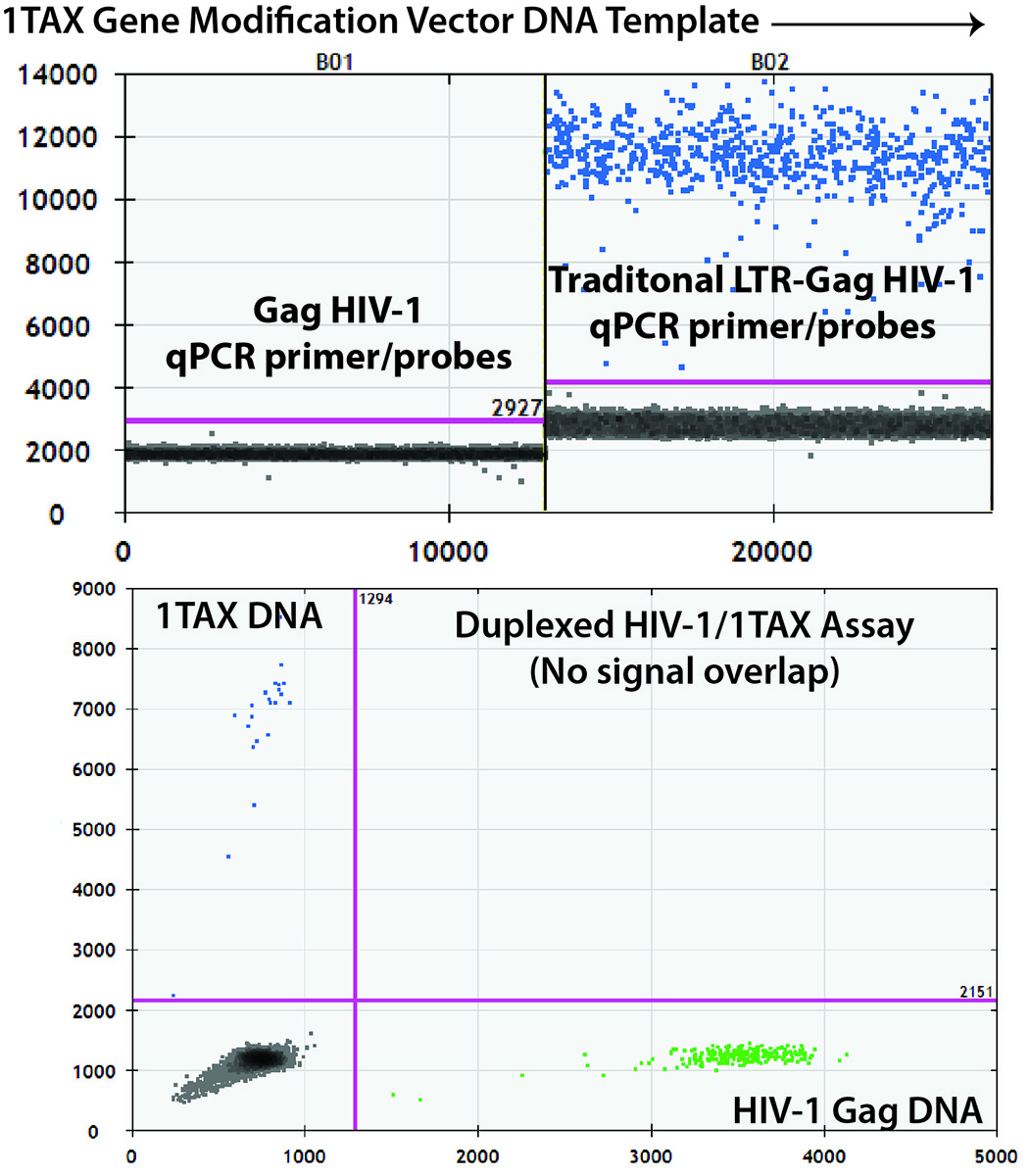
First, we show in the figure that commonly used lentiviral vectors directly cross-react with the HIV-1 LTR, LTR-Gag junction/Psi, and Env regions. Second, we observed that the intact proviral DNA assay (IPDA), co-targeting Psi and Env, quantified nearly 100% of lentiviral vector DNA. Third, of over 30 screened HIV-1 qPCR assays, we identified only one, targeting the downstream Gag region, that did not have significant cross-amplification with lentiviral vector DNA. Fourth, we successfully duplexed the HIV-1 and MNDU3 DNA assays for droplet-digital (dd)PCR with minimal cross-amplification (Figure) using both physiological and super-physiological levels of HIV-1 and vector DNA in bulk cell lysates from combinations of 293T cells transfected with: a) HIV-1 plasmid alone, b) 1TAX (lentiviral vector, c) HIV-1 and 1TAX, d) not transfected. Finally, we have successfully applied the duplexed ddPCR assay in our scdPCR platform for use with individually encapsulated transfected 293 T cells. The multiplexed ddPCR assay is now being implemented on participant-derived cells from a multiple gene modification study in autologous SCT (AMC097) and a duoCAR-T cell study in people with HIV.
Conclusions:
The multiplexed scdPCR assay can reliably quantify both HIV-1 DNA and lentiviral vector DNA in both bulk cell lysates and in individual, encapsulated cells. This method also allows in-depth characterization of residual HIV-1 burden and the potential for infected, transduced cells in vivo/ex vivo across a range of gene modification studies.
Example of Cross Reactivity of Traditional LTR-Gag HIV-1 Region (Top) and Duplexing MNDU3 Viral Promoter and HIV-1 Gag Region (Bottom)