In regions that do not perform routine HIVDR testing, care providers are often uncertain how to manage PWH with VF because it is not possible to distinguish PWH who have HIVDR and require an ART change from those remaining infected with wildtype viruses.
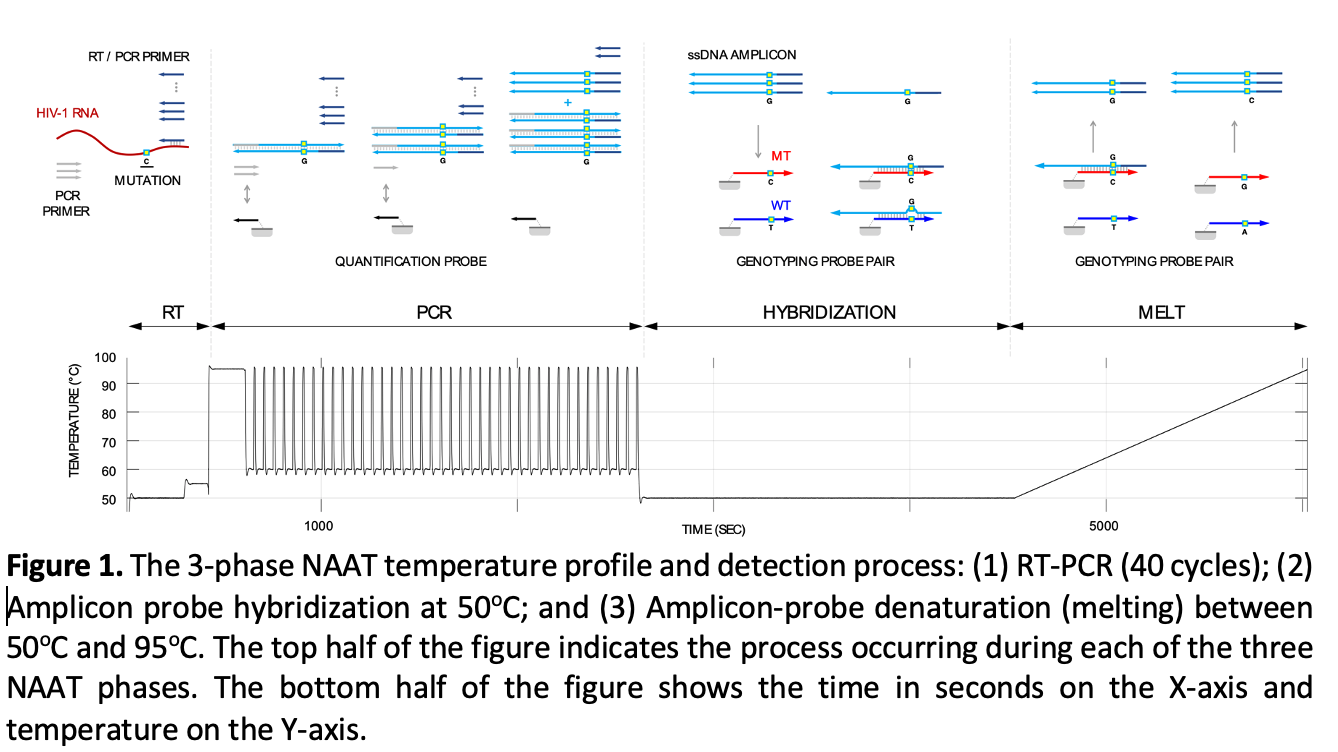
We used a novel semiconductor biochip with a closed-tube near point-of-care NAAT to simultaneously measure VL and detect DRMs at 6 RT (65, 103, 106, 181, 184, 190) and 3 integrase (148, 155, 263) DRM positions. The biochip comprises a 32×32 oligonucleotide probe array immobilized on a biosensor that monitors parallel hybridization reactions during asymmetric multiplex PCR followed by melt curve analysis of the ssDNA PCR products (Figure 1). By thermocycling and measuring fluorescence without external heaters or imagers, the system obviates the need for complex equipment. VL is determined by probes that monitor depletion of the limiting PCR primers during a 6-plex PCR that amplifies the 5’UTR (for VL determination) plus 5 regions in RT and integrase (for VL determination and mutation detection). DRMs are detected by probes that differentially hybridize to DRM-containing PCR products.
We performed 4 sets of experiments using a variety of DNA templates containing wildtype and mutant variants at each DRM position. The 1st set showed that probes complementary to the limiting primers yielded reproducible cycle thresholds (Cts) inversely proportional and linearly related to log DNA copy number. For 4 of 6 probes, the Ct difference between 50 copies and the no template control (NTC) sample was >=2 cycles and between 100 copies and the NTC sample was >=3 cycles suggesting that 50 and 100 copies could be unambiguously distinguished from the NTC. The 2nd set showed that melt-curve analysis reproducibly identified the correct codon at 9 DRM positions in mixtures of wildtype and mutant templates ranging from 20%-100%. The 3rd set showed that even at low template concentrations, asymmetric multiplex PCR generated sufficient ssDNA for melt-curve analysis for all probes with one exception. The 4th set showed that the use of additional probes with variant flanking sequences increased the proportion of samples that could be genotyped despite sample sequence variability.
Further development of this biochip system into a mass-deployable point-of-care test would streamline ART delivery and increase the likelihood that PWH would maintain virological suppression and be retained in care.